Exile
LimonovExile is presented not simply as departure from the Soviet Union but as a condition that persists in work, memory, and the prospect of return. At the Winslow Hotel, Russian émigrés who had left in the 1970s live with the distance between the artists they had been and the precarious lives they now lead. Eduard Limonov shares their displacement, yet his return to Moscow in December 1989 makes his story a pointed exception to their certainty that home will remain forever inaccessible.
The émigré community
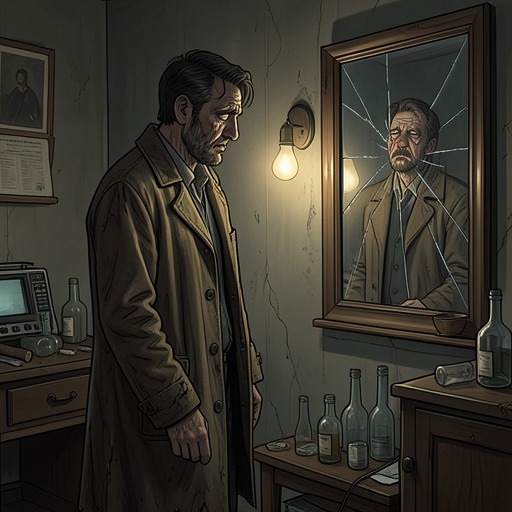
The Winslow Hotel serves as a refuge for Russians, mostly Jews, from the third wave of emigration. Limonov recognizes people like them on the street by an air of lassitude and misfortune. Many had been poets, painters, or musicians and active in the underground in Moscow or Leningrad; in New York City they work as dishwashers, house painters, and movers. They initially tell themselves that these jobs are temporary and that their talents will eventually be recognized, but they know that hope is unlikely to be fulfilled. Together, speaking Russian, they drink, complain, talk about their country, and dream of going back. They believe they will not be allowed to return and will die in exile, trapped and swindled.
The residents’ private rooms make that displacement concrete. One man lives without a dog, though the smell, chewed bones, and dog excrement in his room suggest otherwise; his loneliness is such that he spends whole days rereading the few letters his mother has sent. Another types continually without publishing anything and fears that his neighbors are watching his room. Limonov understands this suspicion as a delusion carried over from the Soviet Union, where a room in a communal apartment could be valuable enough to inspire plots against its occupants. The man clings to the fear even in America: it is his last link to the grimy communal apartment he regrets leaving, though he cannot admit that regret.
Lenya Kosogor’s history gives the refuge a different weight. He spent ten years in Kolyma and takes pride in being mentioned in The Gulag Archipelago; the émigrés call him the man Solzhenitsyn wrote about. He imagines that his longer imprisonment might also give him material for a lucrative, celebrated book, but he never writes it. Instead, after finding Limonov on a sidewalk, almost unconscious and half dead from the cold, Lenya stays beside him. His care places practical kindness alongside the frustrated ambitions and isolation of the hotel’s other exiles.
Home held at a distance
The émigrés of Limonov’s generation are certain that they will never return. They expect the regime they fled to survive for centuries, or at least beyond their own lifetimes. Limonov follows events in the Soviet Union from a distance and imagines his homeland hibernating beneath an ice pack. Although he considers himself better off abroad, he takes comfort in believing that the country remains as he knew it: powerful and morose. Television images of military parades and decorated leaders reinforce that impression.
The succession of Soviet leaders registers for him as a series of changes that do not seem to alter the country’s essential character. Brezhnev’s long period of stagnation ends with his death; Andropov, remembered by Limonov partly because he had flirted with Andropov’s daughter fifteen years earlier, dies less than a year after taking power. Chernenko succeeds him and dies in turn, after which Gorbachev becomes the next leader. Limonov’s refusal to laugh when others mock the Soviet Union shows that distance has not loosened his attachment: he dislikes jokes at his country’s expense even while living outside it.
Return and its limits
In December 1989, fifteen years after leaving, Limonov returns to the Soviet Union. The parallel journeys are marked by snow: in February 1974 he had travelled in the opposite direction, hungover in the back of a car with his head on Tanya’s knees as they watched the buildings and woods pass, convinced they would never see them again. Now he is returning alone, having lost Tanya. Invited back with actress Victoria Fedorova and singer Willi Tokarev, he travels business class and is welcomed at the airport as a VIP, outward signs that he has returned successfully.
Yet the first encounters on native soil unsettle that appearance. Limonov chooses to sit beside the driver rather than with the other visitors and their public-relations aide, hoping to show the driver that years abroad and success have not made him less a man of the people. The driver responds with closed, vaguely hostile indifference, as do the staff at the Hotel Ukraina. The return therefore does not undo exile: the country he had preserved in memory is not simply restored by crossing back into it, and the lost relationship and intervening years travel with him. His homecoming exposes the gap between the familiar homeland he imagined and the reception he actually meets.