Post-revolutionary Romanian social climate
LimonovThe book’s Post-revolutionary Romanian social climate is defined by a rupture that never becomes a clean new beginning: after the Ceaușescu regime falls, the people and institutions of the old order reappear in altered forms, while competing accounts of resistance, violence, and democracy make the truth difficult to establish. Romania becomes the book’s sharpest early portrait of a society in which liberation is proclaimed, but the habits and personnel of coercion survive.
Revolution and the unstable truth
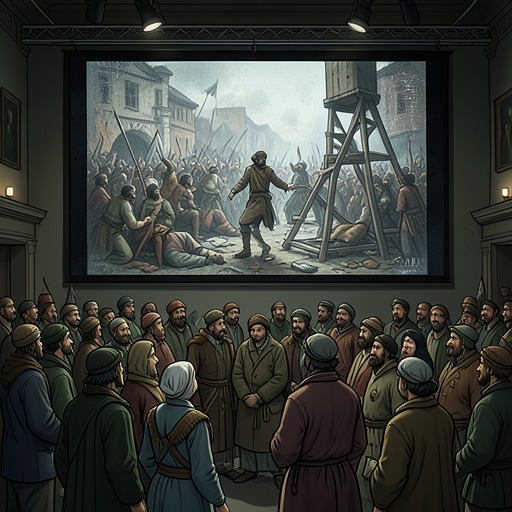
The revolution’s immediate aftermath is first represented through the story of Timișoara’s supposed mass graves. Reports claimed that thousands had been killed in the regime’s final violence: one widely cited figure was 4,000, Libération gave 4,630, and TF1 raised the count to 70,000. Television showed exhumed bodies in striped pajamas, and the reports stirred fears that the Securitate was continuing a genocide. The book then describes the reversal: the bodies, no more than a few dozen, had been brought before cameras at Timișoara Cemetery after having died natural deaths. The spectacle that had seemed to expose a final atrocity was itself staged to mislead.
The political aftermath deepens that reversal. The Securitate’s killers, the narrator writes, did not perish in a desperate last stand; they displayed political shrewdness and became officials of the National Salvation Front under the new president, Ion Iliescu. The Communist Party, although banned and charged with every imaginable crime, survived by changing its name and leader. Its sizable victory in the March 1990 elections is presented as a startling measure of how little the formal end of the party settled the country’s relationship to communism. The apparent opposition between old regime and new government is therefore compromised from the outset: personnel and political continuity persist beneath the language of change.
Suspicion as a social atmosphere
The narrator calls post-revolutionary Romania a landscape of the uncanny: familiar institutions and public identities seem to conceal something alien. Rumors described underground passages dug by the secret police, where people disappeared; Bucharest’s tens of thousands of stray dogs and children competed for scraps, yet the men seemed more frightening still. Hatred, suspicion, and slander are rendered not as isolated political arguments but as an atmosphere that makes ordinary social trust feel impossible.
A conversation with a celebrated writer crystallizes the problem. After receiving prizes and official appointments for twenty years, he described his inward resistance to the regime. Asked whether other people had resisted more openly, he declined to name anyone, invoking discretion and mercy. His explanation was that the Securitate had recruited its most zealous informers from among supposed opposition figures. The narrator’s more subtle interlocutors treated this claim as common knowledge. In this account, neither official prestige nor a dissident reputation can securely establish a person’s past; even the categories of collaborator and opponent become vulnerable to doubt.
The book places this doubt within a broader culture of “subtle minds”: diplomats, journalists, and long-term observers who systematically challenged official accounts and familiar moral judgments. They argued, for example, that the KGB and Securitate were not simply institutions of death and darkness, and they questioned conventional assessments of figures such as Radovan Karadžić and Elena Ceaușescu. These commentators had the ear of François Mitterrand and influenced his foreign policy. Romania, where a genuine political deception accompanied the false story of mass graves, offered unusually fertile ground for arguments that every public account might be distorted. The narrator’s image of a returning Romanian exile conveys the human cost: after thirty years in France, he saw poverty, dirt, suspicion, and fear on the faces in the street and felt that the people around him were no longer his people.
The miners and the performance of democracy
Near the end of the narrator’s reporting stay, Iliescu and prime minister Petre Roman called on workers to defend democracy against an alleged neofascist plot. The plot, the book says, was no more real than the claimed Securitate genocide at Timișoara; the mobilization itself was real. The National Salvation Front arranged buses and trains to bring 20,000 miners to Bucharest on June 14, 1990. Fired up by propaganda and armed with iron bars, they spent two days attacking people suspected of belonging to the opposition, then struck more indiscriminately when few targets remained.
The narrator returned from reporting in the Carpathian Mountains only as the violence was ending. At the Hotel Intercontinental, journalists gathered while crowds appeared and dispersed, leaving rumors and uncertainty in their wake. An American journalist there had been badly beaten. Their discussion of Philip K. Dick’s The Penultimate Truth supplied a frame for the scene: in the novel, people confined underground believe a war is still raging because powerful figures control the television reports, and hatred drives them toward the surface. The analogy made the miners’ zeal to “save democracy” look inseparable from the managed information and fear that had shaped their action. The narrator and the American journalist wished that the hatred would eventually turn against those who had inflamed it.
A wider post-communist landscape
Romania’s mixture of declared rupture and continuing power belongs to a wider portrait of the post-communist world, though the book distinguishes the Romanian episodes from later developments in Russia. In Russia, market reform delivered its own abrupt disorientation. Price liberalization produced inflation of 2,600 percent; vouchers worth 10,000 rubles were mailed to citizens on September 1, 1992, but had lost so much value that beneficiaries might buy only a bottle of vodka. Many sold them cheaply to buyers including Boris Berezovsky, Vladimir Gusinsky, and Mikhail Khodorkovsky, who soon became billionaires. The account links economic shock to the rapid concentration of wealth, rather than treating privatization as a straightforward transfer of prosperity to the public.
That concentration became political power. Facing the prospect of a Communist victory, Berezovsky brought six other oligarchs together to support Yeltsin’s reelection; their newspapers, radio stations, and television channels promoted the choice as Yeltsin or chaos. Later, Berezovsky helped place Vladimir Putin, then a little-known former intelligence officer who headed the FSB, before the oligarchs as a loyal successor. The book thus extends its Romanian question—how much can change when inherited power survives?—into a different national setting, where private wealth and media influence helped shape political succession.
Opposition movements also reveal the limits of the new order. Anna Politkovskaya defended forty National Bolshevik Party militants who received lengthy sentences for occupying and vandalizing presidential-administration offices, and Yelena Bonner also expressed support for the party’s members. The National Bolshevik Party later gathered several hundred delegates for a convention, while its leader, Eduard Limonov, argued that the movement should focus on Russians marginalized in former Soviet republics. The state then denied the party legal authorization under a law against extremism and fascism, despite its thousands of adherents. Years afterward, Limonov’s Strategy 31 demonstrations invoked the constitutional right to assemble, but typically drew about a hundred protesters against five times as many police officers, with arrests a routine consequence. Across these episodes, the book depicts post-communist change not as a settled transition but as a contested struggle over who can name democracy, who controls public life, and whether political continuity can be broken.