Soviet stagnation
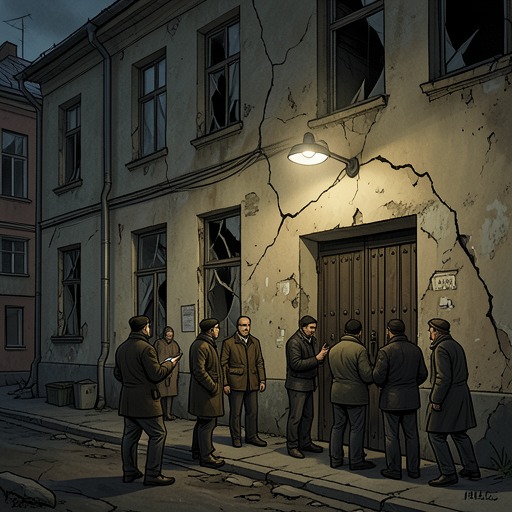
LimonovSoviet stagnation is presented as more than political immobility: it is a condition so durable that even those who fled the country came to regard its permanence as a fact of life. From abroad, Eduard Limonov imagined the Soviet Union under an ice pack, powerful and morose, preserved much as he had known it. The image captures the comfort and constraint of stagnation alike: distance made the country seem unchanged, while that apparent changelessness became part of its hold on him.
A society organized around supervision
The institutional logic of Soviet life appears in the account of Venyamin Savenko, Limonov’s father. In Paris, Limonov liked to call him a Chekist because the word unsettled listeners, then punctured the suggestion of dramatic repression by describing him as essentially a gendarme. The distinction matters: Venyamin is depicted not as a major persecutor but as a modest functionary within a system built around control and reporting.
That system’s principle of double administration had originated in the civil war after the Revolution, when political commissars were assigned to oversee professional military specialists and ensure their conformity to Marxism-Leninism. The arrangement spread beyond the army: one person performed a task, another supervised him, and the logic of supervision could reproduce itself indefinitely. Venyamin’s own duties were comparatively ordinary. During the war, as an NKVD orderly, he was stationed in front of a factory; in peacetime, as a junior lieutenant, he organized soldiers’ cultural life, including dance parties on Red Army Day. He played guitar, sang, and polished his nails with clear lacquer. His small, sociable world coexisted with the structures of oversight that defined the larger one.
The long succession of leaders
For Limonov and other émigrés of his generation, the Soviet regime seemed likely to persist for decades, perhaps beyond their lifetimes. The television image of the country reinforced that expectation: military parades before decorated leaders who appeared almost petrified. Brezhnev had spent eighteen years in power and, late in his rule, could scarcely take a step without support. His death seemed less like the end of an era than another formal act within a system accustomed to ceremonial continuity.
Yuri Andropov, a former security official regarded in informed circles as both a hard-liner and an intelligent one, briefly became the focus of a conservative counterfactual: some imagined that, had he lived, he might have reformed communism rather than helped destroy it. Limonov was amused by Andropov’s arrival partly because he remembered flirting with his daughter years earlier. Andropov died after less than a year, and Chernenko succeeded him. A headline in Libération mocked the Soviet leadership’s succession of whiskered old men; the narrator and his friends laughed, but Limonov did not. He disliked seeing his country made an object of ridicule. Chernenko, too, died, and Mikhail Gorbachev took his place.
Reform imagined as limited
In the West, Gorbachev was an immediate success. He was young enough to walk without being propped up, had a smiling wife, and seemed at ease with the West. Observers studying the Politburo saw the reform-minded figures around him, including Alexander Yakovlev and Eduard Shevardnadze, gaining influence. But the expected change remained modest: better relations with the United States, a more welcoming atmosphere at international conferences, and fewer dissidents confined to psychiatric hospitals.
The possibility that the Communist Party of the Soviet Union and the Soviet Union itself might disappear within six years was outside the prevailing expectations—and, the account emphasizes, outside Gorbachev’s own apparent intentions. He was a model party official who wanted to resume the reform path associated with Nikita Khrushchev before Khrushchev’s removal for voluntarism. The distance between that limited ambition and the eventual collapse gives stagnation its historical weight: a system that looked immovable could be unsettled by changes no one had understood as revolutionary in advance.
The thaw and its aftermath
The crucial change was not simply a new leader or a revised policy. During Gorbachev’s six years, people gained the freedom to write history as they saw fit. That freedom challenged the appearance of an eternally frozen country by making its past newly discussable. Limonov, who had once taken comfort in imagining his homeland unchanged, had to confront a transformation that exceeded the limited détente he and Western observers had expected.
The subsequent economic rupture shows how far the country moved from the old order, without making the transition a simple resolution. Under Boris Yeltsin, prices were liberalized, producing inflation of 2,600 percent. Vouchers worth 10,000 rubles were mailed on September 1, 1992, to Russian citizens over one year old as a means of distributing shares in national wealth. By the time they arrived, inflation had made them nearly worthless; some recipients sold them for little more than the price of a bottle of vodka. Boris Berezovsky, Vladimir Gusinsky, and Mikhail Khodorkovsky were among those who accumulated vouchers and became oligarchs. The contrast with stagnation is stark: a society once organized around collective ownership and political supervision entered a rapid, disorderly transfer of wealth and power. The old order’s apparent permanence had ended, but its replacement brought its own forms of insecurity and concentration.