Anna Chases Comodín and Collapses at the Alcázar (1998)
MayaAna Chases Comodín and Collapses at the Alcázar (1998) is the crisis José recounts as the apparent beginning of Ana María Maya’s final illness and death. In the gardens where Ana had long found refuge, she recognizes the elusive Comodín and pursues him through the Alcázar until she collapses. The account turns a familiar shared place into the setting for a sudden emergency, and gives the episode its lasting ambiguity: José describes Ana’s death, yet a later gathering confirms that she survived.
The Alcázar as refuge and setting
José’s account begins with the couple’s history in the gardens. Though Ana grew up in Seville, she had not visited the Alcázar until José took her there. It became her refuge in the city, and at certain times they walked there at least twice a week. On the day of the incident, their familiar stroll took place in the same enclosed world they had joked about inhabiting for the rest of their lives. José’s emphatic regret that they had made that joke casts the garden’s apparent shelter against the disaster about to unfold.
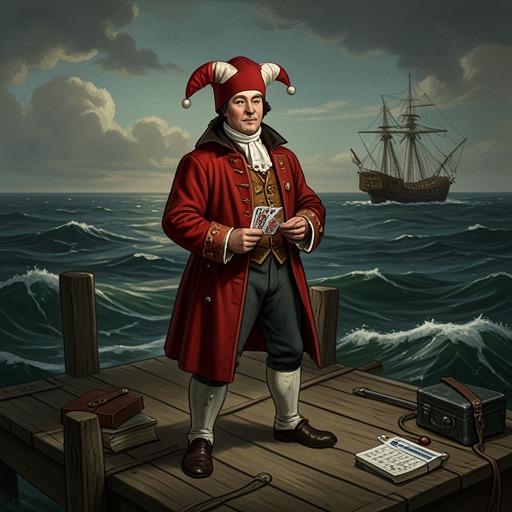
The setting matters in precise, physical detail. Near the café, Ana sees a figure at the Puerta de Marchena and then spots him again on a battlement above the long wall dividing the old and new gardens. He takes another photograph with his camera. Ana identifies him as the bell-ringing dwarf, a figure she has spoken of before, and treats the photograph as a serious affront. Her recognition, rather than José’s, sets the chase in motion; he follows because the mysterious figure has been part of her stories for as long as he has known her.
The pursuit and collapse
Ana springs up from the bench and runs after the figure. José first tries to hold her back, then follows. Their route passes through the wrought-iron gate, by the pond and its statue of Mercury, down through the Garden of the Dance and the Garden of the Ladies, past the fountain of Neptune and the Labyrinth, and along the Gallery of the Grotesque before turning through the Gate of Privilege toward the Garden of the Poets. Both Ana and the dwarf run faster than José. Onlookers see what appears to be a couple chasing a helpless dwarf, an inversion of what José understands to be happening: Ana is pursuing him to put an end to the story once and for all.
In the Garden of the Poets, close to Plaza de Santa Cruz and the Los Gallos flamenco venue where Ana had long been a major performer, she collapses onto a hedge beside the last pond. A crowd gathers before José reaches her. She is still conscious, but her face is nearly blue and she is struggling to breathe. José knows she has a heart condition; he lifts her into a large marble fountain to cool her feverish body and shouts an explanation to those around them. An ambulance soon arrives with a stretcher. In the shock of the moment, he says he cannot register the actual passage of time clearly.
Hospital, reported death, and final words
At the hospital, Ana receives several injections and improves somewhat during the first hours, but she does not get back up. The doctors plan to operate once her pulse has returned to normal; according to José’s account, that recovery never comes. He tells the narrator that Ana died about a week before the conversation and that her funeral is to be held on Friday at the Church of Santa Ana in Triana. He invites the narrator to attend, and the narrator agrees.
José says that Ana remained conscious and was more lucid than ever during her hospital days. She told him things he had not known about the dwarf, spoke of El Planeta and her great-grandfather, who died after a fatal fight, and shared secrets about flamenco. Her last words echo José’s own understanding of life: “Se tarda miles de millones de años en crear un ser humano. Y sólo se tarda segundos en morir”. He understands the words both as a farewell and as a declaration of love, and says that his view of life had left its mark on Ana just as her devotion to flamenco had made him a fan. The line binds intimacy to the episode’s stark contrast between the immense time required to produce a human life and the seconds in which death can arrive.
The story’s reversal
The account is framed as José’s recollection, heard by the narrator after Ana is believed to have died. Its details encourage the reader to accept the hospital outcome as final: an existing heart condition, the collapse, the doctors’ plan to operate, and José’s announcement of a recent death and imminent funeral. Yet the later reunion overturns that conclusion. The narrator states that the group is together again and that Ana had not died. The collapse and the supposed death therefore remain consequential without being the end of Ana’s life; José’s version records what he and the narrator understood at the time, while the later scene exposes the limit of that understanding.
A further retrospective detail gives the earlier dizziness a possible explanation: Frank suggests that Ana may have been pregnant when she became faint. José says that they learned this only later. At the time, frightened by Ana’s known allergy to insect bites, he thought she was having an anaphylactic attack and, unable to think clearly, considered that a slap might stimulate adrenaline production. The later information does not erase the heart condition or change the fact of the collapse; instead, it adds another circumstance the people present did not know during the emergency. In the novel’s wider pattern, the episode makes apparent death a powerful but unreliable boundary: the reported ending, like the garden’s enclosed refuge, cannot contain everything that follows.