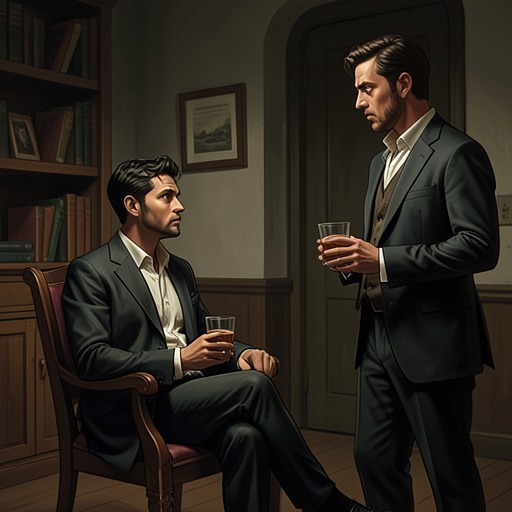
Frank and Gordon’s conversations
MayaFrank and Gordon’s conversations form an unlikely companionship in which teasing and philosophical provocation meet Frank’s fear of death. Gordon is at once a gecko sharing Frank’s room and the voice that presses him to confront the limits of human self-knowledge; Frank, in turn, resists, argues, drinks, and eventually admits how much the conversations have come to matter to him.
An Uneasy Conversation About Mortality
Frank explains that what troubles him is not simply that life is brief, but that death means he will never return to experience reality again. He imagines that even another galaxy might be acceptable, provided it had a bar and a world where reproduction involved both sexes. The comic specificity of these wishes sharpens the underlying dread: he is not merely reluctant to leave one place, but cannot bear the prospect of permanent absence.
Gordon answers that Frank should not torment himself with such concerns, in a tone that seems almost consoling despite Gordon’s role in provoking the despondency. The exchange captures their pattern: Gordon opens or intensifies an existential question, then responds to Frank’s distress as if he were both its cause and its caretaker. Frank argues that reason itself can become destructive, turning back on the mind like a tail bitten by its own owner. Gin can anesthetize the attacked synapses for a few hours, he says, but offers only temporary relief rather than a solution.
The dialogue makes Frank’s anxiety more specific than a general fear of dying. He imagines the long interval after his disappearance, including a future a hundred million years away, and objects to the impossibility of returning to reality after sleep-like absence. His jokes about bars and reproduction do not cancel the fear; they give it a human scale, setting ordinary appetites against an eternity in which he expects to have no further experience.
Gordon’s Enigma and the Shared Self
When Frank asks whether Gordon and his companions have pondered their ideas for a long time or are wandering poets, Gordon replies in a compact, poetic meditation on an unknown soul and an unsolved riddle. He describes a riddle standing on two legs, dream images that pinch themselves without waking, and a story enclosed within its own image. The answer refuses the tidy distinction between the questioner and the mystery: they are the enigma that nobody solves, always moving without arriving at clarity.
Frank’s response is practical and immediate: he tells Gordon to stop because the talk is making him nervous. Gordon does not insist that Frank remain engaged; he says Frank can lie down if he wishes and offers to look after the bottle. The shift from metaphysical language to the gin bottle keeps the exchange grounded in the room, where Frank’s need for rest and Gordon’s presence coexist with the scale of the questions.
Gordon later asserts that he is everywhere and that there is only one self, presenting this as the simplest and most obvious statement of the universe. Frank dismisses it as nonsense, but the claim sits alongside Gordon’s earlier insistence that human beings do not know the soul that carries them. His ideas repeatedly blur the boundary between individual consciousness and something larger, while Frank pushes back against the loss of a clearly separate self.
The Mirror, the Bottle, and Familiarity
The relationship also develops through small domestic acts. After obtaining a new bottle of Gordon’s Dry Gin, Frank fills the empty bottle with water and places a hibiscus sprig inside it by the window overlooking the palms. He takes a drink from the new bottle to mark it as his, locks it in his suitcase, and then sees Gordon hibernating along the upper edge of the curtain. Frank suspects the gecko may have watched him bring in the gin; Gordon asks whether Frank is getting over a hangover, immediately reviving their familiar exchange.
On another night, Frank realizes that one of Gordon’s questions had really been an invitation. He admits to missing the prospect of returning to his room and seeing Gordon, calls him a good fellow, and concedes that Gordon may be right that drinking heavily just before sleep is not especially useful. This admission marks a change in the texture of their conversations: Gordon is not only a source of unnerving ideas or a rival for the gin, but someone whose company Frank has begun to anticipate.
Gordon’s place on the large mirror beside the bedside table extends that companionship into Frank’s private space. Frank hears movement across the mirror after closing the door and initially cannot be certain that it is Gordon rather than another gecko. He does not want to begin again by introducing himself to a different one; when he turns on the light, he sees that it is Gordon. Frank reflects that geckos, like human beings, are individuals, and describes Gordon as an exceptionally large, strong gecko. The recognition is affectionate but remains grounded in uncertainty: Frank cannot always identify Gordon by sound, yet he prefers the particular relationship they have established to starting over with another animal.
Frank’s Self-Recognition and the Conversations’ Role
The philosophical sparring repeatedly turns Frank’s own words back on him. When Gordon asks who started speaking, Frank realizes that he had been the one sustaining the conversation, despite having attributed its beginning to Gordon. He recognizes that Gordon has tricked him again, and Gordon observes that Frank does not know himself very well and has serious difficulty deciding what he wants. Frank admits to a certain weakness rather than denying the charge.
That moment gives the dialogue its recurring structure: Gordon’s questions do not simply present abstract claims but expose inconsistencies in Frank’s account of himself. Frank can resist Gordon’s universal ideas and tell him to stop, yet he also keeps talking, seeks his company, and recognizes his own indecision. The gecko’s teasing works as a form of intimate pressure, making Frank’s self-contradictions visible without resolving them for him.
When the prospect of vast spans of time becomes unbearable, Frank drinks one or two decilitres of gin and decides that sleep is the only real escape available that night. He is less troubled by the thought of a hangover than by the millions and billions of years raised in their discussion. Gordon prepares him for a reprimand but instead tells him that he is disappointed in Frank—or, correcting himself, that Frank is disappointed in himself. Frank answers that they may as well both be disappointed and share the responsibility. The exchange closes not with philosophical certainty but with a negotiated intimacy: Frank’s distress remains, while Gordon’s company gives it someone to be shared with.
A Comic and Existential Counterpoint
Frank and Gordon’s conversations set the abstract scale of the universe against ordinary bodily needs: sleep, a drink, a hangover, and the wish to find a bar even in another galaxy. Their shifts between cosmic claims and the management of a bottle are not digressions from the existential subject. They show how Frank experiences it—as an idea that enters the room and interferes with rest, while the available response is temporary relief, argument, or company.
Gordon’s role rests on this double position. He is physically particular, a gecko Frank recognizes on a mirror or curtain, yet he speaks of a single self extending everywhere. Frank can regard him with fondness and still find his declarations maddening; Gordon can unsettle Frank and then offer to watch the bottle. Their conversations therefore do not produce a final answer to mortality or identity. They repeatedly bring Frank to the edge of his own fear, expose the uncertainty in what he wants, and return him to the small, specific companionship of the room.