Frank and Vera’s romance
MayaFrank and Vera’s romance is a reunion shaped by bereavement and separation, and its decisive turn comes when they take each other’s hands in Seville. The scene offers companionship rather than a guarantee that grief or mortality has been overcome: Frank remains a wounded figure, but he no longer has to face the cosmic night alone.
Background and Distance
Frank and Vera’s relationship is defined in the available account by an earlier rupture and the effort to reconnect. The narrator’s later recollection places Frank in the palm grove at Maravu Plantation Resort, where he was more despondent than he is by the time of the Seville reunion. Their renewed closeness therefore follows a period in which Frank’s grief had left him carrying the prospect of eternity’s loss in isolation.
The novel also places this reunion alongside a contrasting relationship marked by parental control. Laura explains that Bill arranged her life from childhood, found her a businessman husband from his oil-industry circle, and funded the foundation that supported her work. She left home for Adelaide after two weeks of marriage, but Bill followed and wanted them to travel together; Laura says he expects her to return to her husband. This account does not describe Frank and Vera’s courtship, but it sharpens the distinction between intimacy chosen by the people involved and relationships organized through family authority and financial dependence.
The Seville Reunion
The reunion unfolds as a gradual, shared action rather than a sudden declaration. As the group walks through the Plaza de España, Frank and Vera take turns pushing a baby carriage. At Zamora, they are pushing it together. The narrator describes the movement as completing a semicircle; the other half is Frank’s letter to Vera. The metaphor makes their reunion the joining of two previously separate parts, while the narrator acknowledges that this convergence had not been planned: the letter and the later encounter in the Rotonda of the Hotel Palace had come together unexpectedly.
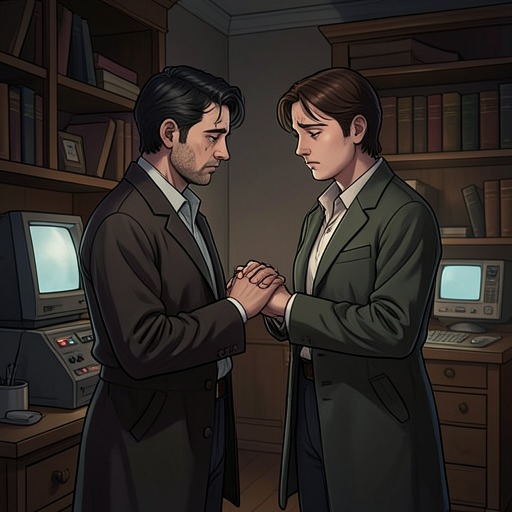
The moment of contact arrives at Zaragoza. José has just spoken about the Basilica of Our Lady of the Pillar and its Goya frescoes; when the carriage is handed to Ana, Frank and Vera take each other’s hands and look steadily into one another’s eyes. The gesture is modest but decisive. Their reunion becomes visible not through an explanation of the past, but through the way they stand together after sharing the task of pushing the carriage.
Companionship After Grief
The narrator measures Frank’s change against their earlier conversation at Maravu Plantation Resort. Frank is no longer as despondent, and the narrator imagines that it may now be easier for him to bear the burden of a lost eternity. The qualification matters: the burden has not vanished. What has changed is that Frank is no longer alone before the prospect of the cosmic night. Vera’s presence gives him someone with whom to share the difficult passage.
The narrator still sees Frank as a grieving angel, but treats grief as compatible with love rather than as its opposite. In this reading, the romance does not repair loss by erasing it; it alters the conditions under which Frank must live with it. The relationship’s emotional movement is from solitary endurance toward shared endurance.
An Ending Left Open
After the walk through the Plaza de España, the group parts. Ana and José go home, while Frank and Vera say that they need to spend the rest of the weekend alone together in Seville. The scene establishes renewed privacy and mutual choice, but it does not narrate a further resolution of their relationship. Its ending is therefore a promise of closeness in the immediate future, not a fully described conclusion.
The narrator’s account of the manifesto deepens that emphasis on togetherness. Frank’s letter to Vera is accompanied by fifty-two Taveuni photographs, each bearing on its reverse an aphorism from the manifesto Ana and José recited to one another. As the narrator mentally recalls the maxims while crossing the plaza, the manifesto appears difficult to bear without someone whose hand can be held. Frank and Vera’s clasped hands give that idea a concrete form: their reunion does not defeat mortality or restore what has been lost, but makes the road ahead shareable.