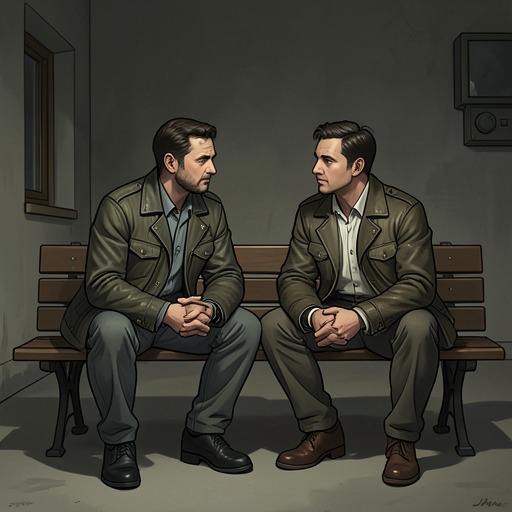
John Spooke and Frank’s relationship
MayaJohn Spooke and Frank’s relationship is an unusual partnership built from recognition, observation, and intervention. Spooke sees in Frank a fellow mind troubled by mortality, makes him the imagined narrator of a novel, and then helps set encounters in motion that bind Frank’s story to Ana and José’s. Their connection is therefore both personal and literary: Frank becomes a companion Spooke values, but also a protagonist whose life Spooke is already shaping into a narrative.
Recognition at Maravu
Spooke first becomes interested in Frank through a combination of intuition and inquiry. He has already been watching Ana and José recite their aphorisms to one another, and he is struck by the sense that he has seen Ana before. When Frank arrives on Taveuni and says that he, too, feels he has encountered her previously, Spooke investigates and discovers what he calls the truth. The discovery changes how he looks at Ana, but he does not immediately disclose it to Frank. Instead, he gives him only a small hint as Frank leaves Maravu, keeping the larger revelation to himself.
Frank matters to Spooke for more than his connection to Ana. Spooke explains that people tend either to accept a finite human lifespan or to recoil from the prospect of living for centuries or millennia, while a smaller group wants eternity because they cannot understand how the world could continue without them. Frank belongs to this last group. His fear of vanishing, and his difficulty imagining a world beyond his own disappearance, make him especially compelling to Spooke, who says this quality was necessary for Frank to become the narrator of the novel he wanted to write.
The two men are separated by a marked difference in age, but Spooke feels they would make a good pair. That sense of affinity is not based on identical lives: it arises from a shared preoccupation with time and the limits of existence. Spooke also reveals that a dream Frank later tells Gordon was borrowed from Spooke’s own nightmare at Maravu. In it, Spooke is unsure whether he is eighteen or twenty-eight, wakes to find himself sixty-five, and confronts his reflection as an aging primate. The borrowed dream quietly reverses the apparent direction of influence: the novelist’s material passes into Frank’s voice, just as Frank’s life becomes material for Spooke’s novel.
A novelist who arranges the encounters
Spooke’s interest in Frank takes an active form. He records Frank’s cabin, date of birth, and passport details, noting that the passport was issued in Oslo, then passes the cabin location to Ana and José and tells them Frank seems lonely. He acknowledges that not everything at Maravu happened by chance and that he helped set social processes in motion that might otherwise have taken at least a week.
His interventions have distinct purposes. He suggests to Ana and José that Frank could take the place of the absent Dutch player in their bridge game, points out where Frank is staying, and encourages them to question the evolutionary biologist about the state of his field nearly 150 years after Darwin’s On the Origin of Species. Spooke presents these actions as deliberate efforts to bring people together and start conversations, not as mere coincidence. The relationship thus contains an asymmetry: Frank experiences the encounters as events in his unfolding life, while Spooke knows that he has helped arrange their conditions.
Spooke’s literary project complicates that intervention. He says he preferred not to discuss what he was writing before he had begun, fearing that conversation at Maravu’s dinners could spoil it. He also admits that meeting Frank in Madrid unsettles his work: the imagined protagonist suddenly appears in the Palace Hotel, the very place Spooke had chosen as the setting from which Frank would write his long letter to Vera. The imagined setting and the living man converge, making Frank at once a person Spooke encounters and a character whose story has already been conceived.
Shared material and narrative distance
The relationship is not a simple transfer of knowledge from older observer to younger subject. Spooke says that much of what he knows about the South Pacific comes from Frank, who had already spent two months there when Spooke’s account of their acquaintance begins. Frank therefore supplies knowledge and experience even as Spooke places him within a design of his own. Their partnership moves in both directions: Spooke selects Frank as narrator and nudges him toward encounters, while Frank provides the regional knowledge through which Spooke understands the setting.
Spooke’s narration makes that difference in knowledge visible. He had noticed the Spanish couple’s whispered recitations before Frank did, but he could not understand Spanish and responded to the manner of their speech rather than its content. Frank understood what they were saying; Spooke identifies that as an essential difference between them. In the same way, Spooke’s early attention to Ana is intuitive and investigative, while Frank’s understanding of her words gives him access to what Spooke cannot hear. Their shared attention does not make their perspectives interchangeable.
This layered viewpoint shapes the reader’s sense of their relationship. Spooke recounts how he watched Frank listen to Ana and José, how he studied the resemblance that led him to investigate Ana, and how he withheld the result while deciding what to do. Frank is central to the story Spooke wants to tell, but the account also exposes the authorial hand behind the apparent accidents. Spooke’s admission that he nudged events turns companionship into a question of narrative agency: Frank acts within the world, while Spooke observes and helps configure some of the circumstances through which Frank moves.
From Taveuni to Seville
The connection eventually extends beyond Maravu. Spooke meets Frank again in Madrid while preparing the novel, then uses a conversation about the beauty of Andalusia to invite him to Seville. When Frank remarks on the season in Andalusia, Spooke recognizes an opening and asks him to come. The invitation is another purposeful intervention, following the earlier arrangements on Taveuni.
Spooke also contacts Vera. As Vera later recounts to Frank, a man named John Spooke called to say that he had been with Frank in Fiji and had happened to meet him again in Madrid. He believed Frank would probably be in Seville that weekend and invited Vera to what he called the flamenco spectacle of the century. Spooke called again in the middle of the night to confirm that Frank would go, saying that he had arranged an airline ticket Vera could collect at Barcelona airport. He also told her that, in his opinion, Frank still loved her, and reprimanded her over how she and Frank had managed their lives after what happened in Oslo.
The contact makes Spooke more than a facilitator of Frank’s social life. He intervenes in the unresolved relationship between Frank and Vera, supplies Vera with a practical means to travel, and gives her his interpretation of Frank’s feelings. His confidence that Frank still loves her is presented as Spooke’s judgment, not as a statement Frank makes in that scene. The distinction matters: Spooke helps create the possibility of a reunion, but he cannot speak in Frank’s place or determine what Vera will make of the invitation.
Partnership and its limits
Spooke’s own account treats his actions as both benevolent and ethically unsettled. He says his intention in directing Ana and José toward Frank was good, and he frames the interventions as ways of accelerating social encounters and making use of an unusual opportunity to speak with a biologist. Yet he also recognizes that, if Frank’s letter to Vera and its epilogue end up in a time capsule near the International Date Line, future readers may judge his “tricks.” His awareness of possible judgment does not undo the fact that he arranged meetings and helped move a private history toward public narration.
The relationship also rests on a shared, though differently experienced, awareness of loss and finite life. Spooke says that after Sheila’s death he, too, hears voices, continuing long conversations with her and sometimes not knowing whether he is speaking aloud or only thinking. He describes how intimately he knew her speech, down to the phrases that still make her feel present. This testimony does not establish that Frank and Spooke share the same grief, but it places Spooke’s literary interest in Frank’s fear of death within a narrator’s own experience of bereavement and continued inward conversation with the dead.
Frank’s importance to Spooke ultimately lies in the conjunction of affinity and usefulness. Spooke recognizes a person who cannot readily accept his own disappearance, values the companionship he imagines across their age difference, and chooses that person to narrate a novel. At the same time, he supplies information, arranges encounters, and draws Vera into the Seville strand of Frank’s story. Their relationship remains genuine without being innocent of design: it is an alliance between two people, and also the point where a novelist’s imagined plot meets the life he is helping to set in motion.