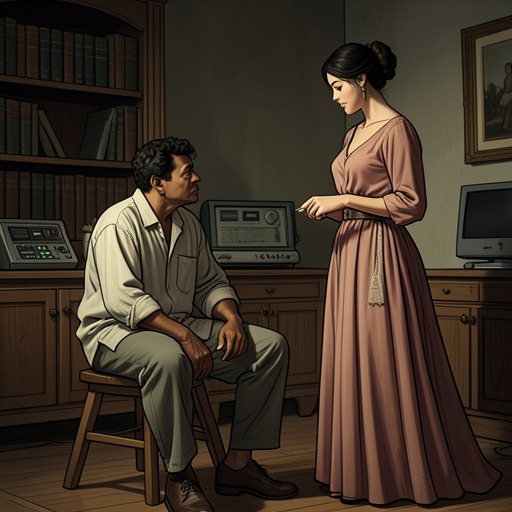
John Spooke and Sheila’s marriage
MayaJohn Spooke and Sheila’s marriage is defined by deep familiarity and by the continuing bond John maintains with her after her death. Its history reaches back to the beginnings of their love, while its aftermath is carried through ordinary details—her clothes, a photograph, a deck of cards, and the phrases he still hears in his mind. The relationship does not end with Sheila’s death: it changes from shared daily life into memory, conversation, and an intimate presence that John both misses and resists.
A marriage of familiarity
John recalls that it had always been easy to talk with Sheila. He knew not only what she would think but, often, exactly what she would say, word for word. Their shared vocabulary became part of the way he recognizes her presence in other people’s speech: familiar turns of phrase can make Sheila seem to remain nearby.
The marriage held both affection and irritation. When Sheila was young, her devotion to solitaire was one of the peculiarities that made John fall passionately in love with her. Later, he sometimes hated that she spent entire afternoons playing. He objected to her occasional attempts to cheat the solitaire into coming out, and once told her that solitaire was considered a game of death, which offended her deeply. After she was gone, however, he missed precisely those habits that had once annoyed him. His recollection turns irritation into evidence of intimacy: the ordinary traits that made a life together difficult are also among the things that made Sheila irreplaceable.
Death and the work of mourning
Sheila died at fifty-nine, before the turn of the millennium John had imagined reaching at sixty-seven. In the year before her death, she received little beyond chemotherapy. For John, the knowledge that she had died sits beside a more personal fear: as a child, he found a dead roe deer in a wood and privately understood that he, too, was a living animal with only a limited time on Earth. He describes the shame that kept him from telling his family about the discovery, and the way its secrecy made the encounter persist as a trauma. His reflections on mortality place the loss of Sheila within a lifelong awareness of how abruptly life can end, but that larger perspective does not remove the particular absence of his wife.
After Sheila’s death, John eventually becomes able to sort through her clothes. He arranges for the Salvation Army to collect them, including old dresses he doubts they will be able to sell. The task feels like removing a swallow’s nest that has been empty for years: a necessary handling of what remains, and an image of a home whose life has already departed. He also finds that he can look at a large color photograph of Sheila without shuddering as much as before. These changes mark an adjustment to widowhood, not the disappearance of attachment.
John says that he is gradually getting used to life as a widower and that it, too, is a form of existence. Yet he would still have taken Vera’s Magic Drink without hesitation, even if he could not be sure of finding someone with whom to share its other half. It is too late for Sheila; she did not receive that possibility. The contrast makes clear that acceptance of her death has not extinguished his longing for a life in which the two of them might have continued together.
Shared grief and an interrupted family
John’s account of his relationship with Sheila also sets his mourning beside the earlier loss of his daughter, Sonia. In Salamanca, he and Vera talk about Sonia while surrounded by the accumulated life of the old university city. Their conversation gives their dead daughter a living place in their shared recollections: John insists that he and Vera alone can create a space in which Sonia’s memories continue to have force. Vera tells him small stories about the child that he had never heard, and the stories hurt because he regrets not sharing every minute of Sonia’s life, even as they allow him to know her better.
That experience clarifies the family history against which John’s grief for Sheila is later understood. After Sonia’s death, John and Vera’s pain became entangled with blame and repeated questions. He recognizes that he insulted Vera in his desperation and repeatedly pressed her about the accident; although he says he had forgiven her long ago, she eventually left because she could not bear living under the same roof with his pain as well as her own. Their separation was not simply an absence of forgiveness but an attempt to divide an unbearable shared grief. The contrast matters to John and Sheila’s marriage: the book presents continuing attachment as something that can preserve intimacy, but also shows how pain can overwhelm a household and drive the living apart.
Sheila’s continuing presence
After Sheila’s death, John continues to have long conversations with her. He is not always sure whether he is speaking aloud or only thinking; he knows that at least sometimes he answers out loud, while Sheila replies in his thoughts. He describes this as a continuation of a kind of conversation that had been easy even when she was alive, because he already knew her responses so well. The passage presents the bond as persistent mourning grounded in their actual familiarity, rather than as a claim that Sheila has physically returned.
John misses Sheila’s body and even the small domestic request that he shuffle the cards for her solitaire. He still responds aloud when something she says in his thoughts upsets him, though he knows in advance what she will say. A neighbor’s observation that John talks to himself makes him glad that the neighbor cannot hear Sheila’s words. John fears that he may eventually lose the ability to keep those words private, but he is not ashamed of speaking to her: he regards her as having left behind a powerful resonance.
The marriage therefore persists through its particulars rather than through a general ideal of love. Sheila remains present in the phrases John associates with her, in the solitaire he once resented, in the photograph he can now face more calmly, and in conversations that blur the boundary between speech and thought. His grief changes over time, but it does not require him to stop addressing her. Their bond survives as a form of daily memory, at once a comfort and a measure of how much of ordinary life was made together.