Vera and Sonia’s mother–daughter relationship
MayaVera and Sonia’s mother–daughter relationship is defined by a bond that continues after Sonia’s death: first as the source of a family’s unbearable grief and separation, then as the shared memory through which Vera and Frank begin to meet one another again. Sonia lives only to the age of four and a half, but in the later account of Salamanca, her parents understand that she remains their daughter and that remembering her together can make her presence part of their continuing lives.
Motherhood Disclosed
Frank’s account of Vera and Sonia begins with the postcard from Barcelona dated May 26, 1992. Vera tells Frank that she will arrive in Oslo with someone, that things will be different, and that he should be ready. Her allusion to the “magic drink” and to the brevity of life gives the message an intimate, urgent quality; Frank, however, does not initially understand that its news concerns a child. When he later explains the postcard, he says that Vera returned from Barcelona that summer and announced that they had, in some sense, taken drops of the drink she had dreamed of as a child. She was thinking of the baby who would be born: something belonging to both parents had begun its own life and might bear fruit for thousands of years. For Vera, motherhood joins a particular child to an imagined future beyond the short span of an individual life.
The postcard reveals that Vera is pregnant, while Frank’s halting account supplies the family’s names and relationships. He says that Vera went to his city to read her doctoral thesis on human migrations from Africa and identifies her as a paleontologist. Asked whom Vera took to Oslo, he answers, “Sonia”; he then makes explicit that Sonia is their daughter. The scene’s small pauses matter: Frank looks into his glass, points to the postcard, and is visibly shaken when asked whether the child was his. Fatherhood and motherhood arrive in the narration not as a settled family history but as facts Frank can scarcely bring himself to state.
A Childhood Cut Short
Sonia’s life ends when she is four and a half, and the account of her death is inseparable from the circumstances that made her mother blame herself. In a later letter to Vera, Frank recounts the ordinary sequence that became catastrophic: Vera collected Sonia from nursery, placed her in the car, and started the engine, then remembered that the child’s shoes had been left in the entrance lockers. She switched off the engine and took out the key but forgot to apply the handbrake; the car was in neutral. When she hurried back with the shoes, the car began to move. Frank describes the terrible helplessness of Vera having to watch events unfold, and refers to what happened at a bend three hundred metres away and to what happened three days later. The family’s loss is thus rendered through an everyday oversight and its irreversible consequences, not through any suggestion that Vera intended harm.
The accident became a subject the couple could scarcely name. Vera had to make statements to the police two or three times; afterward, they referred to the events only as “what happened” or “that.” Their silence protected neither of them from memory: when Frank and Vera meet again in Salamanca, they both fear that returning to the episode will reopen not only the wound of Sonia’s death but the wounds they inflicted on one another. The account also states that Vera had attended a departmental end-of-year celebration and had drunk three or four glasses of champagne. She registered 0.52 when she got into the car, but was not charged; the police said she had already received enough punishment. Frank recognizes that his own repeated accusations had added to her suffering.
Grief and Separation
After Sonia’s death, living together became impossible. In Frank’s first brief telling, there was too much pain under one roof. The later account gives that separation more complicated contours: Frank had asked Vera the same accusatory questions repeatedly, including why she had left Sonia in the car and why she had gone back for the shoes. He admits that, in desperation, he insulted and shouted at her, once telling her to go to hell before breaking down in tears and asking forgiveness. Vera eventually left, but Frank insists that she did not leave because he had refused to forgive her. They had reconciled; she fled his grief because she could not bear either his pain or her own. He understands that, if he had had family in another country, he too might have left. His journey to Oceania offered a way to divide a grief that had become unlivable in one home.
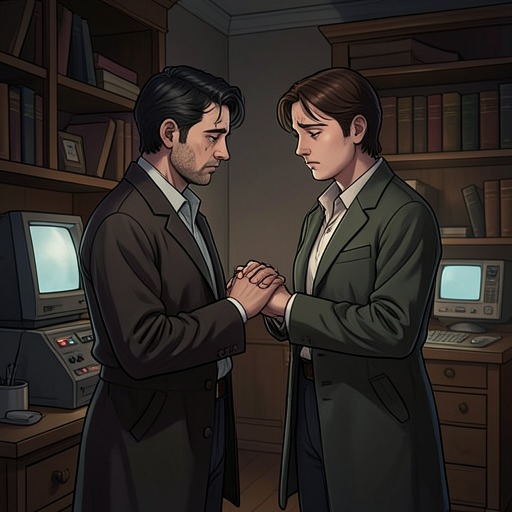
Vera’s motherhood nevertheless remains central to Frank’s understanding of her. On their walk through Salamanca, the parents speak extensively about Sonia amid a city shaped by centuries of remembered life. Vera tells Frank small stories about their daughter that he had never heard. The new knowledge hurts him because he regrets not having shared every minute of Sonia’s life, yet it also gives him a chance to know her better. He notices Vera turning away to wipe her tears and recognizes her not merely as the person whose mistake preceded the accident, or as the woman from whom he had been separated, but as Sonia’s mother. He states that Vera remains the mother and he remains the father of their daughter.
Remembering Sonia Together
The Salamanca conversation makes remembrance a shared act rather than an attempt to deny the death. Frank says that Sonia went with them through the old university city in the sense that her parents spoke about her so fully; their surroundings, full of the past of many centuries, made it possible to talk naturally. He does not claim that Sonia is alive or that her death must simply be accepted. Instead, he proposes that the memories of their daughter can have a living space and a sphere of influence, and that only her two parents can create that space. The relationship between mother and daughter therefore persists through what Vera remembers and can tell, and through Frank’s renewed effort to know the child he lost.
Their memories retain Sonia as a particular little girl rather than an abstract emblem of loss. Vera recalls that, as a newborn, Sonia nearly went home from the clinic with the wrong mother. She also tells Frank about the child returning from nursery with a hundred-kroner note she said she had found in a teacher’s pocket. Frank imagines the visits they might have made as a family through Salamanca: Sonia running ahead into the university courtyard, stopping beneath the blue celestial vault in the University Museum, holding her parents’ hands in the cathedrals, and demanding an ice cream afterward. These imagined scenes are explicitly counterfactual, but they give shape to the childhood that ended too soon and to the details Vera can still contribute to her daughter’s remembered life.
An Enduring Family Bond
Frank’s reflections distinguish reconciliation from erasure. He tells Vera that forgiveness is no longer the question: he has forgiven her many times, and the old reproaches are over. Yet neither parent can undo the accident or restore the years Sonia did not live. Their renewed closeness grows from holding those truths together. Frank even imagines that the tragedy might be given a new meaning by what they do in the present, rather than allowing the death to point only toward their separation. The possibility remains a question he puts to Vera, not a claim that grief has been resolved.
The relationship is consequently carried forward in memory, in the details Vera supplies, and in the parents’ shared recognition of their enduring roles. Their daughter will remain four and a half while her parents grow older; Frank understands that they will live with that fixed image of Sonia for the rest of their lives. The bond between Vera and Sonia is no longer enacted through daily care, but it continues in Vera’s stories and in Frank’s recognition that the woman beside him is still the mother of his child. Their remembrance does not make Sonia’s life longer; it gives that short life a place and consequence within the lives her parents continue to share.