Frank and Sonia’s father–daughter relationship
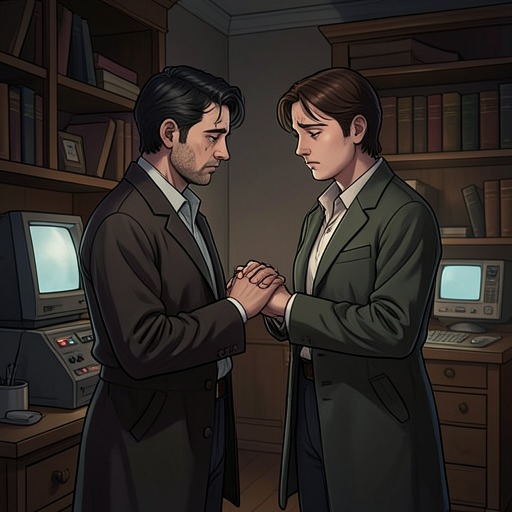
MayaFrank and Sonia’s father–daughter relationship is defined by a bond that death cannot simply end: after Sonia dies at four and a half, Frank and Vera carry her into their later lives through memory, mourning, and the stories they tell about her. Their relationship becomes both a source of acute pain and a continuing connection, one that Frank eventually recognizes only he and Vera can keep alive.
Fatherhood and the Loss of Sonia
Frank’s reflection on what might have been makes the loss concrete. During a walk in Salamanca with Vera, he imagines the family they might have been: the two parents showing the city to their five-year-old daughter, who would have run through courtyards, climbed toward a well, and hurried ahead of them through the university quarter. This imagined outing does not erase Sonia’s absence; it gives that absence the contours of an ordinary family day they will never share.
The imagined walk also sets the child’s brief life against the city’s long history. Frank pictures Sonia encountering the university’s skull-and-toad carving and hearing about the scholar who returned to teaching after five years in prison with the words “Como decíamos ayer…”. In his version of the scene, Sonia might laugh at the mismatch between five years and yesterday, or turn her attention to the carvings. The details make her a particular child in Frank’s mind, not an abstract emblem of loss.
Shared Memory as a Continuing Bond
On their actual walk, Vera tells Frank small stories about Sonia that he had never heard. The new anecdotes hurt because they remind him of the time he did not share with his daughter, yet they also allow him to know her better after her death. Vera turns aside to wipe her tears; Frank hides his face against the old university façade. Their grief appears in these gestures as well as in what they say.
Frank understands the walk as a way of bringing Sonia with them despite her absence. They speak about her naturally while surrounded by Salamanca’s accumulated past, and he concludes that only her parents can create a living sphere for their memories of her. The relationship thus persists not through a claim that Sonia is still alive, but through a shared practice of remembering that gives her a continuing place in their lives.
The Accident and Its Aftermath
That continuing bond is marked by the circumstances of Sonia’s death. Vera had collected her from nursery and placed her in the car, then remembered the child’s shoes left in the entrance lockers. She stopped the engine and removed the key but forgot to apply the handbrake; the car was in neutral. After she went back for the shoes, it began to move. The fatal sequence unfolded at a bend three hundred metres farther down the road, and Sonia died three days later.
The event became a taboo between Frank and Vera, reduced in their conversations to “what happened.” In Salamanca, both are afraid that revisiting the scene will reopen not only the wound of losing Sonia but also the injuries they inflicted on each other afterward. Frank acknowledges that in his desperation he had insulted and shouted at Vera, repeatedly asking the questions the police had asked her. He later recognizes that his reproaches added to her guilt, and that the police treated her more humanely than her own relatives did.
Separation, Reconciliation, and Parenthood
Frank makes clear that he had forgiven Vera long before she left him. Their eventual separation was not, in his account, a consequence of her remaining unforgiven: Vera fled the pain in their home, while Frank was unable to distinguish his continuing grief from old accusations. He describes her departure as a way of dividing a pain too great for them to bear together under one roof. His later reflections do not erase his own role in that estrangement.
In Salamanca, Frank again sees Vera as Sonia’s mother and himself as Sonia’s father. Sonia had lived only four and a half years, but her parents would grow older while carrying the child of that age with them for the rest of their lives. This recognition binds Frank and Vera as parents even while they remain uncertain about rebuilding their marriage. Their reunion in conversation is not the same as an uncomplicated return to their former life; it is a recognition of the family relationship they still share.
Grief in Frank’s Later Life
Elsewhere, Frank’s continuing attachment to Sonia sits alongside the later loss of Sheila. He prepares to give away Sheila’s clothes, comparing the task to removing a swallow’s nest long abandoned by its birds, and admits that Sonia’s death makes him unwilling to take Vera’s magical drink even if he could not be certain of finding someone to share it with. For Sheila, he says, it is already too late; during the last year of her life she received little beyond chemotherapy. These reflections place Frank’s fatherhood within a broader life shaped by bereavement, without making the losses interchangeable.
Frank’s account of his childhood discovery of a dead roe deer supplies another part of his understanding of mortality: as a boy, he suddenly recognized himself as a living animal with limited time. He later tries to set his brief life within the larger history of life and the universe, but admits that this perspective has not brought peace. Against that vast scale, his bond with Sonia remains intimate and irreducible: the child’s remembered life is preserved through the parents who continue to carry it.