Frank and Laura’s brief romance
MayaFrank and Laura’s brief romance is a short-lived intimacy during Frank’s time in Fiji, formed in the shadow of his separation from Vera and his conversations with Gordon. It begins in a moment of confessed vulnerability, becomes a night together, and ends with Laura’s departure the following morning. For Frank, the encounter offers a temporary escape from solitude; its lasting trace is not a renewed partnership but the photograph Laura later sends him of a rare orange-breasted pigeon.
Background and circumstances
Frank’s relationship with Laura takes place during a period when he and Vera have agreed to live apart. In his later account to Vera, he recalls that she had insisted they were no longer bound to one another and that he had proposed allowing the year of separation to pass before beginning new relationships. The romance therefore occurs within a stated boundary, even as Frank recognizes that recounting it may hurt Vera.
Frank also describes the encounter against the backdrop of Gordon’s recurring talk about immense spans of time. The scale of those discussions makes human intimacy feel especially pressing: Frank says that giving himself to another person was wonderful after hearing Gordon’s vast perspectives repeated so often. He had grown unwilling to spend another night in Gordon’s company, and the prospect of Laura’s closeness offered immediate relief from that isolation.
Vulnerability and intimacy
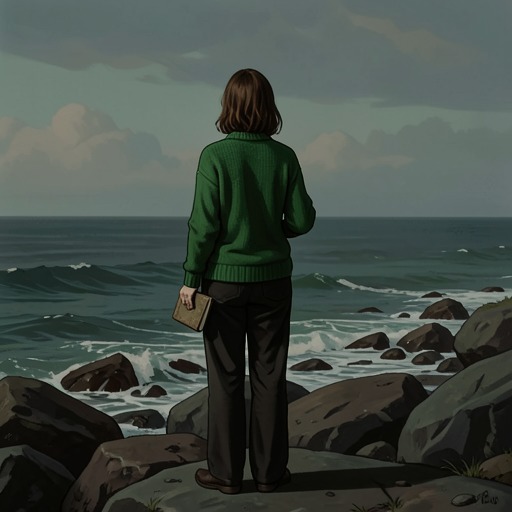
Laura tells Frank that she was an unwanted daughter. Frank notices a small tear in her green eye and moves close enough for her to rest her head against his neck. They remain that way for several seconds; when she looks up, he touches her lips, kisses her, and holds her tightly until the moment must end for reasons of decorum. The sequence turns a painful disclosure into physical tenderness without suggesting that Laura’s history is resolved or that the two have made a lasting commitment.
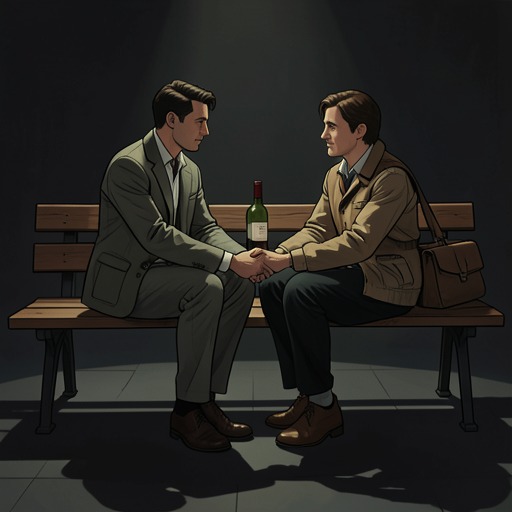
Their closeness continues later at the cabin. While they drink Rioja and talk about the universal soul, Frank considers Laura’s contrasting brown and green eyes. He sees her as sensual and vital, with particular interests in rare birds, old legends, and blue starfish, while concluding that neither her environmental commitment nor Indian philosophy has taken especially deep root in her. Both eyes, he reflects, have challenged him in different ways. The portrait is intimate but provisional: Frank records fascination and difference rather than claiming deep mutual understanding.
A night apart from Gordon
When the bottle is empty, Frank and Laura go into the cabin, and Laura spends the night with him. Beforehand, Frank has noticed Gordon leaning against a wall. While Laura is in the bathroom, he confronts Gordon and demands silence for the night, wanting to be free of him. Frank does not touch the gin bottle that evening, and he explicitly distinguishes that choice from merely trying to avoid irritating Gordon.
The episode gives Frank a brief reprieve from the company of the imagined or recurring Gordon, whose presence frames his solitude. In retrospect, Frank links the relief of being with Laura to the pressure of Gordon’s immense temporal reflections and to his own wish not to face another night alone with him. The intimacy is thus both an encounter with Laura and an interruption in Frank’s particular pattern of isolation.
Departure and lasting trace
Frank wakes the next morning to find Laura gone. He learns over breakfast that she left very early with Bill, heading for Tonga. Frank had given her his contact details, and a few days before he left for Salamanca, she sent him a clear photograph of the rare orange-breasted pigeon. The image remains on his table at the Palace Hotel in Madrid, a concrete keepsake from a relationship that did not continue in person.
In the accompanying letter, Laura says she has returned to the businessman, apparently because he has changed completely and even begun reading the Bhagavad Gita. Frank’s account supplies no further meeting between himself and Laura. Their romance closes in separation: Laura goes back to Bill, while Frank later travels onward, carrying the photograph and the memory of their night.
Meaning within Frank’s relationships
Frank tells Vera about Laura while explaining what he meant to say when they met again in Salamanca. He recalls that Vera had laughed after he pointed out Ana and José and said he had been with them in Fiji; his fuller account places the night with Laura within the separation he and Vera had agreed to maintain. The disclosure makes the romance part of the difficult negotiation between Frank and Vera, rather than an isolated episode with no consequences for their shared history.
That history is marked by the death of their daughter, Sonia, and by the pain that Frank and Vera carried differently after her death. Frank later recognizes that Vera left because she could not live under the same roof with his grief while enduring her own; he describes the separation as a way of dividing the pain. Laura’s brief companionship belongs to the period created by that estrangement, but the text does not present her as a replacement for Vera or as a solution to bereavement. Its significance lies in the contrast between a temporary bodily closeness and the long, shared losses that continue to shape Frank’s life.