The Legend of the Magic Portrait at Cádiz Wharf (1790)
MayaThe Legend of the Magic Portrait at Cádiz Wharf (1790) is a family legend about a miniature portrait that appears to record a young woman with a realism centuries ahead of its time. José’s account links the image to a sailor leaving Cádiz, the future flamenco singer El Planeta, the recurring bell-wearing dwarf Comodín, and Goya’s later depiction of Ana María Maya. The legend’s central disturbance is temporal: the portrait is said to have existed before photography, yet to resemble an image made by a camera.
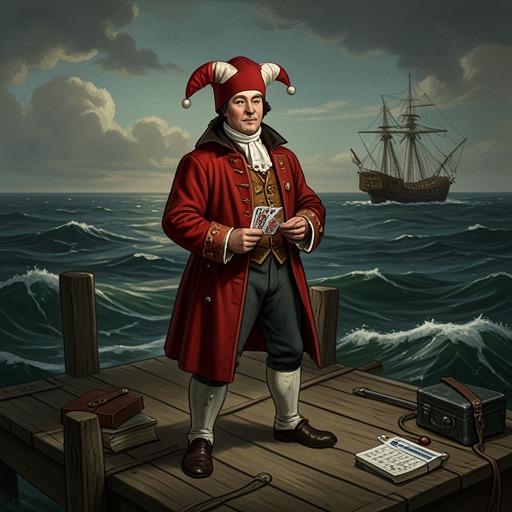
The sailor, the cards, and the dwarf
According to José, a ship from Sanlúcar de Barrameda stopped briefly at Cádiz Wharf in 1790 before putting out to sea. Roma vendors were selling provisions and small goods to sailors preparing to cross the oceans, including oranges, olives, cigars, lighters, and playing cards. The sailor bought an unusual deck from a Roma boy of about six named Antonio, who would later become the celebrated singer El Planeta. José supports the chronology by noting that El Planeta was born in Cádiz around 1785.
The dockside tale also places a dwarf there, dressed in ordinary clothes but said to have concealed bells beneath them, like a jester’s costume. As José’s listener follows the story, he recognizes a contradiction: Comodín was supposedly inside the deck, in the sailor’s pocket, and therefore could not also have stood on the wharf watching the ship depart. The objection makes the tale’s unstable logic explicit. The dwarf is not simply a witness within the scene; he is already bound to the magical object and can appear in places where ordinary chronology says he cannot be.
José gives the portrait a practical place in this lore. Comodín kept it in his jacket pocket and, according to the account, was compelled to use it when escaping drunkards who mocked him for being a dwarf. The portrait is a small likeness of a young woman, carried as an object of wonder and as part of the dwarf’s means of evasion. Its presence turns the harbor anecdote into the beginning of a longer chain of images and encounters.
An image ahead of its medium
The portrait is described as a miniature made by a wholly unfamiliar technique. It is neither a copper engraving nor an oil painting; its surface is so smooth that it recalls silk. More striking than its material is its lifelike precision: the image reproduces what people can see, and the dwarf is consequently thought to be a brilliant artist with supernatural powers. The account does not identify a normal process by which such a likeness could have been made.
José frames the image as belonging to a distant future, which is why people experienced it as magic and suspected the devil’s work. The story called “The Dwarf and the Magic Portrait” had circulated as an invented Roma tale, a piece of imaginative folklore that people need not literally believe in. Yet the legend retained its brilliance because its central object resists the historical sequence that should explain it: the tale is older than the art of photography, but the portrait seems to possess the realism associated with a photograph.
That clash of media also connects the legend to Frank’s search for a clue at the Prado. He had been urged to visit the museum for something specific, and came to understand the visit as more than an echo of his earlier talk about its treasures. The two paintings of a woman associated with the Alcázar gardens lead his mind back to an image that, in the legend, had already existed before Goya painted her. The mystery is therefore not only who the woman is, but how an image can seem to cross the boundary between past and future.
From the wharf to Goya
José distinguishes what the stories claim from what can be established within them. The recurring account says that the bell-wearing dwarf was present when the Ana sailed from Cádiz and showed the crowd a woman’s portrait so detailed and natural that the onlookers fell silent in astonishment. One of those present was the child Antonio, later identified as El Planeta and, in the family account, Ana’s great-great-grandfather. The portrait is said to have been in Seville by 1790, several years before Goya painted his Roma woman, or nude maja.
José then connects Comodín to Goya through another episode. In the spring of 1797, Goya encountered the small jester at Sanlúcar de Barrameda and tried to take him forcibly to his studio to make a portrait of him. The dwarf shouted and protested, but Goya, who was deaf, did not hear. When Comodín produced the mysterious portrait of Ana María Maya, Goya released him: the artist had never seen anything like it. At the time, Goya was finishing La maja desnuda. He transferred Ana’s face onto the nude figure, concealing the model’s true identity.
The sequence reverses the expected relation between image and painting. In José’s telling, Goya does not originate the woman’s likeness; he encounters an image of her that already exists and uses her face in a painting whose model must remain concealed. The miniature thus functions both as an impossible precursor to photography and as the link between Ana María Maya and the historical image of the maja. The story leaves the portrait’s maker and its means of production unexplained, preserving the gap that gives it its uncanny authority.
Family memory and the recurring Comodín
The account gains force from the family’s later experiences with the dwarf. Ana knew stories about El Planeta, Manuel el Solitario, and her great-uncle, but did not necessarily believe all the Roma tales she had grown up hearing. She could sometimes be irritated by them, partly because Roma people were commonly associated with deception and lies. Nevertheless, she was certain that the bell-wearing dwarf was the figure she pursued through the Alcázar gardens: she had heard his bells, and that sound made her follow him. For José, this recognition seemed to restore the family stories’ credibility.
At the funeral of a young woman at the Church of Santa Ana, the narrator encounters the same dwarf again. After the service, Comodín separates him from the departing mourners, removes a handful of photographs from an inner pocket, and gives him a photograph of himself seated in the Alcázar gardens. The narrator reaches for coins, but the dwarf refuses payment and says, “¡De nada, de nada!” Before the narrator can get a closer look, both Comodín and the rest of the crowd have disappeared. The contemporary photograph repeats the old legend’s pattern: an image arrives through the dwarf, whose appearances resist ordinary continuity.
The narrator studies the photograph and recognizes only what he already knows: a grieving primate looking back at him. On its reverse is a statement that human beings may be the only living beings in the universe with universal consciousness, followed by the claim that preserving Earth’s habitats is not only a global responsibility but a cosmic one. The photograph makes the old portrait’s temporal disturbance newly personal: Comodín’s images do not merely preserve likenesses but carry messages that connect human mortality, ecological responsibility, and a future darkness.
The legend’s function
The tale gathers several kinds of image into one chronology: a miniature supposedly made by an unknown technique, Goya’s painted face, the later photograph, and the video José gives Frank of the television program he and Ana made on Taveuni. That program includes an interview in which Frank discusses biological diversity and threats to Oceania’s old habitats. Across these media, images and recordings carry people and concerns from one time and setting into another, while the magic portrait remains the most extreme case: a photograph-like image that predates photography.
The legend also refuses a clean division between verified history and invented family story. José offers dates and a recognizable historical painter, yet qualifies the dwarf’s dockside appearance as something the stories say and admits that the tale belongs to a body of imaginative Roma lore. What he considers sufficient is not proof of the supernatural, but the image’s reported presence in Seville before Goya’s painting. The narrative allows that limited claim to coexist with the far stranger possibility that the miniature came from a distant future.
Comodín’s repeated appearances make the portrait more than an isolated marvel. At the Cádiz wharf he is associated with the sailor and the cards; in the Goya story he carries Ana’s likeness; in the Alcázar he draws Ana into pursuit; and at the funeral he places a photograph in the narrator’s hands. The recurring image joins these episodes without resolving their contradictions. Its significance lies in that unresolved passage between media, eras, and lives: the portrait is at once family relic, impossible photograph, and a sign that the past may contain an image from a time not yet reached.