Barrayar–Komarr political and ethnic tensions
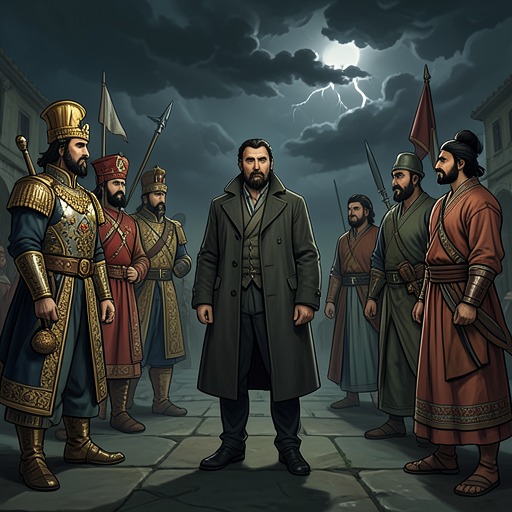
MemoryBarrayar–Komarr political and ethnic tensions form an active pressure beneath the investigation into Simon Illyan’s breakdown and Gregor’s planned marriage to Laisa Toscane. They turn questions of loyalty, appointment, and marriage into tests of imperial belonging: old grievances can make suspicion seem plausible, while meaningful inclusion requires more than declaring the Imperium unified.
Historical Grievance and Imperial Suspicion
The evidence gives the tensions a history of at least thirty years. Lucas Haroche invokes long-standing bad blood between ImpSec under Simon Illyan and some Komarrans when considering a possible motive for the attack on Illyan. That history makes political retaliation conceivable within the investigation, but it does not establish that Duv Galeni was responsible. Miles Vorkosigan presses precisely this distinction: a background of antagonism is not proof of a motive sufficient to explain the original crime.
The investigation’s suspect list reflects how far suspicion can reach across the history of the conflict. Miles identifies people associated with five years of Evidence Rooms inventory teams, those involved in capturing and delivering the evidence, and employees who might have been close to them. He also points to Komarran revolutionaries who escaped capture, people imprisoned at the time and recently released, and people with whom they might have spoken in prison. The record had been filed under the seal of the Komarran Affairs chief who preceded Guy Allegre; Allegre himself had then been working on Komarr as a local section head. Miles regards the altered comconsole record as evidence that the inquiry may involve an insider, while acknowledging that the expanding list is still narrower than the three planets initially under consideration. Historical conflict thus supplies investigative leads, but also a risk: broad political suspicion can obscure the need to establish individual responsibility.
Galeni, Loyalty, and the Burden of Representation
Haroche cites a hostile private exchange in which Galeni condemned Barrayaran rule and accused Miles of siding with the Emperor and his own people. Miles treats the language as evidence of Galeni’s anger, not proof that he would sabotage Illyan. He stresses that Galeni had paid too much to reach his position to throw away his service out of personal resentment, and asks what motive Galeni could have had for the original crime. Haroche, by contrast, presents the grievances between ImpSec and some Komarrans as a possible political explanation. Their disagreement shows how the same history can be used either as context requiring careful inquiry or as a shortcut toward suspicion.
The consequences of that suspicion fall on Galeni even before the case is resolved. After Haroche’s arrest, Galeni asks how much more he must endure to demonstrate his loyalty and why he has been singled out. Simon Illyan answers that the burden is likely to continue throughout Galeni’s life, but that every Komarran who follows him will have less to bear because of what he has done. Miles argues that ImpSec needs Galeni’s perspective: as an institution that helps shape the government’s picture of the world, it cannot reach sound judgments if it excludes the viewpoint of a Komarran officer. Guy Allegre supports the appeal. Their argument presents representation not as a ceremonial gesture but as part of the work of obtaining reliable information and governing justly.
The closing view of Galeni’s prospects gives that argument a qualified outcome. He decides not to resign his commission, in part after quiet encouragement from his fiancée, Delia Koudelka. At the Imperial gathering, he is seen with Delia and her prospective father-in-law, while Miles has heard through Gregor that Galeni is under serious consideration to lead Komarran Affairs. The gathering offers a visible counterpoint to his recent arrest: marriage and family connections may help repair damage to his reputation, while advancement into a senior role would place his perspective nearer the center of imperial administration. Neither development erases the burden Illyan describes.
Marriage as a Political Bridge
Gregor’s intended marriage to Laisa, a Komarran, gives the conflict a public and dynastic dimension. Miles immediately sees the potential opposition: conservative Vor lords could resent a Komarran Empress, while Komarran revolutionaries might regard the union as another sign that Barrayar had wronged Komarr. Gregor recognizes the danger but also sees the marriage as a possible symbol of imperial unity. The exchange makes clear that a political symbol has no guaranteed meaning; different communities may read the same union as inclusion or as a renewed injury.
Gregor asks Alys Vorpatril to serve as his intermediary with Laisa’s parents and to manage the formal approach. The ceremony is delayed until after Alys returns from Komarr, and she argues for time to observe proper forms and allow the Vor ladies to prepare. Miles advises Gregor to give her room to manage the conservative Old Vor faction, while acknowledging that this cannot resolve the opposition on the Komarran side. Alys also proposes holding two weddings, one on Barrayar and one on Komarr. Gregor regards the added ceremony as an ordeal, but accepts its value. The arrangements make the marriage a negotiation across social and planetary boundaries, not simply a private bond.
The political hope is stated directly when Gregor admits that he had hoped his marriage might help heal the relationship with Komarr and move the Imperium toward genuine unity. Miles assures him that it will, and jokes that imperial fashions may encourage more relationships across planetary lines. The humor eases the conversation but does not settle its underlying question: a cross-planetary marriage may offer a model of connection, yet it cannot by itself undo political grievances or guarantee that Komarrans will be treated as equals.
Institutions, Obligation, and the Limits of Unity
The dispute also sits within an Imperium whose institutions hold different ideas about rank and obligation. Miles explains to Haroche that the military often behaves as though Vor status does not matter, while the high Vor whose safety and conduct ImpSec oversees behave as though it matters greatly. He describes this as a clash between competing fantasies, but insists that the Vor system remains the order both men are sworn to uphold. His account does not resolve the tension between merit and inherited status; it shows how those principles coexist in the same government and shape expectations of service.
Miles’s appointment as an acting Imperial Auditor gives him authority to investigate Illyan’s breakdown, but Gregor specifies limits: the investigation must remain connected to the assigned matter, arrests should be supported by evidence adequate for prosecution, and the Auditor is expected to exercise care and decorum. The safeguards matter in a case where suspicion could readily expand along political and ethnic lines. When the evidence against Haroche becomes sufficient, Miles orders his arrest on the capital charge of treason and makes Guy Allegre acting chief of ImpSec pending Gregor’s approval. Haroche denies treason. The charge is therefore a formal allegation, not a settled account of his motives; the distinction reinforces the need to judge conduct through evidence rather than let the history of Barrayar–Komarr hostility determine the verdict in advance.
The state of tension remains unresolved at the story’s end. Gregor’s proposed marriage, Galeni’s continued service, and the prospect of his leadership in Komarran Affairs all suggest routes toward greater participation and trust. Yet Galeni’s expectation that he will face suspicion for the rest of his life makes clear that institutional inclusion does not immediately undo inherited distrust. The political relationship is therefore defined by both movement and persistence: people can build bridges through governance, service, and family ties, while the work of making those bridges credible continues beyond any single appointment or ceremony.