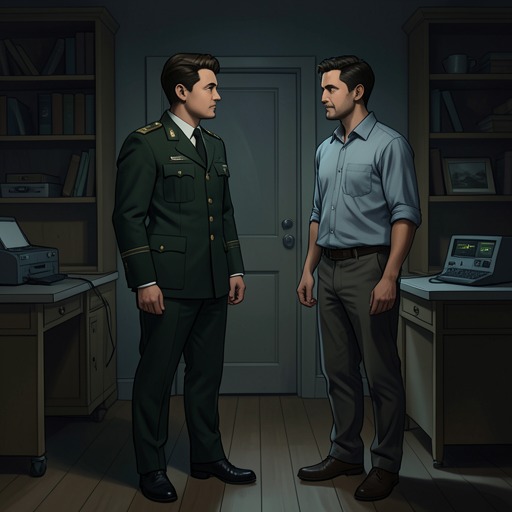
Simon Illyan’s cognitive breakdown
MemorySimon Illyan’s cognitive breakdown turns a seemingly dependable memory system into a source of uncertainty, first for the people around him and then for Illyan himself. The change surfaces in repeated clerical mistakes, a striking loss of coherence during official briefings, and a damaged neural augmentation with no established precedent for comparison. Its consequences extend beyond diagnosis: Illyan must begin rebuilding everyday memory through rest, testing, maps, and note-taking devices after thirty-five years without needing them.
Early Signs and Administrative Errors
Duv Galeni identifies four unusual incidents in the three days before he reports his concerns. The first is easy to dismiss. Illyan asks for a digest Galeni is preparing; after Galeni sends it upstairs, Illyan requests it again two hours later. The office log confirms delivery, and Illyan discovers the code card on his own desk and apologizes. Neither the repeated request nor the misplaced card initially seems decisive on its own, which is precisely why the episode can pass as an ordinary lapse.
The next incidents make that explanation less comfortable. A memo from Illyan’s office carries the wrong date, and Galeni has it corrected without difficulty. Then another incorrectly dated memo is addressed to Galeni’s predecessor, who has been gone for five months. It requests the latest report on a joint Komarran-Barrayaran trade fleet that had completed a long circuit beyond Tau Ceti and returned to home orbit six months earlier. When Galeni calls to clarify the request, Illyan denies having made it. Galeni sends the memo back; Illyan falls silent and ends the communication. The mistakes now involve not only dates but people, assignments, and information that has become obsolete.
At that afternoon’s weekly briefing, the pattern enters Illyan’s speech and judgment. Galeni’s department—five Komarran affairs analysts, with Guy Allegre—expects Illyan’s familiar manner: long pauses followed by incisive remarks. Instead, the pauses grow, and what Illyan says jumps bewilderingly between subjects. He dismisses the group before they have completed half the meeting. When Miles Vorkosigan asks what the briefing was about, Galeni stops before answering, marking the subject as more consequential than a routine work error.
A Breakdown in Public
The disturbance becomes unmistakable at the all-departments briefing. Department heads give their weekly précis reports and identify red-flag items for other departments to watch. Illyan appears nervous and more restless than usual, fidgeting with objects on the table until he snaps a data card in half and apologizes. When he stands to give his usual list of instructions, the sentences remain grammatically correct but no longer connect into a coherent account. Galeni describes the effect as if Illyan were not simply mistaken about the day but displaced by twenty days. Illyan does not seem to recognize the incoherence until he notices the silent, astonished faces around him; then he runs down.
General Haroche stands and urges Illyan to present himself for immediate medical evaluation. Illyan insists that he is not sick and orders Haroche to sit down, but his eyes shift between rage and bewilderment, and he is shaking. Galeni regards Haroche’s intervention as exceptionally brave. The public nature of the collapse also changes the situation: what had appeared as a handful of correctable office mistakes can no longer be contained as a private concern or a minor administrative nuisance.
A separate conversation with Miles shows how the breakdown disrupts Illyan’s sense of time. Illyan summons him to discuss what he describes as a tactical plan developed by Cetagandan analysts: free Colonel Tremont from the prison camp on Dagoola IV, give the fading Marilacan resistance a new leader, and keep Barrayar’s connection anonymous. The mission description closely reproduces the assignment Illyan had given Miles years earlier. Miles tells him that the Dagoola operation was completed five years ago, that the Marilacans drove out the last Cetagandans the previous year, and that Illyan fired him more than a month ago. Illyan demands to know whether Miles has lost his mind, then abruptly stops, apologizes, and cuts the communication. The reversal makes the temporal confusion concrete: a finished operation returns to Illyan not as recollection but as a current plan.
The Chip and the Limits of Diagnosis
Doctors rule out stroke, and the medical inquiry continues without a settled explanation. There is evidence of deterioration or damage to Illyan’s chip, but the clinicians are still investigating other neurological and psychological possibilities. The duration of Illyan’s augmentation makes the case unusually difficult. He has had this form of neural enhancement in place longer than any other human being, and there is no comparable history against which to measure the effects of thirty-five years of accumulated artificial memory. He is, in effect, the baseline; no one knows what that length of use may do to personality.
The medical team’s map of the chip’s internal architecture conveys both the scale of the device and the limits of existing knowledge about it. The chip is a layered structure of organic and inorganic molecular materials, about five by seven centimeters and half a centimeter thick, positioned vertically between the two lobes of Illyan’s brain. Its many neural connections make a jump-pilot’s control headset seem like a child’s toy. The information-retrieval network appears more complex than the protein-based storage, and both are ornate and largely unmapped. The system learned and assembled itself in a highly nonlinear fashion after installation, so its long-term operation cannot be reduced to a simple, well-understood mechanism.
Dr. Ruibal’s assessment distinguishes effects from causes. He finds no evidence of organic neurological damage and judges Illyan’s dangerously high physiological and psychological stress to be consequences of the biocybernetic breakdown rather than its cause. Later, Illyan is physically well apart from understandable fatigue, and his motor reflexes are normal. His short-term memory, however, is severely impaired: scores on tasks involving it fall well below his former norms, which had been extraordinary. Ruibal cannot yet say whether the impairment will persist, whether Illyan’s brain will retrain itself, or whether medical intervention will be necessary. He prescribes a couple of weeks of rest and varied activity, followed by reassessment.
Testing What Remains
Miles does not treat the reassuring appearance of casual conversation as proof that Illyan’s memory has recovered. After tea with Illyan and Alys Vorpatril, he proposes a game of Star-tarot One-up as a private test of neural function. The game demands that players track cards already played, cards held by opponents, and likely cards still to come. Illyan goes along with the test, although he recognizes its purpose. After six rounds, Miles and Alys have split the points between them, and Illyan pleads fatigue. He looks drawn and anxious, but Miles suspects fatigue is not the real reason he stops.
The test exposes a gap between conversational fluency and the capacities the chip once supplied. In ordinary conversation, one comment can prompt another in an apparently flowing sequence. In the game, where success depends on retaining and comparing recent information, Illyan’s short-term memory and eye for detail are nearly absent. The distinction matters: a person may appear socially at ease while struggling with tasks that require deliberate recall and tracking. The card game turns that difference into something observable without mistaking a brief, successful exchange for a full return to Illyan’s former abilities.
Relearning with External Supports
Later, Illyan tells Miles that he has walked around town by himself and returned safely. He grins and shows Miles the holocube Cordelia Vorkosigan gave him: a map covering the North and South Continents and the populated islands, down to a one-meter scale. If he gets lost, he can use it to find his way back. The map does more than locate streets. It gives Illyan a dependable external resource for a task that his internal memory can no longer be assumed to perform reliably.
Illyan is delighted by the device because it functions, to him, like a portable eidetic chip, even supplying information he did not know before. He also carries a high-quality business audionote filer, given to him by Cordelia, that automatically cross-references information by keyword. He calls it nearly a prosthetic memory: crude compared with the neural augmentation, but adequate for ordinary use. Miles points out the practical condition behind the device’s promise: Illyan must remember where he put it. Illyan considers chaining it to his belt or wearing it around his neck.
The map, the filer, the card game, and the medical log Ruibal proposes all represent ways of distributing memory across tools, routines, and other people rather than relying on a single internal system. The breakdown does not establish what Illyan’s final level of recovery will be, and the evidence does not resolve whether the chip damage is permanent. What it does show is a changed daily relation to remembering: navigation and record-keeping, once unnecessary after decades of augmentation, become newly visible tasks with tangible aids. The return to ordinary tools is at once practical and unsettling, because it measures how much of Illyan’s former independence had been quietly entrusted to the chip.