Taura’s engineered short lifespan
MemoryTaura’s engineered short lifespan is the hidden cost of a body designed for combat: the same biological project that gave Sergeant Taura extraordinary strength and speed also made her life brief and its ending potentially swift. By the time Miles Vorkosigan watches her sleep, she is the last surviving prototype, only twenty-two, and medical treatment has extended her life without removing the prospect of its eventual end.
Design and bodily cost
Sergeant Taura was the living prototype of a genetic design project conceived and carried out on Jackson’s Whole. Its aim was to produce a supersoldier, but the research committee was made entirely of biological engineers and included no experienced soldiers. The project’s designers wanted a spectacular result to impress their client; the conspicuous physical traits that resulted were part of that achievement, not incidental decoration.
When Miles Vorkosigan first encountered her, at sixteen, Sergeant Taura had already reached her full adult height of eight feet. She was lean and muscular, with heavy claws at the ends of her fingers and toes and fangs that locked over her lips. Her body radiated heat from a burning metabolism that gave her unnatural strength and speed. Her tawny golden eyes and other features lent her a wolfish appearance, while her concentrated stare could make armed men drop their weapons and throw themselves flat. Miles had witnessed that psychological effect himself. These details show the design operating at once as a physical weapon and as a source of intimidation; the bodily difference that made her formidable also marked the extent to which her body had been constructed for a purpose chosen by others.
A short life built into the design
The prototypes were genetically programmed for short lives. The narration offers possible reasons rather than a settled explanation: this may have served as a fail-safe, or the designers may have believed that soldiers expecting little time would be more willing to sacrifice themselves in battle. Miles judges that the researchers did not understand either courage or life. In the outcome as he sees it, the engineered lifespan made the prototypes die fast, without the long decline of old age. Their deterioration, when it came, lasted weeks or months at most, as fierce as the lives that preceded it.
Sergeant Taura is the last survivor of her fellow prototypes, so their fate is not an abstract warning but the precedent against which Miles measures her future. He notices tiny silver glints in her mahogany hair that had not been there the previous year. At twenty-two, she is already the subject of his urgent, private reckoning with time. He wonders whether she has one year or two left, and whether she will still be there when he next returns to the Dendarii Free Mercenary Fleet. Those questions express his fear, not a stated medical prognosis: the passage supplies no exact prediction of when her life will end.
Treatment and the limits of reprieve
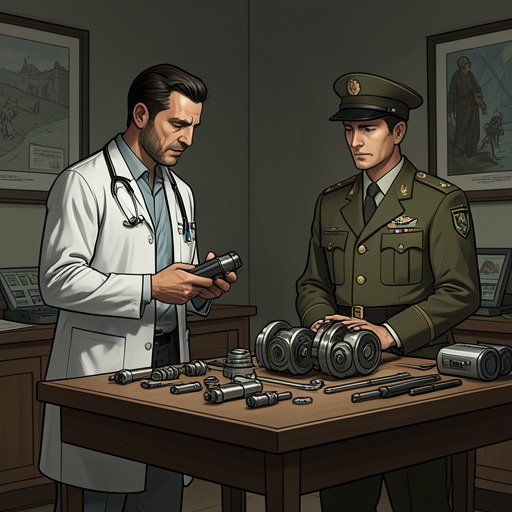
The Dendarii Free Mercenary Fleet surgeon has studied Sergeant Taura and given her drugs to slow her ferocious metabolism. The treatment has also reduced how much she eats: she now consumes as much as two men rather than four. This concrete change makes the intervention legible in daily life, while connecting it to the biological engine that had driven her extraordinary strength and speed.
The treatment extends her life year by year, but it does not reverse the design or promise a cure. Miles imagines the process as pulling hot gold wire through a screen: an effort that lengthens what can be lengthened, yet must eventually reach its breaking point. The image holds improvement and limit together. Medical care buys time; it cannot make the underlying uncertainty disappear, and the passage gives no indication that the drugs can prevent the terminal decline experienced by the other prototypes.
Intimacy under the pressure of time
Miles Vorkosigan’s attention to Sergeant Taura’s breathing makes the abstract fact of a shortened lifespan intimate. He notices that her breaths are a little too deep and too fast and wishes he could slow them, as though the number of breaths remaining might itself be counted. When he watches her sleep, her failure to wake at his slightest movement registers to him as an unusual sign of trust, given her normally hyperalert, genetically programmed drives. In this scene, her body is not only the product of a military design: it is also the vulnerable presence of someone he loves.
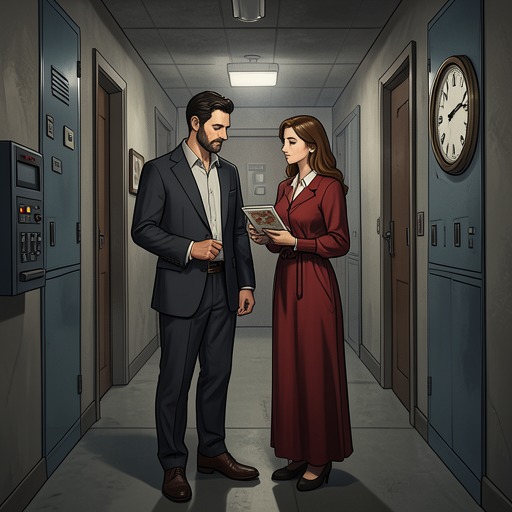
Their relationship reaches back six or seven years, to before Miles Vorkosigan and Elli Quinn became a couple. He remembers Sergeant Taura as a special first for him, as he was for her, and understands their bond as something that has endured. Their intimacy had crossed the Dendarii regulations against fraternization between ranks, rules intended to protect rankers from exploitation and officers from losing discipline. Miles had once tried to model obedience to those rules as the young Admiral Naismith, but that resolve eventually gave way. The passage does not treat their relationship as separate from the danger surrounding her: the possibility that her remaining time is short gives their private attachment its particular urgency.
Miles also thinks, guiltily, of Elli Quinn, his other acknowledged lover, whose match with him is evident to him. The contrast does not erase his attachment to Sergeant Taura; instead, it places that older, private bond alongside the acknowledged relationship. His thought that she loves Admiral Naismith, while Lord Vorkosigan could not handle the situation, links her affection to the divided identities through which he lives. The threatened loss is therefore both personal and specific to a relationship formed within his Dendarii life.
Significance
Sergeant Taura’s shortened life expectancy exposes the cost hidden inside the project’s spectacular success. Strength, speed, a formidable appearance, and usefulness as a soldier were achieved through an engineered body whose life was deliberately limited. The prototypes’ rapid deaths make that cost plain, while the drugs administered by the fleet surgeon show that care can resist the design’s timetable without undoing it.
The passage keeps the issue grounded in particular signs: silver in Sergeant Taura’s hair, a reduced appetite, quick breathing, and the question of whether she will still be waiting when Miles Vorkosigan returns. Her lifespan is not merely a technical feature of her origin; it changes how he experiences her present and imagines their future. At the same time, the evidence here does not record her death or establish a final deadline. It leaves her life extended but finite, and Miles facing the knowledge that love cannot tell him how much time remains.