Miles Vorkosigan’s seizure disorder
MemoryMiles Vorkosigan’s seizure disorder makes his own body an unpredictable limit on his work: stress can abruptly interrupt an investigation, and even a promising treatment requires him to accept medical intervention he does not fully understand. The condition is presented both as a physical crisis—with visual disturbance, loss of consciousness, and a lingering aftermath—and as a practical threat to his ability to serve. An experimental device eventually reduces the duration and visible force of his seizures, but its benefits come with continuing monitoring and self-management.
Diagnosis and proposed treatment
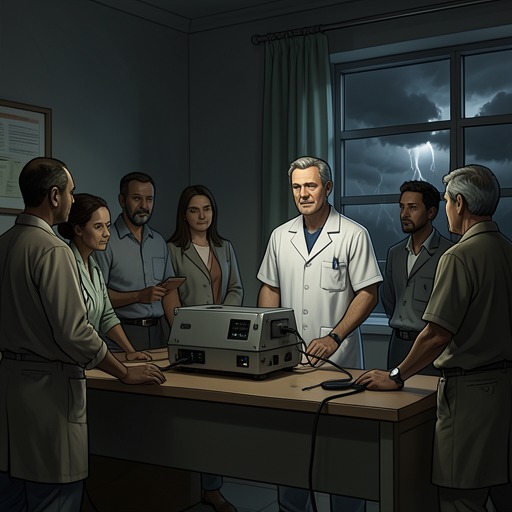
At the Imperial Military Hospital veterans clinic, Dr. Chenko tells Miles Vorkosigan that his team has developed a device small enough to insert beneath his skull. Its intended function is to trigger seizures in a controlled way; if the test succeeds, the doctors can make final calibrations and schedule the operation to install it. The prospect is serious but not presented as a guaranteed cure: the device is still experimental, and the treatment plan depends on whether it works safely and as intended.
The timing is especially difficult. Miles expects Lucas Haroche’s systems team to report soon, and he suspects that the investigation could then accelerate. He is also worried about a clever man trained by ImpSec who has made him a target. Against that background, he wonders whether the proposed device uses protein circuits and what happened to a missing capsule. The unanswered questions turn a medical procedure into a security concern: he is being asked to let people he barely knows place an unfamiliar mechanism in his brain. He postpones Dr. Chenko’s request to come in the next day, and reports that he has had no further episode since the seizure induced in the laboratory.
The treatment is also entangled with institutional scrutiny. Lucas Haroche has obtained Miles’s neurological reports from the Imperial Military Hospital and says he found the treatment plan promising. Miles recognizes this as another reach into his private life by ImpSec, after the tapping of his comconsole, and objects to the access even while the information may help Haroche make a proposal concerning his future. The medical record is therefore not merely clinical background: it becomes part of a conversation about Miles’s capacity and prospects at the same time that he is trying to investigate misconduct.
A seizure at a critical moment
After leaving a formal gathering at the Imperial Residence, Miles is riding in the Count’s groundcar between the residence and ImpSec when a seizure begins. Through the canopy, dilapidated buildings and the brightly lit towers behind them suddenly sharpen into an unreal, overpowering scene, as if they might be outlined in green fire. The perception breaks apart into colored confetti, then darkness. The abrupt sequence gives the episode a recognizable warning and a sudden endpoint, but no opportunity for Miles to control what follows.
He regains consciousness on the backseat, with Martin Kosti leaning over him in panic. Miles’s tunic has been ripped open; the canopy is raised to the night mist, and he is shivering. Martin fears that he is dying. The scene makes the consequences immediately physical and social: Miles is exposed and vulnerable, while the person accompanying him must respond without knowing whether the episode is fatal. The seizure also interrupts his attempt to return to ImpSec and continue the investigation.
Miles has promised Duv Galeni that he will go on to ImpSec, but he has not reviewed the new evidence, the men he wants to question have likely gone home, and he is still dizzy and exhausted. He judges that the medical staff were right about the practical danger: because stress can trigger the seizures, they are likely to arrive at precisely the moment when they are most inconvenient. His conclusion that he is unfit for duty turns the episode from a temporary interruption into a direct challenge to the work and obligations around which he has organized his life. He abandons the journey and tells Martin to take him home.
Implantation and the smoke test
Miles eventually agrees to the operation. The installation is less lengthy and frightening than he had expected, in part because Dr. Chenko allows him to remain awake and watch the procedure on a monitor positioned above his head-clamp. The detail matters: Miles is not simply reassured from outside but is permitted to observe what is being done to him. Dr. Chenko, having become accustomed to Miles’s slightly paranoid outlook, accommodates that need for visibility. Miles is allowed to go home the following morning.
Two afternoons later, Miles returns to Dr. Chenko’s neurology laboratory for a smoke test. The results are encouraging but specific rather than absolute. On that run, his convulsive symptoms last barely half as long as his uncontrolled seizures, and his body movements are suppressed. Dr. Chenko also expects the hangoverlike effects Miles reports to diminish, but asks him to observe those effects over the next day-cycle and provide his own account. The device changes the severity of an episode; it does not make the condition disappear, and its effects still require assessment in Miles’s everyday experience.
Daily management and limits
The implanted unit makes treatment an ongoing task. Dr. Chenko tells Miles to make checking its monitor-readout panel part of his daily routine, like brushing his teeth. In the evening before bed, and whenever the neurotransmitter level rises above one-half but before it exceeds three-quarters, Miles is to discharge it. The prescribed thresholds turn management into a repeated act of attention: the device can help contain the seizures, but Miles must monitor its readings and operate it within a defined window.
The exchange about returning to flight captures the improvement without overstating it. Miles asks whether he can fly, and Dr. Chenko says he can do so the next day. This is a concrete restoration of an activity, not evidence that the disorder has ended. The treatment’s outcome is therefore both enabling and conditional: Miles regains a particular capacity while remaining responsible for a medical routine and for watching how his symptoms change.
Significance
The disorder is consequential because it collides with work whose demands Miles cannot reliably schedule around. An episode can overtake him in transit, after pressure has accumulated and just as he intends to resume an investigation; its aftermath costs him time, concentration, and the ability to continue that night. The condition makes duty a question of bodily capacity, not simply determination. His insistence on getting to ImpSec does not prevent the seizure, and his promise to Galeni cannot make him safe to proceed afterward.
The treatment also places control in tension with dependence. Miles is wary of unfamiliar technology and of the people proposing to put it in his brain, yet he accepts surgery and watches it happen because the seizure disorder threatens his independence in a different way. The device offers measurable relief while requiring continuing cooperation with clinical instructions. Rather than resolving the conflict between service and vulnerability, it changes its terms: Miles can return to flight, but only with a new mechanism, a monitoring habit, and an ongoing awareness that stress may still matter.