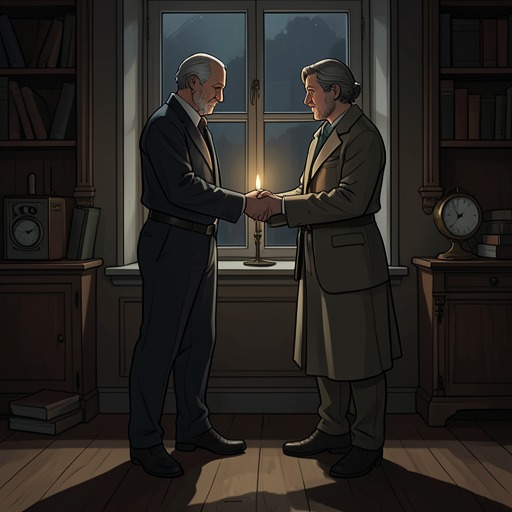
Miles Vorkosigan’s separation from ImpSec
MemoryMiles Vorkosigan’s separation from ImpSec is both a forced departure and a moral reckoning: after concealing post-cryo-revival seizures, he falsifies the report on an injury caused during a rescue mission, and Simon Illyan offers him a medical discharge only if he resigns. The distinction between a resignation and a firing becomes central to how Miles understands the break. His service record remains substantial, but it cannot undo the breach of trust that precipitates it.
The concealed medical condition
The danger began after Miles’s cryo-revival. He experienced several seizures soon after returning from stasis; his surgeon thought they might resolve, as his memory loss and shortness of breath had. When the episodes seemed to stop, Miles did not tell the ImpSec physicians responsible for assessing his fitness for duty. Later, he explained to Ivan Vorpatril and Duv Galeni that the convulsions lasted two to five minutes and seemed to be triggered by extreme stress. His account makes clear both why he hoped the problem would pass and why that hope did not excuse keeping it from the people responsible for his service.
Miles had also acknowledged the episodes to Elli Quinn, telling her that they had occurred several times after his revival and then appeared to abate. Her immediate question was whether ImpSec knew. It did not. The omission therefore extended beyond a private fear or a forgotten medical detail: Miles had continued on covert operations while withholding information that could affect his ability to act safely in the field.
The mission and the falsified report
The immediate cause of the separation was a rescue mission beyond Zoave Twilight. Miles, operating under his long-established cover as Admiral Naismith, personally supervised the effort to recover Lieutenant Vorberg, an ImpSec courier captured by hijackers. During the operation, Miles suffered a seizure while wearing combat armor. The suit’s plasma arc locked on and nearly cut Vorberg in half; Vorberg survived, but lost both legs.
Miles did not report the episode as the cause. He falsified the mission report, describing the accident as an equipment malfunction. In his later confession to Ivan and Galeni, he distinguished the seizure itself from what followed: the incident had been dangerously stupid, but falsifying the record made it worse. His confession also corrects the public shape of his departure. Although Illyan had said that Miles resigned by request, Miles told his friends he had not resigned in any ordinary sense; he had been fired.
Illyan’s decision and the resignation
The evidence reached Illyan through medical records from Miles’s cryo-revival and reports from the Dendarii fleet surgeon. Illyan told Miles that concealing the seizures from ImpSec physicians had betrayed both subordinates who depended on him and superiors who trusted him. He did not dismiss Miles’s previous service: nine years, more than thirty missions, and a record Miles invoked as proof that his service should count. Illyan answered that it counted for much, then offered a medical discharge without prejudice if Miles resigned. He presented the offer as the best way to protect Miles and his name, after considering the matter for weeks.
The separation became tangible in the details Illyan had prepared. Miles could sign his records at once with a palm-print and retinal scan. His uniforms had not come from military stores, and keeping his insignia was traditional; he was, however, required to hand in his silver eyes. At that demand, Miles began to lose control. He collapsed in a seizure before the process was complete, waking on Illyan’s carpet with a light-pen in his mouth and blood on his torn collar. His silver eyes were still in place. After Illyan gave him time to recover and wash his face, Miles returned and completed the formal resignation with his palm-print, retinal scan, and brief statement. He asked to leave while still shaking, saying only that it would pass.
Official discharge and private account
The formal record softened the rupture. For ImpSec headquarters and elsewhere, the account was that Miles had been medically discharged without prejudice. Illyan kept the underlying reason confidential; when General Haroche asked, Illyan remained tight-lipped. Miles likewise warned Galeni that what he had disclosed was private. The official explanation was not simply false, but it left out the decisive facts: the concealed seizures, Vorberg’s injuries, the falsified report, and the breach of trust that made continued service untenable.
In private, Miles resisted the protective framing of a requested resignation. He had hoped Illyan might make the matter disappear, and he initially argued from the weight of his past service. But he ultimately accepted that the record could not be defended away. His confession to Ivan proceeds without the practiced excuses and denials that come to mind; telling the truth marks a contrast with the falsification that ended his career in ImpSec. Mark knew about the seizures, but the evidence here does not suggest that Miles had disclosed them to the agency’s doctors or corrected the report before Illyan confronted him.
A break in service, not in responsibility
Miles’s departure carries particular force because his ImpSec career and his Admiral Naismith identity had grown together. He had spent a decade perfecting the cover of an independent mercenary commander, a role that let him act where the regular forces could not readily reach. The rescue mission brought that covert identity into direct contact with the concealed medical risk; the consequences then exposed the limits of the self-image built around personal competence and command.
The episode does not erase Miles’s record, and Illyan explicitly recognizes its value. Nor does the medical-discharge label capture the whole event. Miles leaves after taking responsibility for a lie, but under the pressure of an ultimatum that makes resignation the condition of a protected exit. His later willingness to discuss Illyan’s possible cognitive problems with someone who had known him over a long period also shows that separation from the agency does not erase his concern for the people within it. The break is from ImpSec and its chain of trust; it is not a simple repudiation of service, loyalty, or responsibility.