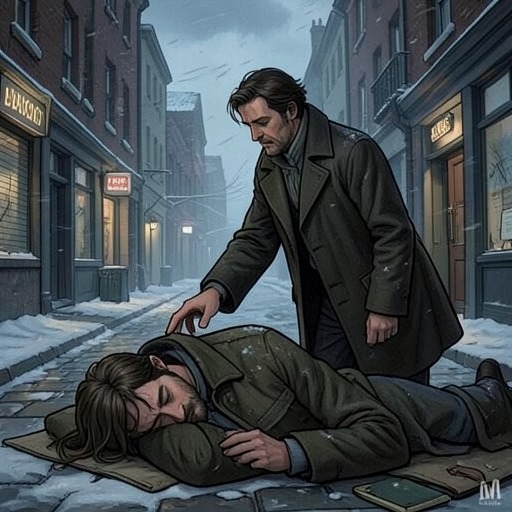
Miles Vorkosigan’s discharged status
MemoryMiles Vorkosigan’s discharged status is both an institutional rupture and a difficult change of identity: he is no longer an ImpSec officer, yet the circumstances of his departure cannot be reduced to his medical condition. His seizures helped make continued service dangerous, but he insists that falsifying a report—not the seizures—was the reason he was dismissed. The difference matters: his new civilian life begins amid illness, concealed information, and the consequences of a breach of trust.
Identity and the concealed illness
Miles’s health problems followed his cryo-revival the previous year. Soon after he was brought back from stasis, he experienced three, four, or perhaps five seizures. His surgeon thought they might resolve on their own, as his memory loss and shortness of breath had appeared to do, and the episodes seemed to stop. When Miles later described the condition to Ivan Vorpatril, he specified that the convulsions lasted two to five minutes and seemed to be triggered by extreme stress. He had not told his ImpSec doctors when he returned home.
The concealment shaped his service before his discharge. During a conversation with Elli Quinn, Miles admitted that the seizures had occurred more than once; Quinn’s question made plain that she recognized the significance of his earlier account. His fear was not simply of illness, but of what it meant to have gone on a covert field mission without telling ImpSec about a potentially recurring condition. He had continued to serve while withholding information that could affect both his safety and the people relying on him.
That secret stood in sharp contrast to the professional identity he had built. Miles had spent a decade refining his cover as Admiral Naismith, leader of the Dendarii Free Mercenary Fleet, and had risen to become one of Barrayaran Imperial Security’s most creative galactic-affairs agents. His work had depended on crossing political and geographic boundaries that regular forces could not easily cross. The seizures threatened that career, but they did not erase the skill or effort that had produced it; the more immediate rupture came when his own conduct made his position untenable.
The discharge and its real cause
At the gate, Miles gave Kosti the simplified account that he had mustered out of the Service on medical discharge. Kosti, a corporal who had not been briefed, responded with sincere sympathy and did not press him for an explanation. The exchange shows how a medical account could serve as a socially acceptable explanation for his departure, especially to someone looking at Miles and seeing no reason to doubt it. It does not, however, give the full reason for his removal.
Miles later made that distinction explicit to Ivan. He had not been bounced out of ImpSec for having seizures; he had been bounced out for falsifying a report, and not a minor one. Even a hypothetical cure the next day, he reasoned, would not change what he had done. In his view, Simon Illyan would not take him back—not because Miles remained medically unfit, but because Illyan was a man of principle. The dismissal therefore carried a moral and institutional consequence separate from the medical uncertainty: recovery alone could not restore the trust his actions had damaged.
The scale of the loss becomes clearest when Miles explains it to Harra Csurik and Lem Csurik. He describes having ended up in a cryo-chamber far out in the galaxy, acquiring medical problems after being revived, then doing something stupid and something worse by lying about it. He presents the sequence as one that ended in being caught and discharged. Thirteen years of career effort, he says, had gone down the waste-disposer in one flush; at thirty, civilian was not an identity he had expected to inhabit. His account ties the end of service not to a single misfortune, but to an accumulating chain of vulnerability, decision, concealment, and consequence.
Civilian life and the loss of a role
The new status does not immediately supply Miles with a replacement purpose. When Gregor asks what he plans to do, Miles says he needs serious time off and time to think, distinguishing that need from ordinary medical leave and travel time. Gregor asks him not to make independent contact with the Dendarii Mercenaries, warning that an attempt to take command of them could expose him to a treason charge. Miles acknowledges the danger and says the Fleet does not need a commander who might convulse. He asks what will become of the Fleet, revealing that even as he recognizes the boundary, his attention remains attached to the command he has lost. The exchange establishes a limit rather than a new destination: he cannot simply resume his old life by reaching for its former instruments.
On a visit to the District with Martin Kosti, Miles encounters another kind of social identity. When Martin jokes about Dendarii hill people, Miles does not laugh; he points out that the mountain population’s history is bound up with resistance to the Cetagandans and with the devastation that left the District behind other regions of Barrayar. The scene does not resolve Miles’s own civilian future, but it shows him carrying his inherited knowledge and loyalties into a life no longer defined by his military office. His status has changed; his connection to the District and its history has not.
Accountability, relationships, and an unsettled future
Gregor’s regret that Miles acted as he did is met with Miles’s own regret. Neither can undo what has happened. Their exchange gives the dismissal a personal dimension: the loss is not merely a change in employment, but a decision whose consequences reach into relationships built around service and trust. Gregor’s concern about Miles contacting the Dendarii also marks a boundary imposed for Miles’s protection and for the state’s security, not a route back into command.
Ivan, meanwhile, responds to Miles’s admission by asking whether anyone else knew; Miles says Mark did. Later, when Ivan offers to arrange appointments at civilian clinics experienced with cryo-revival cases, Miles declines. He has already considered such possibilities, and he does not present the refusal as proof that treatment is impossible. Instead, his reasoning returns to the barrier that medicine cannot remove: even if his health could be restored, the report and the dismissal would remain. His civilian status is thus neither a simple consequence of disability nor a temporary pause awaiting a cure. It is an unsettled condition in which medical care, accountability, and a future outside the Service remain distinct problems.
Miles’s response to Ivan’s concern about Illyan further complicates the transition. Ivan raises the possibility that Illyan is developing subtle cognitive problems and seeks Miles’s judgment because he knows Illyan over a long span. Miles says he is glad Ivan spoke to him, while recognizing the sensitivity of discussing the matter outside ImpSec. Though no longer an officer, he remains a person whose experience and knowledge matter to those still inside the institution. The discharge ends his formal service, but it does not instantly erase the relationships, judgment, or obligations formed there.