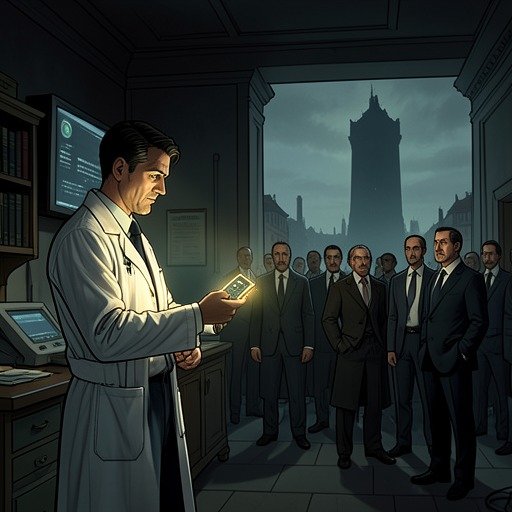
Discovery of the prokaryote sample in the evidence room
MemoryThe discovery of the prokaryote sample in the evidence room gave Miles Vorkosigan a physical lead in the investigation into Simon Illyan’s damaged chip—and exposed how a planted visit could have been used to frame him. The sealed container’s contents did not match its inventory, so Miles set separate teams to preserve the evidence and identify the material before anyone could control or remove it.
The intended frame and the evidence room
Miles recognized that his unauthorized visit to the ImpSec Evidence Rooms was meant to be discovered, but not as the first clue. In the frame he reconstructed, data arriving later would have directed investigators to the evidence room and Bin Twenty-Seven; only after finding the sample would they check the security records and discover that a recently cashiered officer with no business there had entered. That sequence would have made the evidence against him more convincing. Instead, the investigators had begun with the comconsole records, reversing the intended order.
The distinction mattered because the physical contents of the box could now be examined against the records rather than simply serving as a prop in a story about Miles’s access. After ordering the senior officer on call from ImpSec Forensics, Miles called Dr. Vaughn Weddell at home. When the call was blocked, he had Imperial Guards sent to wake Weddell and bring him to ImpSec HQ, bodily if necessary.
Opening the container
Forensics first examined the outside of the small sealed biocontainer. The officer found fingerprints and smudges, though none appeared fresh; he recorded them for comparison. The container’s removal-detection circuit had never been activated, and the examination yielded no hairs or fibers. Those findings documented the limits of what the exterior could establish, but did not settle what had happened to the contents.
Ivan then took the box from its shelf and placed it on a lighted examination board. Its simple numeric lock was intended mainly to keep the lid shut if the box was dropped, and the access code was printed in the inventory description. Ivan entered the listed sequence, and the lid opened without evidence that the lock had been forced.
Inside, a shockproof gel-pack was scored with six parallel slots. Three held small brown capsules; three were empty. The inventory described six sealed vector-delivery units originally, with one removed for examination five years earlier and recorded as destroyed. That accounting meant five should have remained, but only three were present. The discrepancy turned the box into evidence not merely of the sample’s existence, but of an unexplained loss from the recorded inventory.
Securing the samples
Miles ordered the box sent to Forensics for a full examination and directed Ivan to accompany it, insisting that the evidence remain under observation. He assigned Weddell one capsule for molecular analysis, specifically to determine whether it was the same material flushed from Illyan’s chip and to learn what else could be established. Weddell and the sample were to remain in the building; no one else was to handle it, and Weddell was to report only to Miles.
The last two capsules were to be returned to the new box on the shelf and locked under Miles’s Imperial Auditor’s seal. His caution was practical: the old box had been accessible despite its inventory code and had not triggered its removal alarm. The investigation therefore required both laboratory identification and tighter control of the remaining physical evidence.
Significance and unresolved questions
The discovery established a concrete discrepancy, not yet a complete explanation. The record accounted for one capsule as destroyed, while two more were absent from the five supposedly remaining; the scene supplied no answer about when or by whom they had been removed. Nor had Weddell’s molecular analysis yet confirmed the relationship between the capsules and the material from Illyan’s chip. The event shifted the inquiry from the suspicious pattern of Miles’s access records to a sealed object whose contents and history could be independently tested, while leaving the missing units and the sample’s precise identity open.