Miles accepts an experimental seizure-control regimen
MemoryMiles Vorkosigan accepts an experimental approach to controlling the seizures that followed his cryonic revival, choosing a proposed implant-based regimen after doctors explain why medication is unlikely to solve the problem. The decision does not mark a cure or a completed operation: it is consent to try a novel system that would let him trigger an attack under controlled conditions, with its success still uncertain. Its significance lies in the change from enduring unpredictable episodes to attempting to manage them on his own terms.
Discovery of the Seizure Mechanism
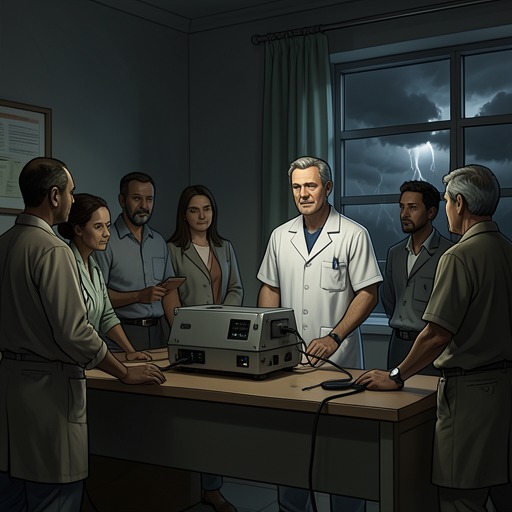
On the sixth day of the medical investigation, a cryonicist and a neurologist working with the Imperial Military team succeeded in provoking one of Miles’s seizures in a laboratory. He regained consciousness on an examination table, his head held in a scanner and his body wired to monitoring equipment. The three technicians nearby kept watch over the setup, while Colonel Dr. Chenko and Captain Dr. D’Guise concentrated on the readouts. Their excitement at the data contrasted with Miles’s immediate discomfort: when he groaned, the monitors still commanded more of their attention than the patient did.
Once the examination was over, Chenko explained the results using data disks, display models, and graphs. The physicians attributed the condition to unusually high neurotransmitter levels after Miles’s cryonic revival. Those chemicals accumulated in neural reservoirs; under heavy brain activity, which could follow stress or excitement, the reservoirs released their contents all at once. The resulting spike temporarily shut down normal neural function and accounted for the hallucinations Miles reported. Afterward, the reservoirs emptied to normal or below-normal levels, producing a brief period of unconsciousness. Equilibrium then began to return, and Miles woke fatigued as the cycle started again. Chenko characterized the mechanism as biochemical rather than phase-electrical and described it as unusual.
Why Medication Was Not the Answer
The physicians considered suppressing neurotransmitter production with drugs, but rejected that as a sufficient solution. Miles appeared to be overproducing dozens, perhaps hundreds, or even all of the relevant chemicals. Suppressing them all was not feasible; even if it were, Chenko believed it would reduce seizure frequency rather than eliminate the attacks. Further examination also suggested that the central malfunction was less a matter of excessive production than of how the reservoirs released their contents.
That distinction shaped the alternative. Rather than trying to suppress a broad range of chemicals, the proposed system would detect when the reservoirs became dangerously overloaded and provide a controlled means of releasing them. The approach addressed the release mechanism the doctors suspected, while accepting that the seizures themselves might remain part of Miles’s condition. Chenko could not say whether a better solution would eventually become available, or whether the attacks would last for the rest of Miles’s life.
The Proposed Regimen
Chenko described a microminiaturized version of the neural stimulators the team had used to trigger a seizure in the laboratory. The proposed array would be installed permanently beneath Miles’s skull, together with feedback sensors that monitored the neurotransmitter reservoirs. If the readings showed that they were becoming dangerously overloaded, Miles could use the stimulator to bring on a seizure voluntarily, in a controlled time and place. The doctors expected that attacks triggered on a schedule might also be milder and shorter.
The possibility offered practical hope without a promise of normality. Miles asked whether he would be able to drive and fly if the levels were monitored and maintained. Chenko considered those activities possible if the system worked and the levels stayed properly controlled, but did not guarantee the outcome. Both the device and its consequences remained experimental: the medical team had a proposed method, not proof that it would reliably control the condition.
Miles’s Decision
After asking whether he might face the attacks for the rest of his life and hearing Chenko admit that he did not know, Miles sat in silence before agreeing to try the plan. His brief smile recalled a habitual phrase of Gregor’s, which Miles recognized as a private joke. The moment ties a consequential medical choice to a small personal association, without making the uncertainty disappear: Miles consents despite the absence of a long-term prognosis.
The agreement initiates a next step rather than resolving his illness. Chenko made notes and asked Miles to return in about a week, leaving the implant and its effectiveness in the future. Miles’s acceptance is therefore measured: he chooses an attempt at controlled management over an impractical drug strategy, while the doctors’ conditional assurances and unanswered prognosis remain intact.