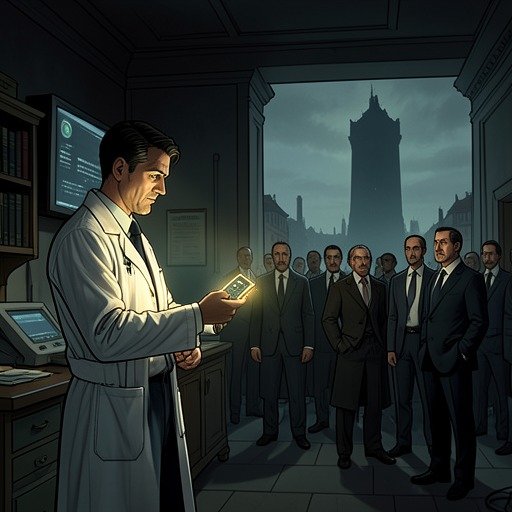
Forged record of Miles entering the ImpSec evidence room
MemoryThe forged record of Miles entering the ImpSec evidence room is the first concrete sign that the agency’s internal security system has been manipulated to implicate him. Its force lies in the mismatches surrounding it: the evidence-room log places Miles there on a day he remembers walking home, the upstairs entry record has been shifted to support the false timeline, and the room’s video cartridge is missing. The discrepancies reveal a possible frame but do not yet identify who created it, when the changes were made, or what crime the record was meant to support.
Discovery in the access log
Miles encounters the record while asking a sergeant to show him the evidence-room procedures. The sergeant’s access panel initially rejects him as not cleared under a standing order from General Haroche. Miles recognizes the restriction as obsolete, dating from several weeks earlier, and tells the sergeant to seek authorization. Once the sergeant contacts Haroche’s office, the correction arrives with an apology. The brief access problem establishes that these systems can carry outdated instructions; the much more consequential discovery comes when Miles examines the history displayed on the console.
The readout lists visits, times, and codes for items carried in and out over nearly a decade. Among the entries are a safely lobotomized zvegan smart bomb and Cetagandan genetic samples that Miles suspects are under further investigation by Vaughn Weddell. Then he sees his own name attached to a visit twelve weeks earlier. The date is his return from his last mission with the Dendarii Free Mercenary Fleet, a day when Simon Illyan was out of town. The recorded time falls just after Miles had reported to and left Illyan’s office, around the time the record implies he would have been going home. Miles knows that he walked home that day, not traveled by groundcar, and recognizes the entry as a loose end that may be either an opportunity or a trap.
A false timeline across multiple records
Miles does not treat the evidence-room entry as an isolated clerical error. He tells Ivan Vorpatril that the ImpSec internal security system is lying: the evidence-room log claims he visited on the day he returned from his mission, while the entry-desk log upstairs has also been altered to show him leaving the building half an hour later than he really did. The two changes work together. The altered departure time creates a window in which the supposed evidence-room visit could have occurred, while the evidence-room record supplies the visit itself.
A separate record at Vorkosigan House still shows the actual time of Miles’s arrival. That timestamp leaves just enough time for a groundcar journey home, but Miles remembers walking instead. The surviving home record therefore does not independently prove the precise route he took; its importance is that it preserves a time inconsistent with the altered account of his departure from ImpSec. The evidence-room video cartridge for that day is missing, removing a potential way to check what happened inside the room. Together, the changed logs and absent recording make the record look deliberately supported yet difficult to verify.
From discrepancy to suspected frame
Miles’s response is to widen the inquiry. He asks the sergeant whether he was on duty on the date in question, and the answer confirms that Miles is listed as having entered the room. He then summons Captain Ivan Vorpatril through a secured channel. With Ivan present, Miles describes the altered upstairs log and missing cartridge, making clear that the problem is not simply that one terminal contains a false entry: the security system’s records have been made to corroborate one another.
After sending the evidence-room personnel to wait in the outer office and instructing them not to go or speak to anyone, Miles tells General Haroche that ImpSec has a mole in its internal security systems. The allegation changes the status of the entry. It is no longer merely a suspicious claim about Miles’s movements; it is a sign that someone may be able to alter or exploit the agency’s own controls. Miles considers shutting ImpSec down while outside experts inspect it, but recognizes that taking the entire system offline for a week or more would invite serious danger. An internal review would avoid that disruption, yet could be compromised by the very insider they are trying to find. Haroche agrees that an internal investigation is deeply unwelcome, while acknowledging the difficulty of choosing between those risks.
The unresolved shape of the frame
Miles calls the evidence-room entry a frame without a picture in it: it appears designed to implicate him, but it does not yet point to a specific offense. Ordinarily, an investigator begins with a crime and works toward suspects. Here, Miles must start with the apparent target and reason backward toward the crime the false record might serve. That reversal makes the record both evidence and an investigative puzzle. Its falsity is suggested by the conflicting timeline and missing cartridge, but the entry alone cannot explain the intended accusation.
The timing could determine who the supposed target was meant to be. Miles asks systems analysts to establish when the records were changed. If the alterations predate his appointment as an Imperial Auditor by more than a few weeks, the person responsible could not have anticipated that office, which Miles himself had not expected to receive. In that case, the intended target may have been the cashiered junior officer who had left ImpSec under a cloud, rather than the newly appointed Auditor. If the changes were made later, that possibility would have to be reconsidered. At this point, the record exposes a possible plot while withholding its authorship, motive, and intended charge; its discovery gives Miles a lead, not a resolution.