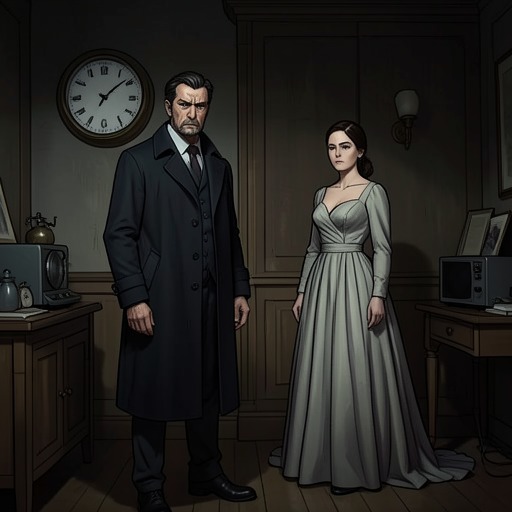
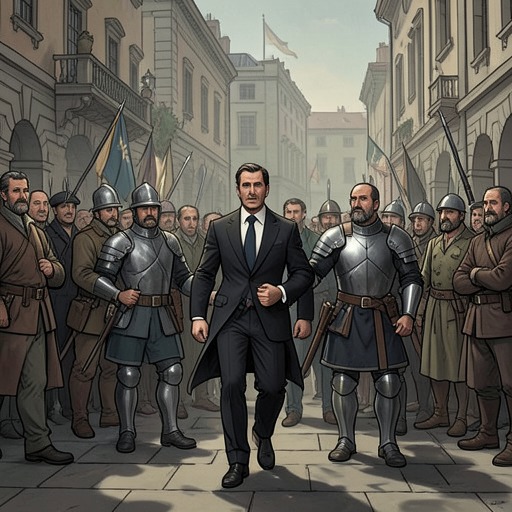
Haroche frames Miles and Galeni
MemoryLucas Haroche’s attempt to frame Miles Vorkosigan and Duv Galeni turns an investigation into a contest over evidence, access, and timing. Haroche planted a false record of Miles’s visit to the ImpSec Evidence Rooms, then used a separate trail through ImpSec’s systems to make Galeni look responsible for altering a record. The frame depended not only on fabricated traces but on investigators finding them in the intended order. Miles’s rapid investigation disrupted that design; forensic checks and Haroche’s eventual explanation exposed how the two accusations had been constructed and why Galeni became the substitute target.
The design of the frame
Haroche intended the false record of Miles’s visit to be discovered, but not first. His plan depended on data arriving that would draw investigators’ attention to the ImpSec Evidence Rooms. They would, he expected, begin with Bin Twenty-Seven and check the security records of people entering and leaving. Only then would they find the record placing Miles inside: a recently cashiered officer with no proper reason to be there. In that sequence, the discovery would appear to confirm a suspicion already built from the evidence-room investigation.
The sequence actually began with the comconsole records, followed by an inventory check. Miles recognized that this reversal had changed the force of the evidence: a record that might have seemed like a corroborating discovery instead became an obvious lead to the supposed visit. He reasoned that Haroche’s intended data would have directed attention toward the evidence room, where investigators could congratulate themselves on finding Miles after tracing the inventory. Haroche had not needed every clue to be invisible. His scheme relied on placing clues where investigators would find them, but in an order that made the false conclusion persuasive.
Haroche later acknowledged the false visit entry had been inserted into the ImpSec Evidence Rooms’ log with considerable skill. His team initially struggled to find how it had been done. A recheck of Miles’s retinal scan exposed the discrepancy: cryo-revival had subtly changed Miles’s retina, but the scan in the log was copied from one made the previous year. The mismatch cleared Miles. The alteration had imitated his identity using an outdated record, and the very bodily change that had gone unnoticed by Miles supplied the forensic difference that defeated this part of the frame.
The trail implicating Galeni
A second strand of the case concerned the Evidence Room comconsole record. Haroche’s team concluded that it had been altered by a mole program physically inserted through the console’s read-slot, which was the only route available to that isolated machine. Miles cautioned against treating the technical conclusion as proof that Galeni himself had inserted it: Galeni, or someone else, might have been responsible. The distinction mattered because the apparent mechanism and the identity of the person behind it were separate questions.
The building’s admittance log supplied another route for accusation. Investigators found it had not been altered on site but remotely, through data links to other ImpSec headquarters systems. To uncover the change, Haroche’s team traced the system down to its undercode and followed the alteration through the section-head level. Section heads could override the system’s lockouts; the trace led through Guy Allegre’s console and down to the Analysts’ level, then to Captain Galeni’s console. Haroche said Galeni could use his analyst’s codes to reach a superior’s console and from there leapfrog into the larger system.
That path made Galeni’s access look incriminating, but the later account of Haroche’s choices changes how the reader understands the trail. Haroche did not describe Galeni as the original target. He said Miles had been his preferred person to frame, and that Galeni attracted his attention only after Miles became too difficult to implicate. The system trace was therefore not simply an independent discovery of Galeni’s guilt; within Haroche’s admitted plan, it was part of the means by which suspicion was redirected toward a more expendable person.
Why the target changed
Haroche’s explanation places the frame within his resentment of Miles’s persistence. He recalled Miles arriving at his office with the Auditor’s chain, a visible change in status that made him understand Miles was more than Illyan’s favored subordinate. Haroche had considered Miles a suitable target, in part because he believed Miles had nearly escaped accountability over the courier affair. He also described the choice as having a kind of justice to it. These were Haroche’s stated rationalizations, not evidence that Miles had committed the acts Haroche wanted attached to him.
Miles’s investigation then made the original plan harder to carry out. Haroche said that if Miles had been held off for another week, he might not have needed to frame anyone. Instead, Miles found the capsules in the evidence room in three days, though Haroche had expected the search to take three months. Haroche said he tried to keep Miles occupied and away from the building, but Miles remained close to him and continued investigating. By Haroche’s account, this pressure prompted him to accelerate the plan against Galeni and deliver the accusation against him.
Haroche described Galeni as a better suspect profile by that stage and more disposable than Miles. He also regarded him as a possible embarrassment to the woman who would become Empress. His reasoning exposes the political calculation underneath the technical evidence: Galeni’s apparent usefulness as a target depended not just on what the records could be made to suggest, but on Haroche’s belief that fewer people would defend him. Haroche’s claim that Miles forced his hand shifts responsibility away from himself, even as his account makes clear that he chose to build the accusation and select its target.
Exposure and significance
The false visit record did not survive the retina comparison, and the investigation’s sequence revealed that the planted material had been arranged to steer suspicion rather than resolve it. Miles understood that the plan had counted on a later arrival of data and a different investigative order. He also reasoned that the staged evidence would eventually be found because too many records existed in too many places for it simply to disappear. The intended effect was to keep the hunt active and give investigators a conspicuous suspect; the actual effect of Miles’s accelerated inquiry was to bring the evidence and the frame into view sooner than Haroche expected.
Haroche’s confession completes the explanation by joining technical method to motive and timing. The retinal scan reveals how Miles was falsely placed in the Evidence Rooms; the system trace explains how Galeni was made to look connected to another alteration; Haroche’s account explains why the target shifted from Miles to Galeni. The frame thus rests on a designed appearance of corroboration, but its parts do not establish the same thing: one record falsely places Miles at the scene, while another chain of access implicates Galeni. Their eventual exposure shows how a forged record can gain persuasive force from investigative procedure—and how changing that procedure can turn the intended trap back on its maker.