Miles exposes Haroche with an air-filter ruse
MemoryMiles Vorkosigan’s air-filter ruse transforms an elusive biological attack into a public demonstration of evidence tampering. By staging a test at ImpSec headquarters, establishing where contaminated filters fluoresce, and anticipating General Haroche’s attempt to remove one, Miles catches him in the act and orders his arrest. The operation is both a forensic test and a carefully timed performance: the hidden threat becomes visible, and Haroche’s effort to hide it becomes the proof that exposes him.
Preparation and Stakes
A scant hour before the day shift was due to leave, Miles assembled a small team at the side entrance of ImpSec headquarters. He used the large rear compartment of the Count’s old groundcar to transport the group and briefed them on the way from the Imperial Science Institute. Ivan Vorpatril was again pressed into service; Simon Illyan came in undress greens bearing the full insignia Miles had insisted he wear. Vaughn Weddell carried a shipping carton whose label described frozen Petri-mice, while Delia Koudelka joined the party as it moved inside.
The staging was intended to accomplish more than a laboratory demonstration. Miles wanted to prevent Haroche from exploiting a brief opportunity to arrange a convenient death for Duv Galeni, whom Haroche had implicated. He therefore moved with a group of witnesses and kept the sequence of actions under his control. The risk of delay shaped the operation: Miles thought of the work as a proof that had to be demonstrated in the right order, not merely an inspired suspicion.
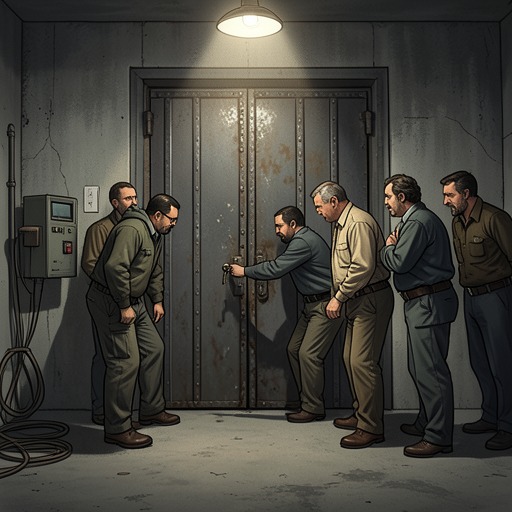
Before entering the Evidence Rooms, Miles confirmed that the duty corporal had been instructed to report to Haroche when Miles came and went. He then led the party to Janitorial and enlisted its department head, an aging colonel, after reassuring him that the inquiry into air-filter maintenance was not a criticism of his department. A forensic technician joined them next. At Aisle 5 in Weapons Room IV, the witnesses gathered around the sealed evidence. The procedure’s orderly appearance depended on this chain of people: each would see the test, and the technician would document and preserve what it revealed.
Making the Invisible Visible
The sample was in a familiar bio-sealed box on Shelf 9, out of Miles’s reach. Ivan handed it down. Its Auditor’s seal remained unbroken, and two brittle brown capsules were inside. Miles broke one and released its fine powder into the room. Weddell advised waiting at least ten minutes for it to spread. The substance represented the weapon that had killed Illyan, now present in the room as an invisible threat; Illyan watched the air while the others waited.
Weddell then prepared a clear solution in an atomizer. He had custom-designed it on three hours’ notice, and explained that the solution detected the regular, distinctive outer structure of the vector capsules. Miles’s test was not to identify the prokaryotes directly, which Weddell described as a much harder problem, but to locate the encapsulated vectors after they had passed through the building’s air system. The distinction gave the search a practical method: find where the capsules had been caught, then use that location to narrow the inquiry.
The colonel removed the cover of a low return-air vent and exposed its top filter. Weddell directed an ultraviolet hand-light over it. A pale red fluorescence gradually brightened across the surface, confirming that the vector encapsulations had been trapped there. Miles treated this first positive result as a baseline. The forensic technician was instructed to document, bag, label, and seal the filter before the group moved on.
Turning the Search into a Trap
The team proceeded to Komarran Affairs and then to Duv Galeni’s small office, where General Guy Allegre joined them. Miles tested the air filter there; it was clear. That negative result mattered as much as the first positive one. It showed that the evidence was not simply being found everywhere the team looked, and it gave Miles a basis for rejecting Haroche’s suggestion that Galeni’s office might contain the source.
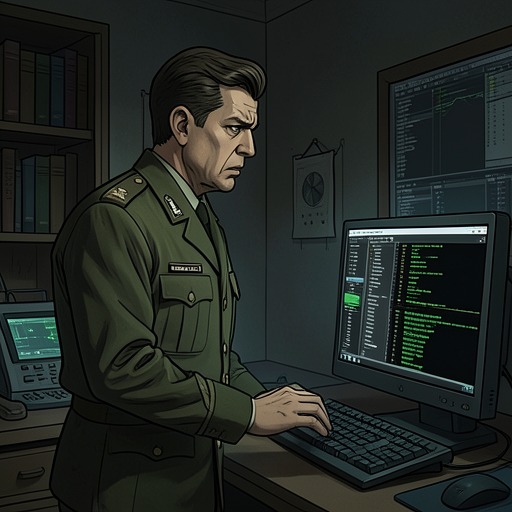
At Haroche’s former office, the general watched the search begin. Miles explained that a contaminated filter would show red under the hand-light and announced that, if necessary, the team would check every filtered vent from the top of the headquarters building down to the basement. He had initially thought the location would identify the responsible person; now he acted as though each successive location might still provide the answer. In practice, this declared search also gave Haroche a reason to leave and an apparent opportunity to interfere with the evidence.
Miles noticed Haroche leave and silently timed the interval. After a count of one hundred, he stopped Weddell from spraying and led the witnesses into the corridor. A commodore who had taken over Domestic Affairs from Haroche reported that the general had sent him to fetch Miles from the Evidence Rooms. Asked whether Haroche had been carrying anything, the commodore recalled a flimsy-folder. Miles then led the party back to Haroche’s old inner office. He overrode the locked door’s codes with his Auditor’s seal.
Haroche was crouched beside the desk, levering a vent grille from the wall. An additional fiber filter lay in the open folder on the floor. The scene disclosed the point of the staged, seemingly exhaustive search: Haroche had left with a folder and was now handling another filter, apparently trying to switch or remove evidence before the team reached it. Miles had anticipated that Haroche might tamper with a filter and used the general’s response to the search to catch him at the act. The source does not show the predicted second grille being found; the decisive discovery is Haroche himself, the opened folder, and the filter beside him.
Exposure and Arrest
Miles had the colonel dislodge the grille while Weddell applied the solution. The team waited; under the ultraviolet light, the red fluorescence appeared again, bright enough to make the previously invisible evidence unmistakable. The repeated test connected the filter Haroche was handling to the same vector encapsulations identified in the earlier baseline demonstration. With ImpSec personnel crowded into the office, the evidence was no longer an isolated laboratory result but a witnessed discovery at the scene of Haroche’s attempted intervention.
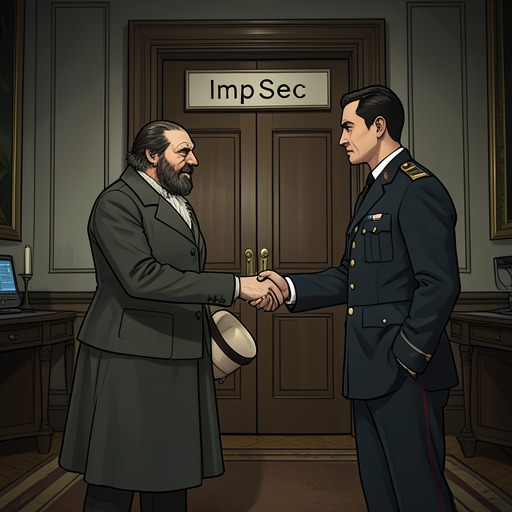
Miles directed Guy Allegre to serve as acting chief of ImpSec, pending Gregor’s approval, and made Haroche’s arrest Allegre’s first duty. He initially named treason as the capital charge. Haroche denied treason, and Miles offered a possible lesser outcome if Haroche confessed and cooperated: a court-martial for assault on a superior officer, a year in prison, and dishonorable discharge. Miles left the final determination to the Service court rather than treating the arrest as a final verdict.
Significance of the Operation
The ruse’s force comes from its sequence. Miles does not rely on a confession or on the mere presence of a suspect: he first demonstrates how the vectors can be detected, establishes a clear comparison in Galeni’s office, gives Haroche a chance to reveal his response, and returns with witnesses at the moment the concealed filter is being handled. The air system, ordinarily part of the headquarters’ background infrastructure, becomes both the route by which the biological evidence can be traced and the mechanism that makes its concealment visible.
The operation also stages a contrast between proof and judgment. Fluorescence supplies material evidence; the timing and witnesses connect that evidence to Haroche’s actions; the Auditor’s authority makes an arrest possible. Yet Miles distinguishes the serious charge from the punishment ultimately to be decided, offering cooperation and a lesser charge as possibilities rather than declaring the case closed. The trap exposes Haroche, while the unresolved question of confession and sentence remains with the Service court.