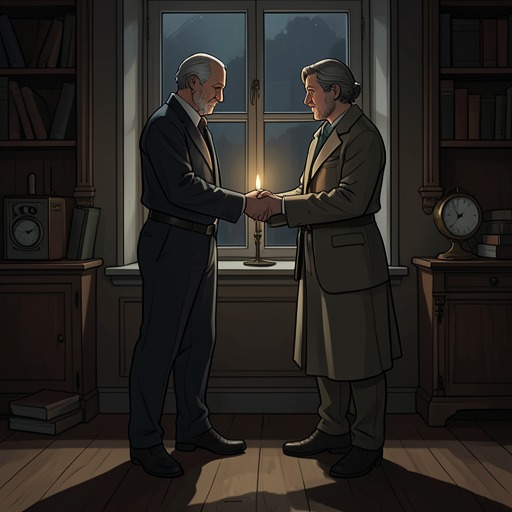
Miles and Elli Quinn's final choice
MemoryMiles Vorkosigan and Elli Quinn’s final choice turns their love into a question neither can solve by compromise: whether either can build a shared life by becoming someone else. As Miles prepares to take up a new role on Barrayar, he offers Elli command of the Dendarii Free Mercenary Fleet and asks her to stay with him. She instead offers him a life among the spacers, as Admiral Naismith. Each understands what the other wants, but neither can accept it without giving up a self that cannot be separated from the life attached to it.
The offer and its stakes
The conversation takes place over dinner, before the next day’s business can overwhelm them. Elli asks directly where Miles’s new appointment leaves their relationship and whether it means he will never return to the Dendarii. Her controlled voice carries only a slight tremor, but the question makes the personal consequences of his career change impossible to postpone. Miles says this is why he wanted to speak with her privately: if she stayed on Barrayar as Lady Vorkosigan, she could be with him all the time.
Elli distinguishes that prospect from the one she wants. She would be with Lord Vorkosigan, she replies, not Miles and not Admiral Naismith. Miles answers that Naismith was an invention made from himself, but not the whole of him. This account neither dismisses the admiral’s reality nor treats it as a complete, independent identity. It frames the lovers’ conflict as a disagreement over whether that created self can be chosen on its own.
Miles then discloses the other offer tied to the next day’s business. Guy Allegre, ImpSec, and Miles, speaking for Barrayar, plan to offer Elli the admiralcy of the Dendarii Free Mercenary Fleet. She would work for Guy Allegre in the capacity Miles had held under Simon Illyan. Elli is startled and says she is not ready; Miles insists that she has already been doing the job and is ready for it. Her response reveals that command is something she has wanted, but not as a hurried substitute for the life and partnership she had imagined with him.
Two incompatible futures
The offer does not resolve the conflict because the disagreement is not about rank. Elli says she does not want to spend the rest of her life confined to one planet. Miles points out that the Barrayaran Imperium contains three planets; she answers that this would make the prospect three times worse. Her reply makes clear that even a broader imperial domain cannot answer her objection: she does not want a planetary life at all.
She proposes the reverse arrangement. The Dendarii Fleet existed before Barrayar entered its sphere and, she argues, could continue without imperial contracts, however favorable those contracts have been. She asks Miles to leave with her, resume life as Admiral Naismith, and build a celebrated partnership together. Her proposal is both practical and intimate: she imagines a fleet able to survive outside Barrayar’s orbit, and herself and Miles creating a future within it.
Miles tells her that he tried for weeks to make himself go, but says he was never a mercenary. When Elli challenges the implication that this makes him morally superior, he denies it; the distinction, he says, is that he is Miles Vorkosigan, not Miles Naismith. He does not claim a moral victory over the Dendarii. Instead, he identifies a limit in what he can become, even for someone he loves. Elli recognizes that there has always been a part of him she could not reach, and her recognition carries hurt rather than surprise.
Identity cannot be divided for love
Miles explains that he spent years trying to extinguish Lord Vorkosigan, but could not do it even for Elli. He refuses the idea that she can keep the qualities she loves in him while setting aside the rest. His image of himself as something that cannot be ordered piecemeal gives the argument its decisive shape: loving him means encountering the whole person, including the obligations and attachments that make a life on Barrayar his own.
That wholeness does not mean he can give Elli everything she wants. He asks her to come to Barrayar and admits that she might be desperately unhappy there. When she says that she cannot become his Lady Vorkosigan, he answers that he can give her everything he has, but cannot give her less. Elli names the cost from her side: accepting his offer would mean Admiral Quinn disappearing so that Lady Vorkosigan could rise in her place. She is not willing to treat that transformation as an ordinary adjustment, and says she is not good at resurrection, a word that turns the prospect of marriage into the threatened death of her own chosen identity.
The conflict is therefore mutual rather than a simple contest between a career and a relationship. Miles will not abandon his Barrayaran life to become Naismith full-time; Elli will not abandon her life as a spacer to become Lady Vorkosigan. Neither asks merely for the other’s presence. Each wants a shared future that preserves the self the other cannot wholly accept. Miles’s appeal that Elli choose who she is, followed by his insistence that she decide now, brings that impasse into the open. Elli protests that he is forcing the choice; he agrees that he is.
A farewell without a substitute self
Miles acknowledges that he can continue with Elli or continue without her, but cannot hold their relationship in suspension. He rejects preservation as a substitute for living: remaining unchanged and undecided would not save what they have. Elli understands that part of his position, though understanding does not make the choice painless. Their affection remains visible in their attention to each other even as they face the fact that love cannot make incompatible futures identical.
They share one last intimate farewell, each hoping that the care they show the other might change the decision. Miles realizes that this would require more than changing their minds: they would have to change their whole selves. Afterward, he says the attempt is not working. Elli briefly insists that she will make it work, then sits beside him in silence. The ending does not offer a new bargain or resolve the distance between Barrayar and the Fleet. Instead, it makes the cost legible: they part not because affection has vanished, but because neither can remain whole by becoming the person the other’s preferred future requires.