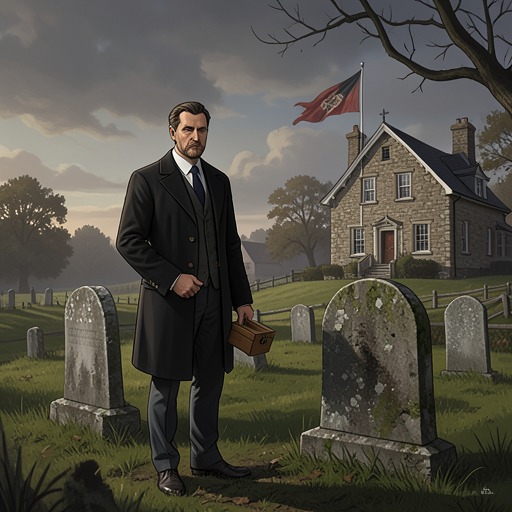
Miles's private wake for Admiral Naismith
MemoryMiles Vorkosigan’s private wake for Admiral Naismith turns an apparent funeral into a recognition of survival. Alone with a glass of wine after returning to Barrayar, Miles revisits the repeated deaths of his mercenary identity and the danger Lucas Haroche seemed to pose to it. Instead of mourning Admiral Naismith as a self he has lost, he understands that he has escaped the belief that either identity must be sacrificed for the other. The quiet ceremony closes the novel with Miles feeling not divided, but whole and newly open to what comes next.
Return and the choice of a wine
After an uneventful return from Komarr, Miles arrives at Vorkosigan House on a quiet late-winter evening. The house is warm and lit, and ordinary domestic life surrounds him: he has supper in the kitchen with his Armsman and Ma Kosti, jokes until the cook laughs, and hears news of Martin Kosti’s basic training. But the wake itself takes place apart from this household company. After supper, Miles goes to the wine cellar and chooses, ceremoniously, his grandfather’s oldest and rarest bottle.
The bottle is going off. Miles considers drinking it anyway for the sake of the symbolism, then decisively pours it down the bathroom sink in his new suite. He returns for a much more recent vintage that he knows is good. The choice gives the scene a concrete turn away from reverence for the past at any cost: the oldest bottle cannot make the occasion meaningful simply by being old, and Miles refuses to drink something spoiled just to honor what it represents. His private ritual will acknowledge the past, but it will not preserve it as an obligation.
The wake and the deaths of Naismith
With a glass of the best crystal and a good bottle, Miles sits in a comfortable chair by the bay window. Fat snowflakes pass through the garden lights, and his reflection in the dark window becomes the recipient of his toast. The setting is intimate and still, a deliberate contrast with the violent and public circumstances attached to Admiral Naismith’s previous endings. Miles counts this as Naismith’s third death: once on Jackson’s Whole, once in Simon Illyan’s office, and now, last and astonishingly painful, resurrected and dispatched again by Haroche.
The earlier deaths are not interchangeable. After the first, Miles had been in no condition to hold a proper wake; he recalls himself as frozen, like lost luggage. During the second, his grandfather’s dagger, used to open a bottle of red wine, had offered more consolation than the brandy. These memories make the current ceremony a belated observance as well as a reckoning with repetition. This time there is a proper glass, a chosen wine, a private hour, and a living man able to decide what the deaths mean.
Miles initially intends to ration himself an hour of self-pity and be done with it. Instead, leaning back in the warm chair, he finds himself laughing softly. The laughter briefly unsettles him: he wonders whether he has finally lost his grip. The answer is the opposite. The wake has not erased the pain of the deaths, but its emotional direction has reversed. He is not mourning a death; he is celebrating an escape.
Haroche’s limits and Miles’s recognition
The escape is inseparable from Miles’s changed understanding of Haroche. Thinking of how close he came to delivering himself into Haroche’s hands gives him a cryonic chill, but he also sees that Haroche was no miracle-worker, not even a stage magician. Haroche never had the power to give or withhold Naismith. The distinction matters: the danger was real, but it did not make Miles’s mercenary self Haroche’s possession, nor did Haroche’s actions determine whether that self could continue to exist.
Miles touches his scarred chest in wonder and says, "I'm not dead. I'm here." The gesture joins the insight to his actual, embodied presence. His wake is not a claim that nothing was lost or that the past can be undone; it marks the difference between the repeated deaths associated with Naismith and the living person who remains after them. The thought that Haroche could dispose of Naismith gives way to the recognition that Miles himself has survived the danger.
Integration and an open future
What follows is not a victory for one identity over another. Miles feels strange and single, no longer in pieces: neither Lord Vorkosigan ascendant nor Naismith lost, but all of himself at once, all the time. He tests the feeling with a brief question about whether this wholeness is crowded, then finds that it is not particularly so. The scene answers the division that has structured the wake without pretending that integration is effortless or familiar; Miles finds it strange, but not unbearable.
Harra Csurik, he reflects, had been almost right. What continues is not simply the same life picked up again, but life anew, and it is not what Miles expected. His smile deepens as curiosity about his future begins to replace the hour of self-pity he had planned. The wake therefore ends not with a final toast to a vanished persona, but with a living Miles looking forward. Its private, domestic scale makes the recognition unmistakably his own: no audience is needed to certify that Naismith’s apparent final death has become an escape, and that the person who remains contains more than either divided role alone.