The Drakkar's interstellar impact and radiation emergency
Mickey7The Drakkar's interstellar impact and radiation emergency turns an uneventful voyage into a sequence of lethal repairs, establishing how the ship's survival depends on Mickey Barnes repeatedly risking his life. A tiny object, almost unimaginably destructive at near-light speed, breaches the vessel's defenses; Mickey replaces a failed field-generator unit and later patches the hull, but radiation kills him during the work. His restoration as a new instantiation does not end the emergency: the hull remains vulnerable, and he is sent back outside.
Causes and Background
For much of the Drakkar's voyage, interstellar travel seems uneventful. The ship has completed its first boost, passed beyond Midgard's heliopause, accelerated again, and settled into a long cruise to Niflheim at just under nine-tenths the speed of light. Mickey Barnes expects that he might reach the destination without entering the regeneration tank. His routine aboard ship is correspondingly ordinary: because he belongs to no single branch, he is meant to train across departments as a flexible substitute, but the planned two hours each day dwindles to roughly two hours a week. The rest of his time is spent eating, sleeping, and playing puzzle games with Berto Gomez. That calm makes the danger of the cruise easy to underestimate.
Jemma explains that the vacuum around the ship is not truly empty. Each cubic meter contains roughly a hundred thousand hydrogen atoms; at the Drakkar's velocity, even these otherwise benign particles become dangerous projectiles. A field generator in the ship's nose deflects them, turning their passage into a stream of cosmic rays just above the hull. Dust grains are more sporadic, but the ship encounters them regularly as it moves through enormous volumes of space. Most are diverted by the field; those that strike the nose produce small explosions that the ablative armor is designed to withstand over a voyage of twenty years or more. That protection, however, is intended for dust—not for a substantially larger object. At cruising speed, even a rock the size of a human head would carry the energy of a hundred fusion bombs.
Impact and Emergency Response
The impact came from an object whose identity could never be established: at nearly nine-tenths the speed of light, it was reduced to quarks and gluons on contact. Engineers estimated its mass at between fifteen and twenty grams, calculating from the armor vaporized and the kinetic energy the Drakkar lost. The jolt flung unsecured crew members into forward bulkheads, causing several broken arms and one serious concussion; Mickey Barnes sprained an ankle when he struck the edge of a table. Those injuries were quickly eclipsed by the damage to the ship: the nose cone was punctured, a field-generation module destroyed, and hard radiation flooded twenty percent of the interior.
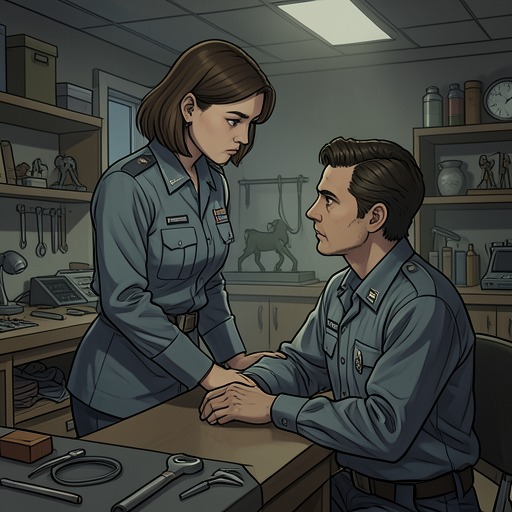
Maggie Ling, head of Systems Engineering during transit, summoned Mickey to the machine shop, the nearest safe compartment to the access hatch. Engineers sealed him into a vacuum suit and gave him a replacement module: a half-meter-square silver cube with two connector cables and maneuvering handles. Maggie suspected that the power coupling had failed, but there was no time to diagnose the unit, so Mickey was instructed to replace the entire module and retrieve the damaged one if possible. The compartment beyond the hatch was open to space, and, while the field remained down, Mickey would absorb a lethal full-body radiation dose every three and a half seconds. Maggie explained that he would not die immediately: the body could continue functioning after receiving many times a fatal dose, leaving enough time for his next instantiation to be prepared in the biological recycler system's regeneration tank.
Inside the lock, Mickey moved carefully despite the urgency. In free fall, heavy equipment has no weight but retains its mass, and accelerating it carelessly risks damaging the machinery. After the outer door was sealed and the chamber evacuated, the hatch opened onto an array of six cube-shaped field-generator units. The damaged module was unmistakable: a black-edged hole, two or three centimeters wide, pierced its top, aligned with a larger hole in the chamber roof. A bluish beam passed through the opening and fell across the wrecked unit. Mickey's skin began to burn as he disconnected and removed the module; while maneuvering the replacement into position, his head crossed the beam, and about ten seconds later he was blind.
Restoration, Second Exposure, and Death
Blind and increasingly incapacitated, Mickey Barnes completed the replacement by relying on Maggie Ling’s instructions over the comm. When she confirmed that the field had been reestablished, she told him to relax and said someone would retrieve him. But the restored field could not undo the radiation already inside his body. His fingers had swollen until he could no longer bend them; unable to remove his helmet or help himself, he floated in pain, waiting to be brought back inside. The first repair had succeeded, but Mickey’s original body was dying.
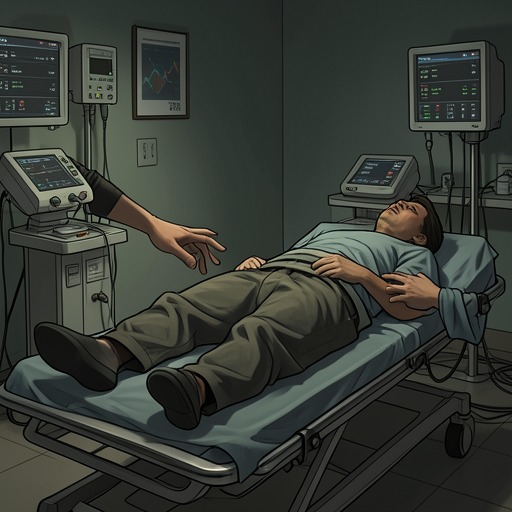
The emergency also explains why the crew required him to upload before death. Experience acquired in a critical situation could not be allowed to disappear with one bodily instance, so the knowledge of the repair had to survive him. When he emerged from the regeneration tank as Mickey2, the ship’s interior was mostly back to normal, but thirty-four people had radiation poisoning, and the hole in the armor remained a threat. A single stray dust grain could recreate the crisis. As soon as Mickey was conscious and functioning, Maggie’s team sent him out again, this time with a tank of high-density emergency patch nanites and only five minutes of instruction.
Maggie directed him to stay close to the hull, where exposure might be lower, and fitted attractors to his palms and knees so he could crawl rather than rely on the force locks used for walking. From the forward air lock, he made his way about a hundred meters to the impact site. Near the nose, the proton stream intensified: he began seeing flashes of light before reaching the breach, and by the time he arrived his vision blurred and his mouth tasted of iron. He pressed the applicator and released the nanites into the ragged opening. The thick material clung to the edges and knitted itself into armor; after almost twenty minutes, the tank was empty, and the mound of patch material gradually flattened until it was difficult to distinguish from the original surface.
Mickey did not return to the air lock. The account of his second death comes from the suit-camera recording, which he watched after emerging as Mickey3 the following morning. The footage showed him stopping halfway back, opening the seals at his collar, and exposing his face to space. The recording preserves the cost of the repair alongside its success: the impact site was sealed, but both the original Mickey and Mickey2 had died in the radiation emergency, and the ship’s survival had depended on sending the next instantiation into the same lethal environment.
Narrative Significance
The emergency makes the Drakkar’s shielding both the condition of ordinary life and the source of danger once the impact disables it: the field generator normally diverts interstellar particles, but its loss exposes the ship and its crew to radiation. The sequence turns the apparent dullness of the cruise into a sharp reversal, where a nearly invisible object can undo the protections built for a decades-long voyage. It also gives the Expendable role its stark practical meaning. The ship preserves the knowledge gained in a lethal repair by carrying it forward into another instantiation, while the suit-camera record lets Mickey3 confront what that continuity costs. The event’s measure of success is therefore double: the damaged systems are restored, but only through repeated bodily loss.