Lowick
MiddlemarchLowick is a parish and estate whose manor, church, rectory, farms, and village form one of the novel’s most important rural social worlds. First encountered as an apparently ordered landscape around Edward Casaubon’s home, it becomes the setting for Dorothea’s marriage, bereavement, and growing authority, while its parish relationships bring larger changes in politics, land ownership, transport, and reputation into intimate local life.
Manor, Parish, and Landscape
Lowick lies five miles from Tipton. Its principal residence, Lowick Manor, had once belonged to the rectory’s history in a narrower sense: Casaubon initially held the living, but his brother’s death brought him the manor as well. The house stands in a small park with old oaks and an avenue of lime trees on its southwestern side. From the drawing-room windows, the view crosses a sunk fence and greensward toward cornfields and pasture; in the evening light, the cultivated land can seem to melt into a lake. The south and east sides of the house are more melancholy, giving the estate a divided aspect even before it becomes the setting for Dorothea’s troubled marriage.
The manor is not an isolated country house. Close by stands the little church, with the old parsonage opposite, and the village is compact enough for Mr. Brooke to describe it as lying in a nutshell. He sees its cottages, each with a small garden, as resembling a row of almshouses. That picturesque description registers both the apparent neatness of the settlement and the social hierarchy embedded in it: the parish is a community of houses and landholders, but also one in which the people are accustomed to regard their betters with deference.
Lowick’s productive landscape is visible in the farms and tenements belonging to the manor and in the neighboring Stone Court. The road into the parish is notably good, and the land is not characterized by muddy lanes and poor tenants. Stone Court appears from the road as a substantial gentleman farmer’s house whose development into a full stone mansion seems to have been arrested by farm buildings on one side. Nearby, pinnacled corn-ricks balance a row of walnut trees, joining the visual signs of agriculture and gentility in a single view.
Church and Parish Community
Lowick Church is the center of a community whose continuity is measured across generations. In 1831, Will Ladislaw enters the curate’s pew before the congregation arrives, but remains alone there as the church fills. From his seat, he watches familiar rural faces gather inside the whitewashed walls and dark old pews. The congregation changes slowly, like an old tree that loses branches but continues to put out young shoots: the Waules and the Powderells sit in their customary places, while successive generations of cottagers attend as before.
The social order is apparent in the children’s view of Casaubon. Wearing his black gown and occupying the highest box, he seems to them the foremost of their betters and the one most dangerous to offend. Lowick is described as at peace, scarcely more disturbed by the Reform question than by the solemn course of Sunday worship. The setting thus registers political change not as a uniform public upheaval but as something that reaches communities unevenly, alongside deeply established habits of deference and religious life.
The parish church also gives public form to private and institutional relationships. It is where the local living has a visible place within parish life, and the manor carries the patronage of that living. After Casaubon’s death, Dorothea understands that she is the owner of Lowick Manor and that the patronage attached to the estate is now part of her responsibility. The church and the manor therefore connect spiritual office, property, and the practical decisions of the person who controls the estate.
Dorothea’s Life at Lowick
Lowick first enters Dorothea’s experience not only as a destination but as a possible future. One autumn afternoon, after Casaubon has driven back to his rectory, she sets out in her bonnet and shawl to walk through the shrubbery and park and into the bordering wood. Monk, the great St. Bernard who accompanies the young ladies, is her only visible companion. She wants to move freely through the future she has begun to imagine, without interruption. The walk places Lowick’s grounds at the threshold between her existing life and her hopes for what marriage might make possible.
Her later visits reveal the setting from the perspective of the prospective bride. On a gray but dry November morning she arrives with her uncle and Celia, seeing Casaubon’s home, its church, the parsonage, and its grounds as parts of the life she is considering. The estate’s composed landscape gives material shape to the prospects she associates with marriage. Yet Lowick is not simply an attractive country residence: its rooms, grounds, and inherited position will also become the boundaries within which Dorothea must confront the difference between her ideal of marriage and its actual limits.
After Casaubon’s death, the manor becomes the center of Dorothea’s new practical position. She knows the purport of the will made at the time of her marriage, and, once she is fully conscious of her circumstances, silently considers what she ought to do as owner of the manor and holder of the living’s patronage. Her widowhood therefore changes the meaning of the estate. What had been her husband’s home and a setting for disappointed expectations is also property and responsibility over which she must exercise judgment.
Lowick does not leave her socially isolated. Dorothea develops a frequent exchange of visits with the Farebrother family and can say that she is not lonely at the manor. When an hour remains before dinner at the parsonage, she spends time at the schoolhouse speaking with the master and mistress about the new bell, listening closely to the small details they repeat. On her way home, she stops to talk with Master Bunney as he plants garden seeds. Such encounters make daily parish life more than a backdrop: Dorothea’s attention to local people gives her a sense that her life is busy and connected to their ordinary concerns.
Land, Work, and Change
The estate’s practical affairs draw Caleb Garth into Lowick. Because Dorothea and Garth understand one another, she asks him to handle business concerning the manor’s three farms and numerous attached tenements. The work expands Garth’s prospects; his expectation of employment for two is rapidly being fulfilled. Lowick’s land is thus not only scenery or inheritance but a working system of farms, dwellings, and management, with consequences for people whose livelihoods depend on it.
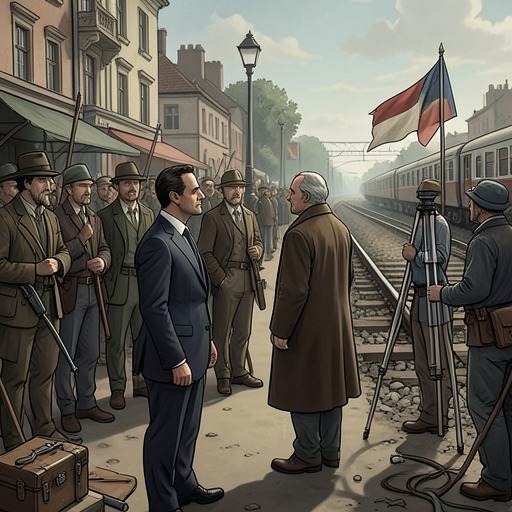
Railway construction begins to alter that system. A projected line is to run through Lowick parish, where cattle have hitherto grazed in undisturbed pasture. The prospect makes the new railway an immediate concern for local landholders, since the route will cut through property and bring questions of access and compensation. Solomon Featherstone and Mrs. Waule, who own land, take time to grasp the implications. Their attention fixes first on the prospect of the Big Pasture being divided into awkward three-cornered pieces; accommodation bridges and substantial payments seem remote and unbelievable. The contrast between the engineers’ plans and the landholders’ first, concrete fear of a pasture cut apart shows how public works become local experience through particular fields and claims.
The change also creates new possibilities and new misunderstandings. Garth’s estate work is connected to the expanding railway business, and the projected line helps determine the history of two people dear to him. Meanwhile, Solomon Featherstone’s family history shows another kind of property question at work: one account of his will says that he has divided his property equally among the relatives he favors, though an interested relative argues that some ought to count for more than others. In Lowick and its neighboring estate world, land and inheritance are not fixed abstractions but matters shaped by decisions, expectations, and competing claims.
Local Affairs and Wider Events
Lowick’s quiet does not insulate it from the political and institutional conflicts of the period. Reform enters the parish through conversations about elections and the work of the press and political meetings. Will sees the public temper heating as the Reform question develops and expects another election; Mr. Brooke, by contrast, speaks of political tactics, compromise, and the difficulty of deciding where electoral qualifications should be drawn. Their disagreement puts Lowick within a changing political landscape without turning its rural community into a simple miniature of national politics.
The parish is also connected to the region’s medical institutions. The New Hospital’s construction depends on large expenditures by Nicholas Bulstrode after most potential supporters prefer to give to the Old Infirmary. Caleb Garth undertakes the building work but later withdraws from its management before the interior fittings begin. The hospital’s difficulties show how decisions made by influential people elsewhere in the district can shape Lowick’s residents and professionals, including those whose work and patronage connect them to the manor.
A later crisis brings Middlemarch’s public suspicion directly to Lowick. After John Raffles dies, Bulstrode says that the man should be buried in Lowick churchyard and claims, so far as he knows, that Rigg is Raffles’s only connection. The burial locates a concealed past in the parish itself. Mr. Hawley rides to Lowick village to inspect the register and consult Farebrother; although he sees no legal basis for action, Farebrother begins to connect Bulstrode’s fear of Raffles with his generosity toward Lydgate. The churchyard and parish records become evidence within a scandal whose consequences reach far beyond the village.
Lowick’s importance lies in the way these different scales remain joined. Its manor is a domestic home, a landed estate, and a source of patronage; its church embodies continuity and hierarchy; its farms and tenements expose the practical effects of economic change. Dorothea’s personal history unfolds among these institutions, while railways, political reform, medical ambition, inheritance, and public rumor enter through the same roads, fields, parish relationships, and local records. The parish is peaceful in the limited sense that its old rhythms endure, but those rhythms are repeatedly altered by the decisions and histories moving through them.