Middlemarch Town Hall
MiddlemarchMiddlemarch Town Hall is a venue for civic deliberation that becomes, during a meeting called over a cholera case, the scene of Nicholas Bulstrode’s public confrontation. A debate about how to secure a burial-ground gives way to a demand that Bulstrode account for damaging claims about his past, bringing the town’s public authority and its private judgments into the same room.
Civic Setting and Public Business
A cholera case had made sanitary measures pressing in Middlemarch. After an Act of Parliament authorized assessments for such measures, a local Board had been appointed, and Whigs and Tories had cooperated in cleansing and preparation. At the meeting in the Town Hall, the immediate question was whether to acquire land outside the town as a burial-ground through public assessment or private subscription; the proposed purchase was also described as large enough eventually to serve as a general cemetery.
Bulstrode, a member of the Board, set out from the Bank shortly before noon intending to advocate private subscription. He had recently kept himself in the background and regarded the meeting as an opportunity to resume his former role in the town’s public affairs. Tertius Lydgate joined him on the way, and they entered together. The room was already well attended: the principal townsmen and medical men were present, with Mr. Thesiger in the chair, Mr. Brooke of Tipton at his right, and Camden Farebrother opposite the place where Bulstrode and Lydgate sat.
The Meeting Turns Against Bulstrode
When the chairman opened the discussion by outlining the advantages of purchasing a cemetery site by subscription, Bulstrode rose to speak. Lydgate noticed a peculiar exchange of glances among those present. Before Bulstrode could give his opinion, John Hawley asked to address what he called a preliminary question of public feeling. The chairman agreed, and Bulstrode sat down.
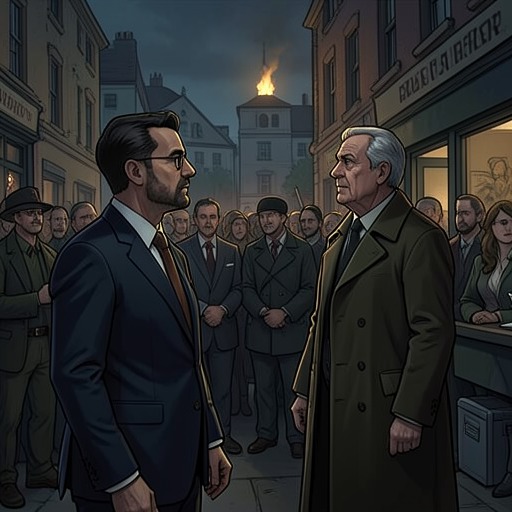
Hawley spoke on behalf of himself and eight fellow townsmen. He called on Bulstrode to resign public positions held, in Hawley’s formulation, as a gentleman among gentlemen. He referred to allegations made by a man who had since died and who had died in Bulstrode’s house: that Bulstrode had long been involved in dishonest practices and had gained his fortune by dishonest means. Hawley demanded either a public denial and refutation of those allegations or Bulstrode’s withdrawal from his civic positions. The meeting’s sanitary business was thus interrupted by a challenge to Bulstrode’s standing in the community.
Bulstrode’s Exposure and the Hall’s Significance
With the room’s attention fixed on him, Bulstrode underwent an intense crisis of feeling. Lydgate, himself shocked by the confrontation, felt his resentment checked by his instinct to relieve a suffering person. He saw Bulstrode’s misery and understood the force of the public exposure: the banker had habitually occupied the position of a moral reprover, but now had to face the town’s judgment about the allegations against him. The claims made at the meeting are presented as allegations requiring an answer, not as a verdict delivered by the assembly.
The Town Hall brings together two forms of local power: organized civic action, represented by the Board and the sanitary question, and communal reputation, voiced through Hawley’s demand before the assembled townsmen. The abrupt shift from public health to Bulstrode’s history makes the location more than a backdrop for municipal business. It is where private conduct becomes a public issue and where Bulstrode’s anticipated return to influence is abruptly challenged.