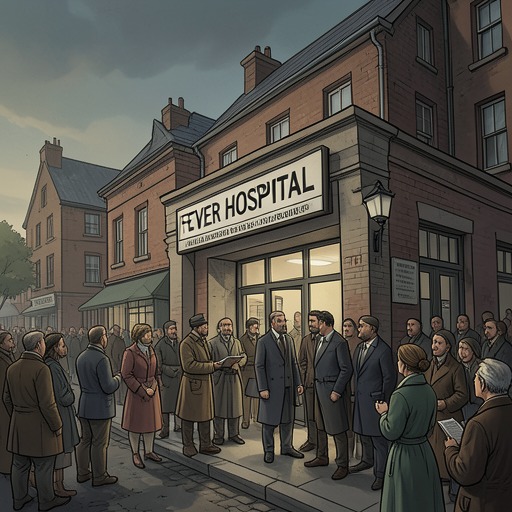
Middlemarch New Fever Hospital
MiddlemarchMiddlemarch New Fever Hospital is both a place of treatment and a contested experiment in provincial medicine: Nicholas Bulstrode’s costly institution gives Tertius Lydgate authority to pursue clinical inquiry, but the local profession’s refusal to cooperate makes reform depend on a narrow alliance. Its fever cases show the practical stakes of Lydgate’s methods, while its governance and reception reveal how scientific purpose can become entangled with money, reputation, and town politics.
Purpose and Local Setting
The Hospital is planned as a specialist institution for fever, intended to complement the existing infirmary rather than simply duplicate it. When Lydgate first discusses its management with Bulstrode, the building is nearly finished. Lydgate argues that a fever hospital could become the nucleus of a medical school in Middlemarch, helping medical education spread through the provinces instead of drawing every promising opportunity toward London. His ambition is not confined to treating individual patients: he hopes that a local institution can support systematic observation and eventually improve medical practice more broadly.
The project also intersects with the town’s developing public-health concerns. When Lydgate walks around the Hospital’s laurel-planted plots with Dorothea Brooke, he explains that the health of the poor is bound up with their miserable housing, an issue she had asked about before her marriage. Dorothea, whose attention to village welfare has lately been displaced by her private life, responds by asking how she can help. The exchange connects the Hospital’s medical work to the conditions beyond its walls: treatment matters, but so do housing and the practical circumstances that shape illness.
Funding, Governance, and Opposition
Bulstrode has borne the building’s expenses after most potential supporters declined to help, preferring to give to the Old Infirmary. Lord Medlicote provided the land and timber, but not personal oversight; Bulstrode supplied the money and has become deeply invested in directing the institution. The project had already suffered delays. Caleb Garth undertook the building work and later withdrew from its management before the interior fittings were begun, though he respected Bulstrode’s concern for sound construction, drains, and chimneys.
Bulstrode’s proposed arrangement concentrates authority. The Hospital is reserved for fevers in all their forms, and Lydgate is to serve as chief medical superintendent, with freedom to conduct comparative investigations informed by his studies in Paris. Other medical visitors may advise, but cannot overrule his final decisions. General management rests with five directors associated with Bulstrode, whose votes are weighted according to their contributions; the Board itself fills vacancies, and small contributors receive no share in its government. The plan promises Lydgate room to work, but makes the institution’s independence depend on Bulstrode’s personal control and on a small circle of substantial contributors.
That structure intensifies local resistance. Bulstrode recognizes that his unpopularity is one source of opposition: people who dislike him may take trouble simply to frustrate his plans. Lydgate adds that Bulstrode’s masterful manner, religious tone, and association with trade give critics other grounds for suspicion, while the appointment of a newcomer to medical direction has made professional antagonism more pointed. The town’s doctors not only refuse to cooperate but, in Lydgate’s account, also try to blacken the project and hinder subscriptions. Dorothea calls this petty; Lydgate sees it as an institutional obstacle that tests whether his commitment to reform can survive the loss of professional comfort.
The opposition becomes explicit when every medical man in Middlemarch refuses to become a visitor at the Fever Hospital. Lydgate answers by resolving to work harder: he has a capable house-surgeon and dispenser, proposes to bring in Webbe from Crabsley twice a week, and expects Protheroe from Brassing to assist with exceptional operations. He has given up his post at the infirmary and insists that the new plan can flourish despite its isolation. Bulstrode promises his support, while noting that Mr. Brooke has agreed to join the Board and contribute annually, though without naming an amount.
Clinical Work and Lydgate’s Methods
The Hospital’s purpose is inseparable from Lydgate’s ambition to make medicine more scientific. Around 1829, he regards pathology as a field still open to discovery. The work of Bichat, who treated living bodies as structures made from fundamental tissues rather than as a mere collection of separately understood organs, has helped illuminate the foundations of medical inquiry. Lydgate wants to extend that rational basis, particularly through close attention to disease and fever. Yet the narrative stresses the gap between scientific possibility and everyday practice: medical work advances slowly, and much contemporary treatment continues along older paths.
This commitment also shapes Lydgate’s conduct outside the Hospital. He decides to prescribe without dispensing drugs or receiving a percentage from druggists, an innovation for a general practitioner in a country town. He regards removing that financial temptation as a practical safeguard for honest practice. The principle is relevant to the Hospital’s larger purpose: reform requires not only new knowledge but institutional arrangements and habits that make it possible to act on what a physician believes.
The treatment of Nancy Nash shows the difficulty of putting such judgment into practice amid professional convention and public misunderstanding. Dr. Minchin has described her condition as a tumor and recommended her as an infirmary outpatient. At the infirmary, Lydgate examines her and concludes that it is cramp, not a tumor. He prescribes a blister and steel mixture, and sends a note to her employer, Mrs. Larcher, saying that Nancy needs good food. When Nancy worsens at home, Lydgate attends her there for a fortnight, until she recovers and returns to work.
The case nevertheless circulates through Middlemarch as a story of a tumor that moved around the body. Dr. Minchin avoids admitting that his diagnosis was mistaken, and he and Mr. Wrench regard Lydgate’s open contradiction of an established physician as a breach of etiquette. Lydgate does not use the episode to congratulate himself or belittle Minchin, but popular report gives him credit for a dramatic cure while missing what he considers the valid point: the original diagnosis was wrong. The episode makes the Hospital’s scientific purpose legible as a struggle not only against illness but against entrenched diagnoses, medical status, and the distortions of reputation.
Another patient offers a more deliberate test of Lydgate’s approach. When the auctioneer Borthrop Trumbull contracts pneumonia, Lydgate judges him robust enough for expectant treatment: close observation while allowing the disease to take its course as far as possible, so its stages can be studied. Lydgate presents Trumbull as unusually capable of serving medical knowledge by becoming an observed case. Trumbull accepts the idea enthusiastically, takes pride in contributing to science, and bears abstinence from drugs with the help of a thermometer, microscopic attention, and technical explanations. The episode gives the Hospital’s reformist ideals a human face, while also showing how a patient’s consent can be shaped by the prestige and language attached to scientific participation.
Public Health and the Wider Town
The Hospital’s role belongs to a broader pattern in which local institutions are drawn into changing public concerns. The novel places Middlemarch’s fever institution amid debates over political reform, religious allegiance, town reputation, and the material relations between municipal life and rural parishes. Those connections are not abstract background: a hospital needs money, patients, staff, and public confidence, and each resource is governed by local relationships. Bulstrode’s project can be understood as a public good and, at the same time, as an enterprise whose management grants him unusual personal power.
A cholera case later brings a separate sanitary question to a public meeting in Middlemarch Town Hall. The town must decide whether land outside the town should be secured as a burial-ground through assessment or private subscription. Bulstrode, a member of the sanitary Board, sets out intending to advocate private subscription and encounters Lydgate on the way; they enter the meeting together. The burial-ground debate is not a decision about the Hospital, but it places Bulstrode and Lydgate within the same wider field of public health, where questions of sanitation, funding, and collective responsibility become matters of open civic dispute.
Railway construction similarly shows how local change can alter the work of those connected with Lowick. Dorothea asks Caleb Garth to handle business associated with the farms and tenements of Lowick Manor, and a projected railway through the parish brings new demands involving land and compensation. The episode does not concern the Hospital’s administration directly, but it illustrates the surrounding world in which professional and public projects take shape: institutions and livelihoods are affected by changing transport, landholding, and local opinion.
Narrative Significance
Middlemarch New Fever Hospital gives physical form to a conflict between an emerging, evidence-seeking medicine and a provincial professional culture wary of both innovation and outsiders. Lydgate sees a hospital, a specialist fever service, and the beginnings of a medical school as parts of one program. The opposition shows how that program can be constrained by institutional loyalties and personal dislike even when the building stands ready and Bulstrode supplies its resources.
The Hospital’s promise is therefore real but conditional. Lydgate’s clinical work demonstrates the value he places on revising diagnoses, observing disease, and refusing financial incentives that might compromise treatment. Yet the Nancy Nash case shows that correct judgment can be obscured by gossip and professional etiquette, while the plan’s centralized governance makes reform vulnerable to the same local power relations it hopes to overcome. As a location, the Hospital gathers the novel’s questions about medical knowledge, public service, and social resistance into a single institution: its significance lies not in an easy triumph, but in the difficult attempt to make useful knowledge serve a town that does not readily trust its advocates.