Leviathan
Moby-DickLeviathan names the whale at the point where natural history, scripture, myth, and human terror become inseparable. For Ishmael, the great whale first appears as a mysterious monster whose island-like bulk rolls through remote seas, carrying nameless perils and the marvels of distant coasts. It becomes the overwhelming image that draws him toward the whaling voyage: behind the ordinary decision to go to sea stands a “grand hooded phantom, like a snow hill in the air,” an apparition that makes the whale both an object of curiosity and a figure for the unknown itself.
Meaning and Biblical Inheritance
Leviathan is not simply a grand synonym for whale. The name places the creature within a scriptural and mythological history of beings too immense for ordinary human measures. Ishmael invokes Job when he approaches the task of describing the whale, recalling the challenge posed by an animal that cannot easily be mastered, classified, or made to enter a covenant with humanity. The whale therefore stands at the limit of human confidence: to attempt its description is to “grope down into the bottom of the sea” among the foundations, ribs, and pelvis of the world. Ishmael presents himself as an architect rather than a builder of cetology, offering an outline because any human system that claims completeness must be faulty.
The name also gathers together older stories of heroic encounters. In the history of whaling’s honor, Perseus becomes the first whaleman, attacking Leviathan to rescue Andromeda rather than to supply lamps. The tale makes the whale a monster of legend and whaling a form of rescue before it becomes an industry. A whale skeleton once displayed at Joppa was identified by local tradition as the remains of Perseus’s victim; the same city is associated with Jonah’s departure. Such connections make Leviathan recur across sacred narrative, classical myth, and maritime labor, so that the whale’s body becomes a material bridge between stories separated by centuries.
Sovereignty, Scale, and the Limits of Knowledge
The Leviathan’s power is repeatedly measured against human institutions and human bodies. Ishmael argues that the terror of a sperm whale’s tail may drive back a veteran who would advance toward a battery, because the whale’s danger combines physical magnitude with the “terrors and wonders of God.” The comparison reverses conventional hierarchies of courage: the celebrated violence of soldiers is not necessarily greater than the peril faced by whalemen confronting an animal whose movements exceed ordinary comprehension.
Scientific classification does not dissolve this mystery. Ishmael notes that even the boundary between whales and fish remained unsettled in practice: Linnaeus had separated whales from fish on anatomical grounds, yet sharks, shad, alewives, and herring continued to occupy the same waters with Leviathan. The history of whale writing is equally incomplete. Many authorities have written about whales, but only a small number had seen living ones, and Captain Scoresby’s authority concerning the Greenland whale does not extend adequately to the sperm whale. The latter remains, in Ishmael’s formulation, an unwritten life. Leviathan is thus both the subject of knowledge and the evidence of knowledge’s incompleteness.
That incompleteness is dramatized by the difference between a skeleton and a living body. The remains of Zeuglodon, discovered in Alabama and first mistaken for those of a huge reptile, revealed an extinct whale, yet the skeleton gave little clue to the form of the fully invested animal. Among ancient skulls, jaws, ribs, tusks, and vertebrae, Ishmael imagines a world before human time in which the whale ruled the globe. He sees Leviathan’s possible antiquity extending beyond human history, with a pedigree older than royal dynasties and an existence that may outlast all humane ages.
Living Creature and Ecological Presence
Although Leviathan carries immense symbolic weight, the narrative also presents whales as active beings with their own social and reproductive life. In the whale herd encountered by the Pequod, immense numbers gather into caravans that seem to form a mutual league for protection. This aggregation helps explain why whalers may travel for weeks or months without seeing a spout and then suddenly encounter what appears to be thousands upon thousands of whales. The herd is not merely scenery for human adventure; it changes the conditions of pursuit and suggests collective behavior shaped by prolonged hunting.
The whales’ peaceful life continues within the very circles where the boats conduct their attacks. While some whales are drugged and pursued at the edges of the host, others at the center engage in courtship and delight. A young whale may remain tethered to its mother by a natural umbilical line, which can become entangled with a human whale-line and trap the calf. The image joins biological intimacy to industrial danger: the same line that enables the hunter’s power can invade and disrupt a relationship belonging to the whales themselves.
Leviathan also belongs to a wider marine food web rather than standing outside ecology as an isolated monster. The Right Whale feeds on brit, the minute yellow substance that spreads around the Pequod like fields of ripe wheat. Sharks gather around a captured Sperm Whale in such numbers that the sea seems filled with maggots consuming a vast cheese. These scenes place the whale within cycles of feeding, predation, scavenging, and extraction. The whale is powerful, but it is not invulnerable or detached from other forms of life.
Human Industry, Empire, and Resistance
Ishmael’s defense of whaling turns Leviathan into the center of a global historical system. He rejects the land-based view that whaling is merely disreputable butchery, comparing the dangers and bloodshed of whale hunting with the battlefield violence celebrated in military commanders. The whale-ship, he argues, has explored uncharted seas, entered unknown archipelagoes, interpreted between European and American sailors and peoples in remote harbors, and opened routes later used by navies, merchants, and missionaries.
This account gives the whale-ship an imperial and commercial significance. Whaling helped break the restrictive policy of the Spanish crown toward Pacific colonies, and Ishmael connects the activity with the later liberation of Peru, Chili, and Bolivia from Spanish rule. He likewise calls the whale-ship the true mother of Australia’s powerful colony, recalling that whale-ships sometimes saved early settlers from starvation by supplying biscuits. Polynesian islands, in this version of maritime history, acknowledge the ship that cleared routes for missionaries and merchants, while Japan stands at the threshold of contact through the same industry.
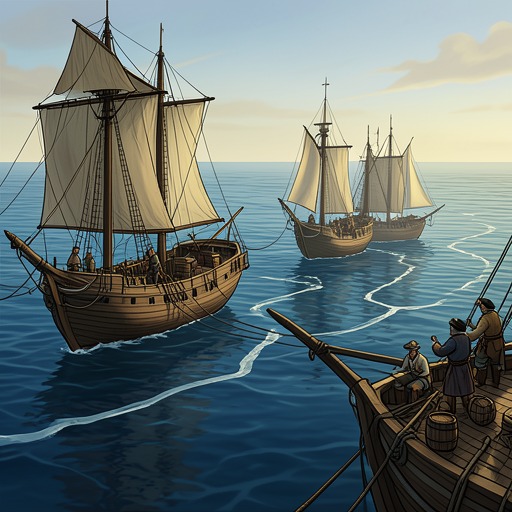
The Pequod’s route embodies this global ambition. Captain Ahab plans to pass through the Sunda Straits into the Javan sea, cruise toward the Philippine Islands and the coast of Japan, cover nearly all known Sperm Whale grounds, and descend into the Pacific Line where he expects to meet Moby Dick. The whale is therefore both the object around which global movement is organized and the force that resists being reduced to a predictable resource. Ahab’s itinerary attempts to map the world through Leviathan’s habitats, but the whale’s distribution, concealment, and sudden appearance continually defeat the fantasy of total command.
Antiquity, Survival, and Narrative Significance
Leviathan’s historical force extends from ancient myth to modern depletion. Ishmael notes that hunted Sperm Whales increasingly appear in immense, widely separated herds rather than in the smaller pods of earlier times. Whale-bone whales, meanwhile, may retreat from familiar grounds toward Polar citadels, where ice fields and barriers offer refuge from human pursuit. Even after Americans kill not less than 13,000 such whales annually on the northwest coast, Ishmael resists a simple conclusion that the species must be disappearing, emphasizing the size of the oceanic pasture and the animals’ ability to move beyond ordinary human observation.
This confidence is not wholly reassuring. The Leviathan’s apparent endurance depends on distance, migration, and inaccessible refuges rather than on human restraint. The whale survives by escaping the routes and grounds that hunters can reach, while the industry continues to pursue it across four oceans. The tension between resilience and destruction gives the concept an ecological seriousness beyond the rhetoric of grandeur: an animal may seem inexhaustible because its life exceeds the limits of observation, yet that very invisibility can conceal the scale of violence directed against it.
As a narrative presence, Leviathan joins the intimate and the cosmic. Ishmael can regard Queequeg as a human being despite his tattooing and call the Pequod’s companion a sober cannibal, while the whale expands until it becomes an ancient monarch, a biblical adversary, a living species, a source of oil and global commerce, and an image of the unknowable. In the herd’s calm center, whales continue their own peaceful concerns while human boats wage war around them; Ishmael finds in that contrast an analogue for the quiet center of his own being amid surrounding affliction. Leviathan consequently remains both creature and emblem, never exhausted by either role: the more fully the narrative describes the whale’s body, behavior, history, and habitat, the more decisively it reveals the limits of the human desire to possess its meaning.