fate, free will, and chance
Moby-DickThe concept of fate, free will, and chance is one of Moby-Dick’s central ways of explaining how human choice operates within forces that exceed individual control. The novel neither treats destiny as an absolute denial of agency nor presents freedom as unlimited self-determination. Instead, necessity establishes conditions, individual will acts within them, and chance gives events their unpredictable final shape. This tension is dramatized in Ishmael’s reflections on Queequeg’s sword-mat and in Captain Ahab’s increasingly desperate attempts to decide whether he is acting from his own nature, from divine power, or from an unseen Fate.
The Interwoven Model of Action
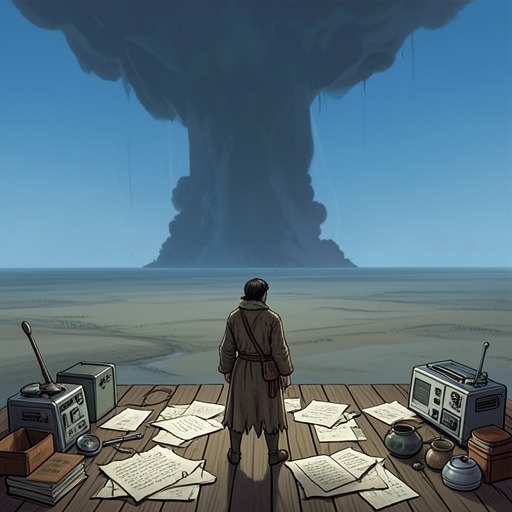
Ishmael develops the clearest image of the relationship among the three forces while weaving a sword-mat with Queequeg aboard the Pequod. The fixed threads of the warp become necessity: they cannot be diverted from their ultimate course. Ishmael’s own hand, moving the shuttle through those threads, represents free will, which remains capable of choosing and acting within prescribed limits. Queequeg’s sword, however, strikes the woof at varying angles and with varying force. Those irregular blows determine the final appearance of the fabric, making the sword an image of chance.
The model is not mechanically balanced. Chance is constrained by necessity and directed by free will, yet it may still rule either one in turn and deliver the last determining stroke. The finished mat therefore cannot be attributed wholly to a fixed design or wholly to deliberate intention. Its pattern emerges from the cooperation and collision of constraint, choice, and contingency. Ishmael’s metaphor gives the novel a formal account of causation: events are shaped by several powers at once, and no single power can claim complete ownership of the result.
The image also connects personal action to the sea voyage itself. Ishmael and Queequeg are not simply observers of an abstract doctrine; they are sailors whose labor occurs within material limits, inherited practices, and unpredictable maritime conditions. Their hands make something, but they do not command every thread or every blow. The loom thus turns ordinary shipboard work into a figure for destiny without reducing human action to helplessness.
Ahab’s Will and the Iron Path
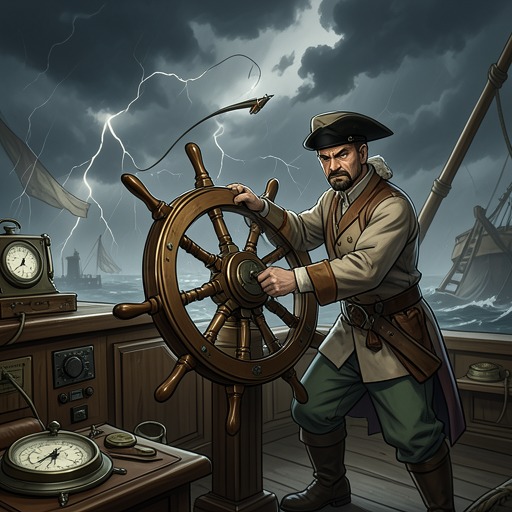
Captain Ahab embodies the most extreme form of the problem. He recognizes that a prophecy foretold his dismemberment and links that prediction to the loss of his leg, but he answers the injury by asserting a counter-prophecy: he will dismember the dismemberer. His purpose is presented as an act of will, yet the language surrounding it is already fatalistic. He imagines the path toward his fixed purpose as iron rails over gorges, through mountains, and beneath torrents, with his soul grooved into an unerring course. The image suggests determination, but it also suggests confinement: Ahab’s freedom has become the ability to follow a track from which he no longer permits himself to turn.
Ahab calls himself not merely mad but madness maddened, declaring that what he has willed he will do. His rebellion against the powers he believes oppose him therefore depends upon an apparent paradox. He treats resistance to Fate as the supreme expression of freedom, while the rigidity of his purpose makes him increasingly indistinguishable from the destiny he resists. The desire to choose his own meaning becomes a compulsion to pursue one predetermined object, the White Whale.
This conflict is also bound to Captain Ahab’s bodily history. The lost leg is not only evidence that the prophecy has been fulfilled; it becomes the physical basis for his renewed determination to reverse the injury. He interprets the wound as an encounter between himself and a power capable of dismembering him, then converts survival into a vow of retaliation. The body records necessity, while the vow claims free will, and the whale’s unpredictable movements preserve the domain of chance.
The Question of Agency
Late in the voyage, Captain Ahab confronts the possibility that his resolve may not originate in him at all. When Captain Gardiner asks him to turn toward home, Ahab sees the prospect of his wife Mary and his son waiting for the first glimpse of his sail. Yet he continues toward the pursuit. The refusal exposes a conflict between natural affection and the command of the hunt: his “proper, natural heart” would not dare what his conduct is making him ready to do.
Ahab asks what hidden master commands him and whether the force lifting his arm is himself, God, or someone else. He then extends the problem from his own mind to the entire universe, reasoning that if the sun and stars move through invisible power, a human heart and brain may also act under a power they do not govern. His image of people being turned around like the ship’s windlass makes Fate the handspike that supplies the motion. The language does not settle whether Ahab is excusing himself, discovering a metaphysical truth, or dramatizing the helplessness produced by his own obsession. It preserves the pressure of all three possibilities.
The scene’s emotional force comes from the value shift between domestic return and continued pursuit. Mary, the child, and the hill represent a possible restoration of ordinary human bonds, but Ahab’s course converts that possibility into another abandoned future. His decision appears voluntary because he refuses the route home; it appears fated because he experiences himself as compelled; and it remains contingent because the voyage’s outcome depends on forces neither his intellect nor his command can fully master.
Institutions, Rules, and Contingency
The novel also places individual freedom inside social and institutional structures. The Pequod is owned through a dispersed investment system in which old annuitants, widows, fatherless children, and chancery wards hold small shares, while Captain Bildad and Captain Peleg possess major interests. Ishmael’s employment is governed by the whaling system of lays rather than ordinary wages: his expected share is the 275th part of the voyage’s clear net proceeds. His choices are therefore made within an economic arrangement that determines what risks he can undertake and what rewards he may receive.
The hierarchy of the whaling ship likewise limits and distributes authority. The harpooneer’s vocation is so important that the older Dutch system divided command between the navigator and the Specksnyder, or chief harpooneer. In the American fishery, the senior harpooneer may command the deck during night watches on a whaling ground, while remaining professionally superior yet socially familiar to the men before the mast. This history shows that agency aboard ship is never simply personal: it is organized by inherited offices, occupational competence, and maritime custom.
Whaling law provides another structure within which chance must be interpreted. A whale may be struck by one vessel, escape, and be killed by another; a body may break loose during a storm and later be captured by a second ship. Such contingencies require the customary rules of Fast-Fish and Loose-Fish, which convert uncertain possession into an accepted legal order. Even the English rule of Royal fish divides a captured whale by assigning the head to the King and the tail to the Queen. Chance may determine where a whale escapes or who finally reaches it, but institutions impose meanings and claims upon the event afterward.
Significance in the Narrative
Fate, free will, and chance allow Moby-Dick to hold incompatible explanations together without collapsing them into one final doctrine. Ishmael’s mat presents a balanced, relational pattern in which necessity, choice, and contingency cooperate. Captain Ahab’s monomania narrows the same problem into a crisis of selfhood, as his insistence on freedom begins to look like submission to an iron purpose. The contrast between them is crucial: Ishmael interprets interdependence, while Ahab tries to turn uncertainty into a personal war against the White Whale.
The concept also explains why the novel repeatedly moves between practical detail and metaphysical speculation. Contracts, shipboard offices, laws of possession, bodily injury, prophecy, family obligation, and the shifting behavior of whales all supply different scales of causation. Human beings act, but they act inside systems, histories, physical limits, and accidents that alter what their actions become. The resulting vision is neither simple determinism nor uncomplicated freedom. It is a tragic and open pattern in which the hand chooses, the threads constrain, and the final blow may come from elsewhere.