Gam
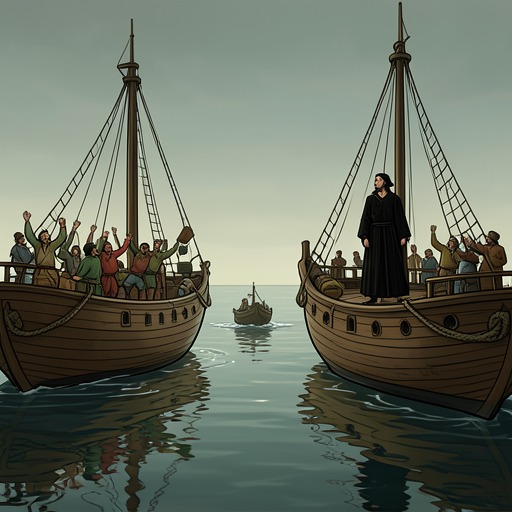
Moby-DickGam is the distinctive social institution of the whaling fleet: a meeting between two or more whale-ships, usually on a common cruising ground, in which an initial exchange of hails develops into visits by the boats’ crews. The captains and chief mates divide themselves between the vessels, turning an encounter in the middle of the ocean into a temporary community. More than a nautical courtesy, Gam makes the scattered whaling world socially legible, allowing ships separated by immense distances to exchange news, recognition, and practical knowledge.
Definition and Maritime Setting
A Gam begins when two whaling vessels discover one another and hail across the water. The crews then establish closer contact by sending boats between the ships. The two captains remain for the time being aboard one vessel, while the two chief mates stay aboard the other, so the meeting is neither a casual passing salute nor a complete transfer of command. It is an organized exchange whose structure preserves the ordinary hierarchy of the ships while bringing their communities into contact.
The practice belongs especially to the open cruising grounds where whaling vessels may encounter one another far from land. In such spaces, ships can be compared to travelers meeting in an inhospitable wilderness: the very desolation that separates them makes communication more valuable. Vessels from the same port may carry captains, officers, and sailors who know one another personally and therefore have domestic news and shared associations to exchange. Even when national differences intervene, American and English whalers can meet through a common language, though English reserve and metropolitan condescension sometimes create a slight social distance.
Sociability Among Whale-Ships
The whaling vessel is presented as unusually sociable among ships at sea. Merchant vessels may cross one another’s wake without recognition, treating the encounter as a silent comparison of appearance and rig. Men-of-war perform formal gestures and lower or raise ensigns, but their ceremony does not necessarily produce heartfelt fellowship. Slave ships are characterized by haste and avoidance, while pirates greet one another with a question about skulls and then separate once their immediate interests have been measured.
The whaler’s question is instead about barrels, a practical sign of a profession organized around shared labor and common information. The Gam embodies a “godly, honest, unostentatious, hospitable, sociable, free-and-easy” culture. Its sociability does not erase competition: each ship still pursues whales and values useful intelligence. Yet the meeting acknowledges that isolated vessels belong to a larger occupational world whose survival depends on mutual recognition. The contrast gives Gam a moral force within the narrative, setting whaling fellowship against the vanity, suspicion, violence, or empty ceremony associated with other maritime professions.
Information, Pursuit, and the Pequod
Gam is particularly important in relation to Captain Ahab’s pursuit of Moby Dick. The ostensible reason Ahab avoids boarding another whaler is bad weather, but his later conduct reveals a more decisive motive: he does not wish to spend even five minutes with a stranger captain unless that captain can provide information connected with his obsessive search. Ahab therefore treats the customary social meeting instrumentally. He recognizes the form of fellowship, but his monomaniac purpose determines whether the encounter has value.
This tension connects Gam with the larger information system of whaling. Ahab studies old logbooks, charts, seasons, currents, feeding grounds, and the regular migratory paths of the Sperm whale. Whaling vessels carry knowledge across waters that may be distant from every port, and their meetings can supplement written records with recent sightings and practical reports. A Gam thus functions as a mobile archive: information is exchanged not in an institution on land but between working ships whose crews have personally observed the ocean’s changing conditions.
The wider history attributed to whaling enlarges this significance. Whalers are described as pioneers who explored uncharted seas, entered harbors later used by American and European warships, opened communication with previously isolated regions, and helped carry missionaries and merchants into Polynesia and other parts of the world. The whale-ship’s global movement also contributed to contact around the Pacific coast of South America, Australia, and the waters approaching Japan. Against this background, Gam appears as the social mechanism accompanying maritime expansion: ships do not merely move through a global network; they continually recreate that network through meetings, reports, and visits.
Conduct and Physical Ritual
The practical details of Gamming reveal the culture’s resistance to land-based ideas of rank and comfort. In a pirate ship, a man-of-war, or a slave ship, a captain traveling by boat normally sits in the stern sheets, sometimes on a cushioned seat, and may steer with a decorated tiller. The whale-boat has neither a stern seat nor a tiller. Because the boat steerer or harpooneer must serve as steersman, the visiting captain is pulled across the water standing upright.
This posture turns dignity into a physical ordeal. The projecting steering oar strikes the captain in the small of the back, while the after-oar can rap his knees from the front. He must spread his legs to remain upright as the boat pitches, yet he is expected not to steady himself by grasping the boat. The captain commonly keeps his hands in his trouser pockets, partly as a display of self-command and perhaps partly because his heavy hands serve as ballast. In an abrupt squall, however, even a captain may seize the nearest oarsman’s hair and hold on. The scene makes authority comic without abolishing it: the captain’s rank remains visible, but the sea subjects it to balance, weather, labor, and the awkward mechanics of the whale-boat.
Narrative and Historical Significance
The narrator presents Gam as a word and practice absent from ordinary dictionaries, despite its long use among thousands of American whalemen. Its absence from formal lexicons marks a larger gap between shore-based culture and the knowledge of maritime workers. The narrator’s act of defining it gives the custom a place in written language and challenges the assumption that whaling is an unpoetic or disreputable occupation.
That defense belongs to a broader argument for the dignity of whaling. Whaling is described not only as a physically dangerous trade but as a powerful peaceful influence that explored remote regions, opened routes, supported commerce, and connected peoples across oceans. Gam condenses that argument into a human-scale encounter. A whale-ship may travel without seeing land for long periods, carrying its own crew, weapons, supplies, and years of water, yet it is not entirely solitary when another whaler appears. The meeting interrupts isolation without ending the voyage.
Gam therefore joins fellowship and distance, routine and uncertainty, information and mystery. Its rules are concrete, its gestures sometimes ridiculous, and its purpose partly practical; nevertheless, it creates a temporary brotherhood in a world where ships might otherwise pass as strangers. In the novel’s maritime imagination, the practice stands for a form of democratic sociability made possible by shared danger: oceanic isolation does not merely divide people, but can also make their mutual recognition indispensable.