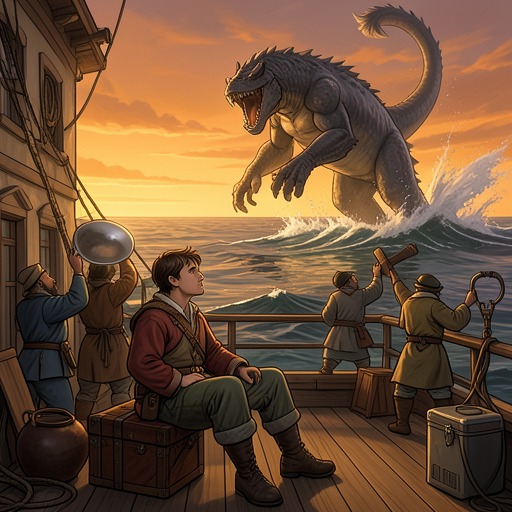
civilized and savage
Moby-DickCivilized and savage is one of Moby-Dick's central reversals of moral expectation. The category does not remain a fixed distinction between Christian society and pagan otherness; instead, it shifts according to kindness, courage, sincerity, and the treatment of fellow human beings. Queequeg's conduct repeatedly exposes the weakness of outward labels, while Ishmael's response transforms fear of the supposedly savage into friendship, fellowship, and a more capacious religious charity.
The First Reversal: Fear and Hospitality
Ishmael first encounters Queequeg through the machinery of prejudice. Tattooing, foreignness, and the reputation of cannibalism make him appear dangerous, while Ishmael imagines the threat of sharing a bed with an armed stranger. Yet Queequeg's actual behavior reverses that expectation. He invites Ishmael into the bed with a civil and charitable gesture, puts away the tomahawk and pipe when asked, and rolls aside to assure him that he will not touch him. The immediate moral contrast is therefore between Queequeg's considerate conduct and Ishmael's anxious assumptions. Ishmael concludes that Queequeg is a human being with as much reason to fear him as Ishmael has to fear Queequeg, and the comparison culminates in the recognition that it may be safer to sleep with a sober cannibal than with a drunken Christian.
This reversal does not merely soften one awkward inn encounter. It establishes the method by which the novel will judge civilization: not by costume, doctrine, or national belonging, but by what a person does when another person is vulnerable. Queequeg's hospitality is concrete and physical. He makes room, accepts a boundary, and restrains the instruments that have frightened his companion. The supposedly uncivilized man behaves with greater tact than the civilized observer initially expects, and Ishmael's own judgment becomes the first object subjected to criticism.
Friendship as Moral and Cultural Exchange
The movement from suspicion to friendship occurs through shared, ordinary acts rather than an abstract declaration of tolerance. In the lonely room, Ishmael feels his hostility toward the world melting away. Queequeg's indifference seems free of civilized hypocrisies and bland deceits, and the very traits that might repel other observers draw Ishmael toward him. Ishmael decides to try a pagan friend after Christian kindness has seemed hollow, then deliberately moves closer, explains a book and its pictures, and begins communicating through gestures and imperfect speech.
Their friendship becomes reciprocal through the shared pipe. Queequeg offers Ishmael a puff, and the two exchange puffs until the remaining ice between them thaws. Queequeg then presses his forehead against Ishmael's, clasps him around the waist, and announces that they are married, using his country's expression for bosom friends: a friendship involving a willingness to die for the other. The gesture overturns the suspicion that foreign intimacy must be either primitive or threatening. In Queequeg's case, emotional directness becomes a form of moral knowledge, while Ishmael's culturally trained caution appears less perceptive than the friendship it initially distrusts.
Queequeg also makes fellowship materially visible. He gives Ishmael an embalmed head and divides roughly thirty dollars in silver into two equal portions, forcing one share into Ishmael's pockets when he tries to object. The act combines generosity with an instinctive refusal of possessive individualism. Money, possessions, and personal identity become divisible between companions; the friendship is not merely sentimental but expressed through the redistribution of what Queequeg owns.
Religion Beyond Religious Boundaries
The civilized-and-savage opposition is tested most sharply in worship. Queequeg performs prayers to Yojo, his wooden idol, while Ishmael identifies himself as a Christian raised in the Presbyterian Church. At first, Ishmael faces what seems an irreconcilable choice: either preserve his own religious identity by refusing Queequeg's practice or enter the ritual of an idolator. His reasoning eventually displaces formal religious superiority. If worship means doing the will of God, and if that will requires treating a fellow human being as one wishes to be treated, then Ishmael must extend the same religious respect to Queequeg that he would want Queequeg to extend to Presbyterian worship.
Ishmael therefore helps prop up the idol, offers burnt biscuit with Queequeg, salutes it, and kisses its nose before going to bed at peace with his conscience and the world. The scene does not erase the difference between their traditions; it makes fellowship possible without requiring sameness. Queequeg remains a pagan, and Ishmael remains a Christian, but their relationship converts religious difference from a barrier into a reciprocal obligation. The supposedly civilized faith is judged by whether it can recognize humanity beyond its own forms.
The same principle governs Ishmael's later reflection on Queequeg's Ramadan. Ishmael calls Queequeg's beliefs concerning Yojo absurd, yet refuses to interfere with a religious observance that appears to give Queequeg contentment. He argues that Presbyterian Christians should be charitable toward other practices rather than imagine themselves vastly superior to pagans. His conclusion is deliberately self-implicating: Presbyterians and pagans alike are somehow cracked about the head and in need of mending. Religious certainty thus becomes another field in which the civilized observer must surrender claims to automatic superiority.
Queequeg's Biography and the Failure of Christian Civilization
Queequeg's history gives the reversal a political and historical dimension. He comes from Rokovoko, an island absent from maps, and from a royal lineage: his father is a High Chief and King, his uncle a High Priest, and his maternal aunts are wives of unconquerable warriors. His desire to see Christendom is not presented as a simple escape from savagery. He seeks knowledge that might make his own people happier and better, and he undertakes the voyage as an ambitious act of education.
When a ship refuses him passage, Queequeg pursues it alone in a canoe. He hides among mangroves, waits in a strait bordered by a coral reef, darts toward the departing vessel, capsizes his canoe, climbs the chains, and grips a ring-bolt on deck. Even threats, a threatened expulsion overboard, and a cutlass suspended over his naked wrists cannot make him release his hold. His determination eventually compels the captain to relent, but Christian society does not receive him as a prince. The sailors place him among the crew and make a whaleman of him. His royal identity is displaced by the laboring identity imposed on him by the ship.
Queequeg accepts this apparent humiliation because he hopes to learn useful arts among Christians and carry them back to his people. Yet his experience in Sag Harbor and Nantucket teaches him that Christians can be miserable and wicked, even more so than the heathens of his father's world. Observing sailors and the way they spend their wages, he concludes that the world is wicked in every meridian and decides to die a pagan. His conclusion is not a rejection of knowledge but an indictment of the conduct of those who claim religious and civilizational superiority. He wears Christian clothes and attempts their speech, but his adopted exterior does not alter his judgment that Christian practice has failed its own moral test.
Mobility, Identity, and the Harpooner's Sceptre
Queequeg's relation to civilization remains unsettled rather than resolved by assimilation. He says he may eventually return and ascend the throne of the thirty pagan kings before him, but feels that Christianity, or more precisely Christians, has unfitted him for that inheritance. He will return when he feels baptized again; meanwhile, he proposes to sail through all four oceans. The phrase presents identity as a condition that can be altered by travel, contact, and moral experience, not as a permanent essence attached to race or birthplace.
His harpoon supplies the final emblem of this displaced sovereignty. A prince who might have inherited a sceptre now carries barbed iron as a whaleman. The weapon represents labor, travel, and the practical knowledge acquired from foreign society, but it also recalls the authority and purpose that his original culture gave him. Queequeg is neither simply civilized nor simply savage. He moves between worlds, adopting clothes and work while retaining pagan loyalties and a critical view of Christian conduct.
Narrative Significance
Through Ishmael's changing perception, civilized and savage becomes a method of exposing hypocrisy and enlarging fellowship. Queequeg begins as a frightening outsider and becomes a trusted companion whose hospitality, generosity, religious seriousness, and courage repeatedly exceed the expectations attached to his label. Ishmael's willingness to share a bed, a pipe, money, and worship marks a value shift from defensive separation to mutual recognition; the change is ethical before it is intellectual.
The concept also complicates the novel's use of the word savage. Ishmael does not simply replace one hierarchy with another. He recognizes Queequeg's violent or unfamiliar cultural markers, including tattooing, cannibal reputation, pagan worship, and the harpooner's life, but places them beside the cruelty, vanity, waste, and spiritual emptiness he observes among Christians. The result is not that one culture is declared pure. Rather, civilization loses its automatic moral privilege, and humanity becomes visible in conduct shared across cultural boundaries. Queequeg's friendship teaches Ishmael that the decisive division is not between Christian and pagan or European and islander, but between sincerity and hypocrisy, generosity and selfishness, and humane fellowship and the refusal to recognize a fellow human being.