democratic dignity
Moby-DickDemocratic dignity is the principle that human worth belongs equally to people without regard to rank, costume, profession, ancestry, or social reputation. In the account of whaling, it becomes both a defense of the despised laborer and a theological claim: dignity is not conferred by kings, institutions, or fashionable society, but shines through the ordinary human body and binds all people under one universal mantle of humanity.
A Defense of Whaling and Labor
The idea first emerges in the argument that whaling has been unjustly treated as an unpoetic and disreputable occupation. A harpooneer introduced into metropolitan society would gain little esteem from the announcement of his profession, and even the initials identifying the Sperm Whale Fishery on a visiting card would appear presumptuous. The social judgment is classed as well as aesthetic: people who labor at sea are denied the cultural recognition granted to supposedly “liberal professions.”
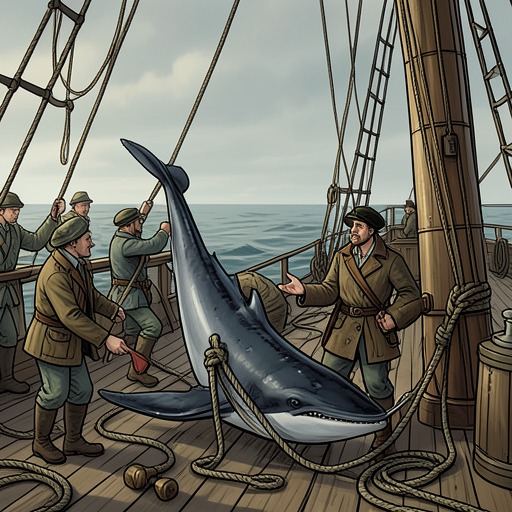
The defense answers this contempt by comparing whaling with the military careers that society honors. Whalemen are indeed engaged in a bloody form of butchery, but military commanders are also celebrated despite the slaughter associated with battle. The disorder of a whale-ship’s decks is set against the carrion of battlefields, where soldiers nevertheless receive public praise. The danger of the whale hunt is likewise presented as no less demanding than martial courage: a veteran who can advance toward a battery might recoil before the enormous tail of a Sperm whale. The comparison relocates courage from the officially honored profession of arms to the working men who confront the sea and the whale directly.
Dignity Beyond Rank and Costume
The narrator explicitly distinguishes the dignity he values from the dignity of kings and robes. It is an abundant dignity visible in an arm that wields a pick or drives a spike, a bodily power belonging to labor rather than aristocratic display. Its source is described as divine equality: God is imagined as both the center and circumference of democracy, present in every human being rather than reserved for a privileged order.
This formulation does not merely praise equality as a political slogan. It changes the scale by which persons are judged. Mariners, renegades, and castaways may possess high qualities even when their lives are dark, tragic, or socially abased. The workman’s arm can receive “ethereal light,” and a disastrous life can be given tragic grandeur without being cleansed of its suffering. The principle therefore joins democratic recognition to literary representation: the narrator claims the right to portray the lowly with seriousness, nobility, and emotional depth.
Ancestry, Culture, and the Reversal of Respectability
The argument repeatedly overturns conventional tests of worth. When whalemen are said to lack good blood, the answer is that they possess something better than royal blood. The example is Benjamin Franklin’s grandmother, Mary Morrel, later Mary Folger, an old settler of Nantucket whose descendants included Folgers and harpooneers. The relation between Franklin’s celebrated public stature and the laboring whalemen is used to collapse the boundary between national greatness and manual maritime work: the barbed iron cast across the world can be wielded by people who are kin to a figure treated as noble in the civic imagination.
The same reversal operates through cultural authority. Whaling is said to have no famous author or chronicler, but the response invokes Job as the first writer of an account of the Leviathan, Alfred the Great as the recorder of a whaling voyage told by the Norwegian whale-hunter Other, and Edmund Burke as a public eulogist of the industry. These references give whaling a literary, royal, and parliamentary genealogy. The occupation rejected as vulgar is repositioned within sacred narrative, learned history, and national eloquence.
Whaling’s Global and Imperial Reach
The defense also derives dignity from the material reach of the whale-ship. The industry is presented as powerful enough to command state attention: Dutch whaling fleets had admirals in De Witt’s time; Louis XVI financed ships from Dunkirk and invited Nantucket families there; Britain paid its whalemen more than one million pounds in bounties between 1750 and 1788. American whaling is described as a navy of more than seven hundred vessels and eighteen thousand men, consuming four million dollars annually, carrying ships worth twenty million dollars at departure, and returning seven million dollars in yearly imports. These figures convert an occupation treated as socially low into a major economic and maritime institution.
Its significance is made still broader through exploration and empire. Whale-ships are credited with entering uncharted seas and archipelagoes before celebrated naval explorers, opening harbors later visited by American and European men-of-war, and mediating between foreign powers and peoples described as savage. The account attributes to whalemen a role in breaking the Spanish crown’s restrictions on Pacific colonies and even links their movement around Cape Horn to the later liberation of Peru, Chili, and Bolivia and the establishment of democracy there.
Australia and Polynesia receive a similar treatment. After the first Dutch discovery of Australia, other ships long avoided its shores, but the whale-ship touched there and is called the true mother of the colony. During the early settlement, whale-ships allegedly saved emigrants from starvation by supplying biscuit. Across Polynesia, the whale-ship is said to have cleared paths for missionaries and merchants and, in many cases, carried missionaries to their first destinations. Even Japan, described as closed to the outside world, is imagined as becoming hospitable through the whale-ship’s persistent presence. Democratic dignity thus acquires an imperial contradiction: the industry is praised as a vehicle of contact, commerce, settlement, and liberation, while its authority is also tied to the expansion of American and European power.
Equality as a Narrative and Ethical Principle
The doctrine reaches its fullest expression in the appeal to a “democratic God” who spreads “one royal mantle of humanity” over every person. The narrator invokes John Bunyan, the convicted and socially diminished writer whose spiritual and poetic value survives his disgrace; Miguel de Cervantes, whose crippled and impoverished arm is imagined as clothed in gold; and Andrew Jackson, raised from humble origins to military and political greatness. The pattern is consistent: the finest champions are selected from the common people rather than descended from a ruling class.
This principle governs how the Pequod’s mariners are to be seen. A castaway or renegade is not reduced to his social label, and a ruined person is not exhausted by the visible wreckage of his life. The narrator’s concern that Starbuck’s fortitude might suffer an ignominious collapse shows the moral seriousness of this claim: human dignity can be wounded by humiliation, but its ideal form remains deeper than outward character. The narrative therefore asks readers to recognize greatness in men whose work, origins, bodies, or reputations would ordinarily exclude them from honor.
The broader history of whaling reinforces the same argument by placing anonymous captains beside celebrated explorers. Nantucket whalemen who sailed without marines, muskets, or institutional support are credited with confronting dangers that famous expeditions could safely record and publicly celebrate. Their anonymity becomes part of their dignity: achievement does not require official memorialization, and the common log may omit adventures that would fill chapters in an explorer’s published account. Democratic dignity is consequently both a subject of the narrative and a method of narration, restoring grandeur to labor that history and polite society have trained themselves not to see.