the sea as metaphor
Moby-DickThe sea as metaphor is one of Moby-Dick’s governing structures: it is the material environment in which ships and whales move, but also the largest image through which the novel thinks about human inwardness, historical power, and the limits of knowledge. Water attracts the dreamer, resists possession, exposes human vulnerability, and joins the world’s scattered shores into a single unstable field. Its significance lies precisely in this doubleness. The sea can promise freedom and truth while remaining the realm of disaster, uncertainty, and death.
Water and the Human Longing for the Infinite
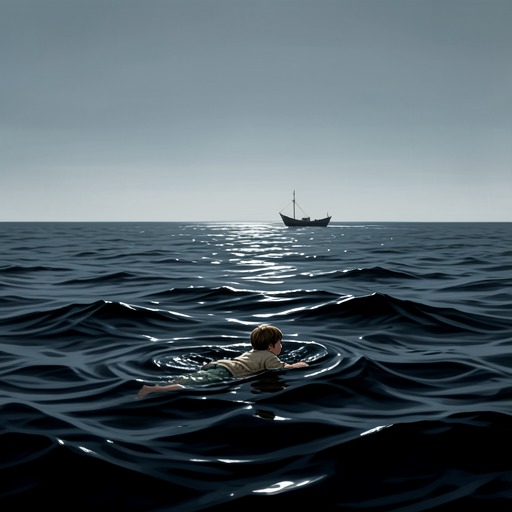
The metaphor begins with an almost universal bodily and imaginative attraction to water. In the city, landsmen abandon streets, counters, benches, and desks to gather at the extreme edge of the shore, where they can look seaward from piers, warehouses, and ships’ rigging. The impulse is presented as more than leisure: even an absent-minded person, when set walking, will be drawn toward a pool if water exists in the region. Meditation and water are described as permanently joined, as though the mind recognizes in the sea an answer to its own restlessness.
This attraction also governs artistic imagination and the desire for escape. A romantic landscape remains incomplete until the shepherd’s eye is fixed upon the stream, while the flower-filled prairie loses its central charm when it contains no water. The question of why a healthy boy becomes eager to go to sea, or why a first voyage produces a mystical vibration when land disappears from sight, points toward a shared human need rather than a specialized nautical passion. The sea is holy in older cultures and receives divine status in classical myth, but the most revealing emblem is Narcissus, who plunges into the fountain while trying to grasp his reflected image. The image in every river and ocean is identified with “the ungraspable phantom of life”: people are drawn toward a likeness of existence that they can never seize.
Landlessness, Freedom, and Existential Risk
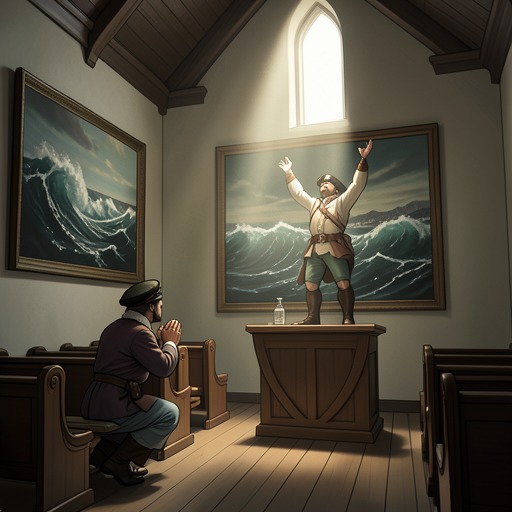
The ocean also figures the mind’s effort to preserve its independence. Bulkington’s return to the Pequod after a dangerous four-year voyage makes land appear not as uncomplicated refuge but as a threat. Port offers safety, food, warmth, friends, and domestic comfort; yet to the storm-tossed ship, land is the place where the vessel may be wrecked. The ship must flee the hospitality that would destroy it and rush back into the landlessness of the sea. The image converts physical navigation into a philosophy of existence: safety can become submission, while peril can be the price of freedom.
For the narrator, deep thinking is likewise an “intrepid effort” to keep the soul’s open independence from being driven onto a “treacherous, slavish shore.” The shore represents fixity, limitation, and the temptation to exchange difficult freedom for protected confinement. The ocean’s openness is therefore not merely scenic spaciousness. It is an ethical and intellectual condition in which the self remains exposed, mobile, and unfinished. The metaphor reaches its most extreme formulation when it declares that the highest truth resides in landlessness and that it may be better to perish in the shoreless infinite than to be ingloriously dashed upon the lee. The claim is tragic rather than comforting: freedom is exalted, but the same openness that protects independence also exposes the individual to destruction.
The Sea as Mortal and Inner Adversary
The novel refuses to sentimentalize the ocean. Human beings have grown accustomed to its terror through repetition, but the sea remains capable of insulting, murdering, and pulverizing the most imposing vessel. It is an everlasting unknown whose disasters have destroyed countless lives, and its danger is not confined to human sailors. The sea also turns against its own offspring, smashing whales against rocks beside the wrecks of ships. Its violence is depicted as autonomous, without mercy and without any power capable of controlling it.
This hostile environment becomes a figure for the divided human soul. The sea’s beautiful surface conceals dangerous creatures; its brilliantly formed sharks are remorseless; and its inhabitants perpetually prey upon one another in an ancient universal cannibalism. Against this green and gentle land, the ocean exposes a hidden resemblance to inward life. The soul contains an island of peace and joy, figured as Tahiti, but that island is surrounded by the horrors of half-known existence. The contrast makes the sea more than an external threat: it is the surrounding uncertainty within which inner peace exists, and from which there may be no return once one pushes away from the island.
The metaphor consequently joins terror to knowledge. The sea’s unknown worlds exceed human science, and its creatures move beneath surfaces that appear lovely or calm. What looks most intelligible from above may conceal forces that cannot be mastered. The ocean’s beauty is therefore not evidence of benevolence; it is part of the danger, because seduction and violence occupy the same environment.
The Pacific and the Imagination of the World
When the Pequod finally reaches the Pacific, the sea becomes a vast historical and spiritual medium. The Pacific is remembered as the ocean long desired by the narrator, a thousand leagues of blue whose serene motion seems to speak of a hidden soul. Its waves are imagined as the restless movements of drowned dreams, lives, shades, and somnambulisms lying across the watery fields and burial grounds of the continents. The ocean does not simply contain the dead; it gives their unresolved motion a continuous physical form.
The Pacific also encircles the planet and connects civilizations separated by immense distances. Its waters reach both newly founded Californian towns and ancient Asian shores, while coral islands and unknown archipelagoes float between them. By making every coast a bay of the same ocean, the metaphor turns the Pacific into the tide-beating heart of the earth. It is at once geographic totality and a divine, seductive power before which the observer is compelled to bow.
Yet this expansive vision is sharply divided from Captain Ahab’s purpose. While the Pacific invites meditative wonder, Ahab perceives chiefly the water in which Moby Dick may be swimming. The same ocean that seems to offer spiritual adoption intensifies his monomania. Its serenity becomes the stage for pursuit, and its immense unity becomes a hunting field. The contrast shows how a single environment can produce radically different meanings: contemplation finds mystery, while obsession converts mystery into an object to be located and destroyed.
Whaling, Cartography, and Global Circulation
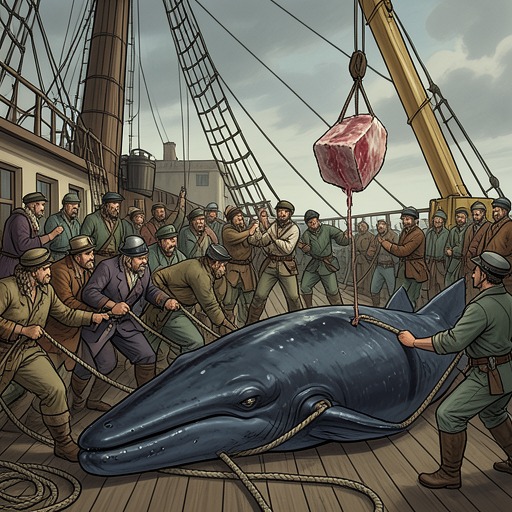
The sea as metaphor also has a material and historical dimension. Ishmael defends whaling against landsmen who regard it as unpoetic or disreputable, arguing that the whale-ship has exerted a peaceful influence across the world. Whaling vessels explored uncharted seas and archipelagoes, entered harbors later used by American and European warships, and interpreted between foreign powers and peoples whom imperial maps had treated as remote or inaccessible. In this account, the ocean is not an empty distance between civilizations but an active medium of exploration, contact, commerce, and political change.
The whale-ship’s routes are linked to major transformations. Whalemen are credited with breaking through the Spanish crown’s restrictions on its Pacific colonies, with consequences reaching toward the liberation of Peru, Chile, and Bolivia. The whale-ship is also described as the true mother of Australia’s modern colony, whose early settlers were repeatedly saved from starvation by supplies from visiting vessels. Across Polynesia, whaling cleared paths for missionaries and merchants and sometimes carried missionaries to their first destinations. The sea therefore appears as a network through which labor, provisions, knowledge, religion, and imperial power circulate.
The Pequod embodies this world-making mobility. Captain Ahab plans to pass through the Sunda Strait into the Javan Sea, cruise toward the Philippine Islands and the Japanese waters, sweep across the known sperm-whale grounds, and eventually reach the Pacific Line. The ship carries little conventional cargo beyond itself, its crew, weapons, necessities, and a large reserve of water; it may cross the world without seeing land or meeting anyone except other floating sailors. Its self-contained movement makes it resemble an ark, but the isolation is also a warning. Global reach and radical estrangement are produced by the same voyage.
Charts, Measurement, and the Limits of Mastery
The ocean’s resistance to possession is dramatized through Captain Ahab’s charts and navigational instruments. After declaring his purpose to the crew, Ahab repeatedly studies charts of all four oceans, compares them with old logbooks, and draws and erases courses in pursuit of the white whale. He treats currents, the movements of the sperm whale’s food, seasonal latitudes, and migratory “veins” as a system from which a solitary creature might be found. The sea seems to become legible: its recurring routes promise that possibility can be converted into probability and probability nearly into certainty.
The method is not wholly irrational. Sperm whales are said to travel along remarkably exact ocean lines, and particular seasons and widths of water offer grounds where migrating whales may confidently be expected. Moby Dick, however, cannot be reduced to a fixed location. His appearances at the Seychelles ground and Volcano Bay are only temporary stopping places, while the decisive Season-on-the-Line offers Ahab his strongest but still incomplete expectation. The chart creates order, yet the whale’s movements preserve contingency within that order.
Ahab’s crisis with the quadrant makes the conflict explicit. The instrument can tell him where he is, but not where he will be, where a drop of water or grain of sand will be tomorrow, or where Moby Dick is at the present moment. He destroys the quadrant and rejects the elevated science that seems to promise mastery, turning instead to the level compass, dead reckoning, log, and line. Yet the abandoned tools return as a practical necessity: the Pequod’s neglected log and line, already damped, warped, and rotting, are ordered back into use. The episode does not replace knowledge with certainty. It reveals that every system of measurement is partial, and that the sea remains larger than both scientific confidence and passionate defiance.