The Whiteness of the Whale
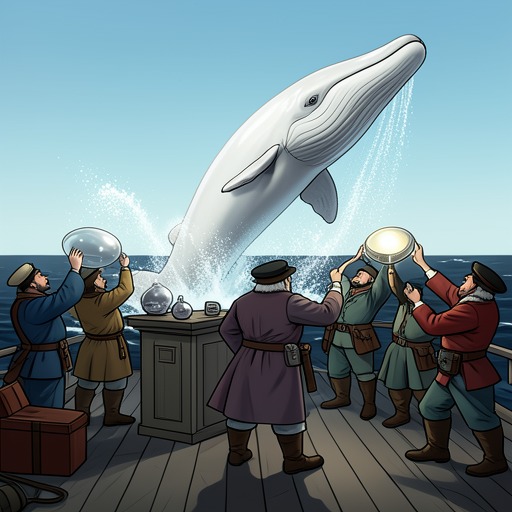
Moby-DickThe Whiteness of the Whale is the symbolic and philosophical center of Ishmael’s meditation on Moby Dick. Whiteness first appears to promise purity, majesty, and transcendence, but in the White Whale it becomes strangely vacant and terrifying. The chapter does not settle the color’s meaning; instead, it builds a sustained tension between sacred radiance and annihilating blankness, making the whale a figure for the limits of human knowledge and the unstable meanings imposed upon the natural world.
Ishmael’s Personal Horror
Ishmael distinguishes his response to Moby Dick from Captain Ahab’s more explicit obsession. Ahab sees the whale through the logic of revenge, whereas Ishmael admits that the whiteness of the whale, above all its other physical qualities, awakens in him a vague and nearly inexpressible horror. The fear is not simply that the whale is powerful or dangerous. It arises from the color itself, which seems to exert a mysterious influence on the soul and threatens to make the entire narrative’s attempt at explanation inadequate.
The whiteness is frightening because it combines an apparently gentle surface with an object already terrible in itself. Ishmael compares this effect to the white bear of the poles and the white Shark of the tropics: their pallor does not soften their menace but intensifies it, giving their aspect an abhorrent mildness that can be more disturbing than open ferocity. Whiteness therefore produces a peculiar form of terror, one in which violence is concealed beneath smoothness, stillness, and an almost innocent appearance.
Sacred and Royal Associations
Ishmael’s argument proceeds through a long catalogue of meanings traditionally attached to white. The color enhances the beauty of marble, flowers, and pearls; it has been associated with royal authority in the imagery of the White Elephant and the white charger; and it has represented gladness, honor, justice, and the elevated dignity of rulers. White also signifies innocence, the benignity of age, and the deepest pledge of honor in the white belt of wampum. These associations make whiteness appear to be a universal language of value and distinction.
The color is equally powerful within religious symbolism. Christian priests derive the name of the alb from the Latin word for white, while white appears in the sacred vesture and ceremonies of the Catholic tradition. In the Vision of Saint John, the redeemed wear white robes, the elders stand before the great white throne in white, and the Holy One is described as white like wool. Other traditions likewise invest whiteness with holiness, including the white flame of Persian fire worshippers, the snow-white bull associated with Great Jove, and the sacred White Dog of the Iroquois. Yet the accumulation of noble meanings does not stabilize the color. Instead, it makes the later reversal more severe: the same hue that suggests divine purity can become the vehicle of terror.
Whiteness as Death and the Uncanny
Once detached from its benevolent associations, whiteness becomes an instrument for magnifying fear. The White Squall derives its menace from a snowy aspect, while the White Hoods of Ghent demonstrate how a pale emblem can intensify human violence. More fundamentally, Ishmael identifies the marble pallor of the dead as one of the most horrifying visible signs of mortality. The shroud inherits this color, as do the milk-white fogs through which ghosts are imagined to rise. Even the personified king of terrors rides a pallid horse.
This chain of images makes the White Whale uncanny rather than merely monstrous. Its whiteness suggests not only an external threat but a presence that seems to belong simultaneously to life, death, nature, and the supernatural. The color’s power comes from its refusal to remain within one category. It can signify the innocent bride, the judge’s justice, the holy figure, the corpse, the ghost, or the predator. In the whale, these meanings gather without resolving into a single allegory, so that the creature’s calm whiteness becomes more disturbing than a plainly blood-colored or violently marked body would be.
Blankness, Absence, and the Universe
Ishmael then asks whether whiteness is terrifying because it gestures toward the heartless voids and immensities of the universe. The white depths of the Milky Way can suggest annihilation, while a landscape of snow becomes a blankness full of meaning. Whiteness is presented paradoxically as both the absence of color and the concrete of all colors: it is empty and total at once. That double condition makes it an image of an existence from which familiar distinctions have been erased.
The argument extends from color to the apparent structure of reality itself. The hues of sunsets, forests, butterflies, and human faces may be only external appearances rather than inherent properties of things. Light, the principle that produces these colors, remains white or colorless in itself; without a mediating surface, it would cover every object with its own blank tone. Nature consequently appears as a beautiful cosmetic laid over an interior associated with death. The Albino whale becomes the symbol of this unsettling theory: it exposes the possibility that the visible world’s loveliness is a surface masking an unknowable or charnel interior.
Knowledge, Classification, and the Living Sea
The chapter’s symbolism is reinforced by the book’s larger struggle to know the whale. Ishmael’s attempt at Cetology is openly provisional. He offers a systematized outline rather than a complete science, calling himself the architect rather than the builder, and acknowledging that any human system claiming completeness is therefore faulty. The difficulty of classifying whales reflects the difficulty of interpreting Moby Dick: both natural history and symbolism must work among fragments, uncertain authorities, direct experience, and the vastness of the sea.
This uncertainty is not confined to abstract speculation. The Pequod encounters whales in materially specific ecological relations: Right Whales feed upon vast meadows of brit; Daggoo sees the mysterious jet of a Giant squid; sharks gather around a captured Sperm Whale; and Sperm Whales increasingly travel in immense herds or caravans after persistent hunting. The sea is beautiful, hidden, and cannibalistic, while the peaceful center of whale life exists within circles of alarm and violence. Ishmael’s image of an inner Tahiti surrounded by the horrors of half-known life parallels the chapter’s treatment of whiteness: apparent serenity and surrounding terror occupy the same world without canceling one another.
The whale’s whiteness therefore cannot be separated entirely from the living animal or reduced to a human emblem. The great whales retreat toward Polar citadels when driven from familiar grounds, and the Sperm Whale’s unwritten life exceeds the incomplete records of both science and poetry. The animal remains a subject that resists total possession, even as human hunters classify, pursue, measure, depict, and consume it.
The Limits of Human Instruments
The conflict between knowledge and mystery recurs in the Pequod’s instruments. In the Japanese sea, Captain Ahab uses the quadrant to determine his latitude, but the instrument can tell him only where he is, not where Moby Dick is or where any living thing will be. Ahab’s attack on the quadrant exposes the limits of a science that offers exact position without granting mastery over destiny, motion, or the unseen. The sun can locate the observer, but it cannot reveal the whale’s location or the future course of the chase.
Even the compasses lose their authority when lightning reverses their magnetic direction. The accident is physically explainable, yet its practical consequence is profound: the ship’s trusted instruments point wrongly, and the Pequod must alter course according to a sun bearing rather than the apparently reliable needles. The episode echoes the symbolism of whiteness by showing that what appears clear and objective may conceal instability. Similarly, experienced whalemen can predict a whale’s unseen course through darkness from its last observed movement, but such knowledge remains conditional upon wind and sea. Human perception can extend into absence, never abolishing it.
The Whiteness of the Whale finally gives the White Whale its fullest significance. Moby Dick is not merely the object of Ahab’s revenge or one specimen within Ishmael’s natural history. His pallor gathers the sacred and the deadly, the beautiful and the void, animal vitality and intimations of death. The chapter’s deepest claim is not that whiteness has one hidden meaning, but that its power lies in the collision of incompatible meanings. The White Whale becomes terrifying because the world itself, beneath its colors and classifications, may be both radiant and empty, knowable in fragments yet ultimately beyond the reach of any instrument, system, or human gaze.