Salvatore
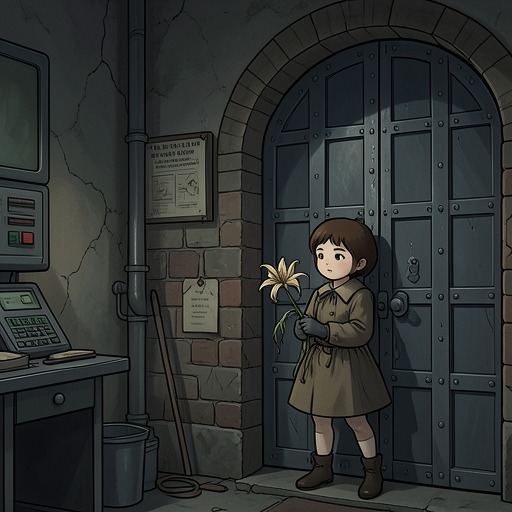
MomoSalvatore is a bricklayer, a neighbor and friend of Momo, and a craftsman whose later work leaves him deeply alienated. He once built Momo’s stove and painted a flower picture on her wall; later, he earns good money on a hurried housing development but recognizes that the speed and methods of the work are producing buildings that will not last. His contrast between skilled, worthwhile labor and construction governed by relentless efficiency gives his short arc a human scale: he can see what is wrong, yet does not manage to escape it.
Identity and Earlier Relations
Salvatore is introduced as a strong-built man with a curled black moustache. His work has already entered Momo’s home in useful and decorative forms: he built her stove and painted a flower on the wall. These details present him not merely as a neighbor but as a maker whose skill has helped shape a place where Momo lives. He is also among her friends, and his link to Nino and Liliana belongs to the same close neighborhood world. Nino and his wife have often brought Momo food, while Salvatore’s craftsmanship has left a lasting mark on her room.
That everyday connection does not prevent conflict. Salvatore and Nino arrive at Momo’s stone arena after a violent quarrel and sit apart, scowling. Friends have urged them to visit her because their enmity is disrupting relations between neighbors; both men have resisted before agreeing to come. Momo sits midway between them rather than choosing which to approach, giving each space while she waits. Her patience is especially apt in a story where time is increasingly treated as something to save: at this point, waiting and listening are resources she can offer freely.
As the men’s accusations emerge, the argument proves to have competing grievances rather than a single agreed account. Salvatore says he assaulted Nino after Nino slapped him in front of customers; Nino counters that Salvatore had earlier tried to smash his crockery. Salvatore distinguishes throwing one jug at the wall from smashing all the dishes, and says that jug was already cracked. Nino’s response is that it was still his property. Their exchange reveals Salvatore’s readiness to answer an insult with force, but also shows the quarrel widening over the interpretation and ownership of a damaged object. The available account does not establish how the dispute ends.
Work and the Changing City
When Momo later goes looking for Salvatore, she learns that he has moved into a different routine. He lives in a little garret under the roof, but now works on a large housing development on the far side of town. The work pays well; it also keeps him away so much that he seldom comes home, and when he does, it is often in the small hours. His neighbors say he has taken to drinking and is difficult to get along with. The improved earnings therefore sit beside signs of a narrowed life: long absences, late returns, and a reputation for irritability.
Momo waits for him outside his door. When Salvatore comes home in the middle of the night, he is embarrassed at being seen as he is, but he settles beside her on the stairs and talks about work. He describes a construction site organized around speed, where the crew is expected to put up one floor a day and every movement is tightly arranged. At first his account sounds like an explanation of changed times and a demanding job. As Momo listens, however, his enthusiasm drains away; he falls silent and rubs his face with his work-roughened hands. The pause marks the difference between repeating the language of efficiency and confronting what that efficiency requires of him.
The Cost of Rushed Construction
Salvatore eventually identifies the defect in the work with the precision of a tradesman. He says there is too little cement and too much sand, and estimates that the buildings will last only four or five years before they collapse under even slight pressure. The construction is shoddy throughout, in his view, and the tenements are unsuitable places for people to live. This is not simply a complaint that work has become unpleasant: he sees the material consequences of a process that values the pace of construction over the durability and human use of what is built.
His own position is conflicted. He says he often gets drunk because that is the only way he can bear thinking about what the crew is making. He remembers that building something worthwhile used to give him satisfaction, while now the work violates the standards he associates with honest bricklaying. At the same time, he asks why he should care if he receives his wages at the end of the week. His admission sets moral knowledge against economic dependence: he recognizes the damage, but continues to take part in producing it and can point to his pay as a reason to carry on.
Momo’s Visit and an Unfulfilled Intention
Salvatore tells Momo that he will leave the job once he has made enough money to do something different. The plan is a future one, with no fixed departure date or alternative occupation. After talking, he sounds somewhat brighter and says he may come to see her the next day or the day after, depending on whether he can fit it in. Momo is pleased by the promise. They are both tired, say good night, and she leaves.
The promised visit never happens. Salvatore fails to appear on either of the next two days and, in the account given, never turns up at all. The missed appointment turns a casual assurance into the concrete outcome of his arc: his wish to make time for a personal visit is repeatedly subordinated to the schedule he already follows. The narrative does not say that he changes jobs, stops drinking, or repairs his friendship with Momo. Instead, it leaves the intention suspended and stresses the gap between what he recognizes and what he manages to do.
Narrative Significance
Salvatore’s experience unfolds against the novel’s account of the Men in Gray, who understand time as a resource to be taken and whose concealed plans gradually invade people’s lives. The broader narrative insists that time is not merely a measurable quantity: it is bound to life and to the human heart. Salvatore is not shown being approached or recruited by the Men in Gray, so his connection to their scheme is contextual rather than a directly narrated encounter. His workplace nevertheless embodies the kind of time discipline the novel criticizes: a daily quota, an imposed pace, and the organization of every movement.
His story also sharpens the difference between saving time and gaining a life. The housing project produces wages and rapid progress in the narrow sense of floors completed, while Salvatore sees that it produces fragile homes and drives him toward a job he can scarcely bear. His former craftsmanship, visible in Momo’s stove and painted flower, contrasts with the hurried work he now performs. Momo’s quiet attention briefly allows him to articulate that contrast, but listening cannot by itself make his promised return happen. His unfinished plan and absence leave the cost of the new pace visible not only in defective buildings but in a friendship left waiting.