Momo
MomoMomo is an unusual child whose power lies not in giving answers but in listening so attentively that others find their own. That quiet gift becomes the basis of her relationships and her resistance to the Men in Gray: when fear and isolation threaten to make her retreat, she turns back toward the friends who need her. Her story joins private attention to public courage, and ends with her return to the community gathered around her.
Identity and the gift of listening
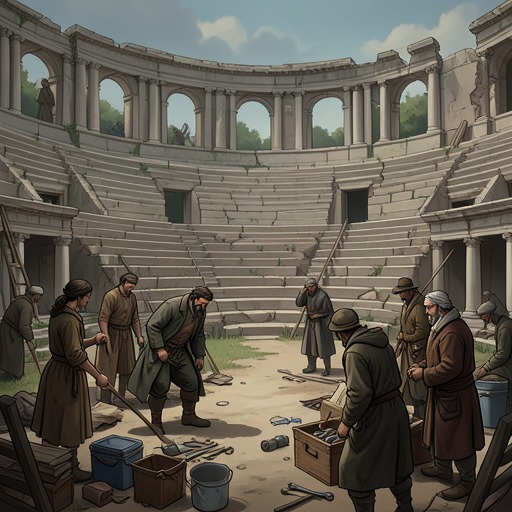
Momo first appears as a newcomer in the ruins, her arrival announced among the nearby residents as a child, probably a girl, whose clothes made it difficult to be sure. She is small and thin, with unruly black hair and large dark eyes; she usually goes barefoot. Her clothes are gathered from what she has found or been given: a patched ankle-length dress beneath an oversized man’s jacket with many pockets. She leaves the sleeves long, reasoning that she is still growing and might not find another jacket so useful. The details establish a child living with very little, but also one who makes practical choices about what she has.
Her defining ability is listening. Momo does not need to speak, offer advice, or ask leading questions: she gives people her close, sympathetic attention, fixing them with her dark eyes. In that attentive silence, even people who are slow to find ideas can experience sudden inspiration and recognize thoughts they had not known they possessed. The effect is not that Momo supplies other people with answers, but that her presence allows them to hear themselves. The gift explains why she matters to those around her without making her a conventional adviser or authority.
Encounters with the Men in Gray
When Momo meets Agent No. BLW/553/c, she remembers what Beppo Roadsweeper and Guido Guide have said about the infectious spread of time-saving. She suspects that the stranger is connected to that spread, and wishes her friends were beside her. The encounter makes her loneliness explicit: she has never felt so alone. Yet she does not let that fear decide the outcome. She gathers her courage and looks directly into the darkness in which the stranger conceals his true self. The agent notices the change in her expression, lights a fresh cigar from the old one, and tells her that she is no match for his organization. Momo’s first response is therefore a mixture of vulnerability and resolve, not fearlessness.
Later, when children insist that she speak, Momo hesitates over whether to comply with Beppo or with the children. She eventually tells them what has happened. Their reaction shows the cost of making the threat understandable: a long silence follows, the children grow uneasy, and one very young child bursts into tears before being comforted. Momo’s account does not leave the group with an easy reassurance; it reveals to them how sinister the time-thieves are. The scene also carries her listening gift into a collective setting. The children have asked to hear her, and she gives them a truthful account rather than keeping the danger private.
The threat she represents occupies the Men in Gray’s deliberations as well. At an emergency conference, one speaker argues that they have ample human accomplices and can dispose of Momo without confronting her themselves, pointing to the fate of their late agent as a warning. Another director names fear as their motive and proposes a different course: instead of trying to get rid of her, they should persuade her to join them. The competing proposals make Momo’s significance clear from the opponents’ perspective. They regard her as a danger, but also consider whether her influence might be turned to their advantage.
Turning back toward her friends
At a later point, Momo jumps from a slowly moving truck and starts walking toward the crowded streets, which seem to offer protection from the man in gray. Remembering her nightmares, she stops. She recognizes that running has kept her attention fixed on her own loneliness and fear while her friends remain in trouble. If anyone can persuade the Men in Gray to release them, she decides, she must at least try. The decision changes her purpose: instead of seeking safety for herself, she accepts the risk of acting for others.
Her courage is described as a change in feeling rather than a sudden discovery that danger is harmless. Fear and helplessness have reached such a pitch that they turn into their opposites. Once she has overcome them, Momo feels capable of confronting any power; more precisely, she has stopped worrying about herself. The distinction matters. Her resolve comes not from denying her vulnerability but from moving beyond self-preservation when her friends’ predicament demands action.
Homecoming and narrative significance
After the struggle, Momo comes to herself in the side street where she had last seen Beppo Roadsweeper. He is leaning on his broom, looking into the distance as he used to, but he is no longer hurrying and feels brighter and more hopeful. He wonders whether he may already have saved the hundred thousand hours needed to ransom her. At that moment someone tugs his jacket: Momo is standing before him, smiling. Their reunion breaks into laughter and tears, repeated embraces, and a rush of talk. Passers-by stop to share the happiness, and Beppo takes the rest of the day off before walking arm in arm with Momo to the old amphitheater.
There they find a gathering of people from Momo’s earlier life, including Guido, Nino, Liliana, Salvatore, and many of the children. The celebration lasts until the stars appear. When the cheering and excited conversation subside, Momo steps into the arena and sings, thinking of the music of the stars and the hour-lilies. Her return is thus marked not by a solitary victory but by a renewed community: the people who had been separated from her are together again, and their shared time makes the celebration possible. In Nowhere House, Professor Hora watches Momo and her friends through his omnivision glasses after the return of time has awakened him from his first sleep. Cassiopeia touches his foot, linking the distant witness to the homecoming. Momo’s arc closes with the same qualities that first defined her—attention, connection, and a capacity to draw others into a shared human moment—now expressed in a song heard by her gathered friends.