Mr Figaro
MomoMr Figaro is a neighbourhood barber whose dissatisfaction makes him a target for the Men in Gray. Convinced that he must save time to gain a better life, he turns his work and private relationships into items on an efficiency schedule. His story shows the cost of that bargain: the time he tries to accumulate never becomes available to him, while the life he hoped to improve grows narrower and more monotonous.
Identity and Dissatisfaction
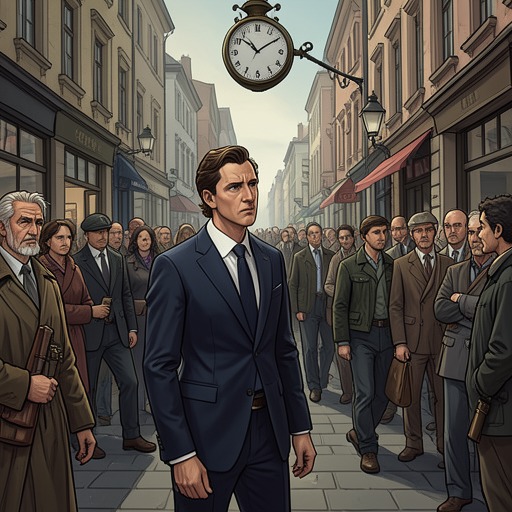
Mr Figaro owns a small barbershop in the centre of town and employs an apprentice. He is neither rich nor poor, and, although he is not considered a high-class hairdresser, the neighbourhood respects him. This modest security does not satisfy him. One bleak day, alone at the shop while his apprentice is off, he sees his familiar work—cutting hair, talking with customers, and lathering faces—as evidence that life is passing him by. He fears that when he dies it will be as though he never existed.
His dissatisfaction has a shape, but not a clear plan. Glossy magazines supply a vague picture of the distinguished, affluent existence he thinks he wants; he cannot say exactly what such a life would involve. He believes his work leaves him no time to pursue it and imagines himself a lifelong prisoner of scissors, lather, and conversation. The contrast between this ordinary routine and the grander future he pictures makes him receptive to the promise that saved time can be reclaimed later.
Recruitment by the Men in Gray
A gray limousine stops outside the shop, and a gray-suited stranger enters carrying a briefcase and notebook. The man settles into the barber’s chair and smokes a small cigar. Mr Figaro abruptly shuts the street door, finding the shop strangely chilly, but proceeds with the ordinary question of whether his visitor wants a shave or a haircut. The bald stranger’s arrival in the quiet shop marks the point where Mr Figaro’s private frustration meets the Men in Gray’s concealed campaign to take control of people’s lives.
The visitor makes time seem measurable as money. He writes out an elaborate account of Mr Figaro’s life, ending in a total of zero seconds. Shattered by the calculation and impressed by its apparent precision, Mr Figaro is ready to accept the stranger’s advice. The agent reinforces the pitch with a hypothetical calculation: saving one hour each day for twenty years would amount to more than twenty-six million seconds, and saving two hours would double that figure. The scheme presents an imagined future credit as the answer to Mr Figaro’s fear that his life will amount to nothing.
Mr Figaro asks how the saved time is to be paid in or kept safe. The agent’s instructions instead make saving a practice of subtraction from daily life: serve each customer in fifteen minutes rather than half an hour, avoid conversation, reduce visits to his mother, place her in a home, sell his budgerigar, see Miss Daria less often, and give up singing, reading, and time with friends. The agent also recommends an accurate clock for timing the apprentice. Mr Figaro accepts the programme eagerly, believing it offers a route to the freedom he lacks.
The New Routine and Its Costs
After the visitor leaves, cigar smoke lingers in the shop. Only when it has dispersed does Mr Figaro begin to feel better. The figures on the mirror fade along with his memory of the man who wrote them; he forgets the visitor but keeps the resolve to save time, believing it to be his own idea. The new ambition takes hold like a poisoned arrow: he means to save now so that he can begin a new life in the future, but the instructions that define this future have already been supplied by the agent.
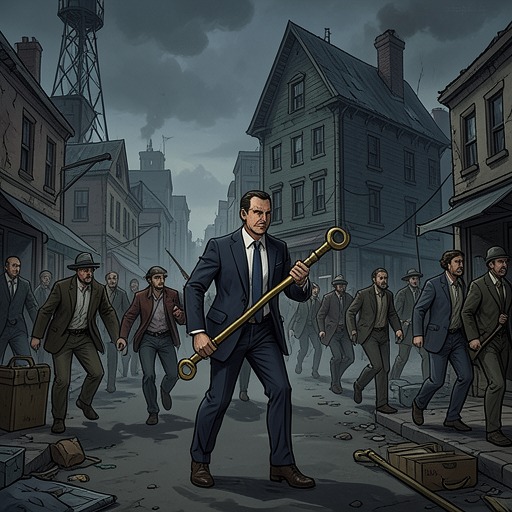
His first customer receives a surly welcome. By doing only what is necessary and keeping quiet, Mr Figaro completes the job in twenty minutes instead of the usual thirty. He extends the same treatment to every customer, though he no longer enjoys his work. He hires two assistants in addition to his apprentice and watches them closely to make sure they waste no time. A timetable governs each movement in the shop, beneath a notice proclaiming, "TIME SAVED IS TIME DOUBLED!" The slogan turns the agent’s promise into a rule for everyday labour, and the clock becomes an instrument for enforcing it.
The change reaches beyond the shop. Mr Figaro sends Miss Daria a brief, businesslike note saying that work will prevent him from seeing her in future. He sells the budgerigar to a pet shop. He places his mother in an inexpensive old folks’ home and visits her just once a month. He carries out the stranger’s recommendations as though each were his independent decision. The details matter: saving time does not remain a matter of shaving minutes from a haircut, but reorganizes the relationships and pleasures that made up his ordinary life.
Consequences and Significance
Despite his increasingly strict routine, Mr Figaro never seems to have time to spare. He grows more restless and irritable, and the time he saves appears mysteriously to vanish. His days become shorter; weeks, months, and years pass with growing speed. The promised future remains deferred, while the present in which it might have been enjoyed is steadily diminished.
His experience forms part of a broader pattern in the city. The Men in Gray understand time as something to extract from people, while the story frames it as life itself, residing in the human heart. People fail to notice that saving time means losing something else; life becomes poorer, bleaker, and more monotonous. Children feel that impoverishment especially keenly because adults no longer have time for them. Mr Figaro’s altered shop and neglected connections give this social argument a concrete scale: his supposed savings are registered in shorter appointments and stricter schedules, but their real cost is a reduced life. The more people save, the less they have.