Guido Guide
MomoGuido Guide begins as a charming fabricator: he invents histories for tourists, making up names, dates, and events until listeners’ heads spin. With Momo’s friendship, his imagination flourishes into stories that can hold audiences for weeks. Later, he uses his knack for performance in a more urgent cause, addressing the children gathered in the Amphitheater and proposing a mass demonstration against the Men in Gray. His movement from entertaining an audience with inventions to urging one to reveal the truth gives his storytelling a new public purpose.
Identity and Informal Work
Guido Guide is the name everyone uses for Girolamo, a handsome, dreamy-eyed youth with an infectious laugh and a taste for practical jokes. In contrast to the older, deliberate Beppo Roadsweeper, he is carefree and quick with words. He has no proper job, but one of his unofficial activities is guiding tourists through the city. His qualification is a peaked cap: whenever visitors wander into the neighborhood, he puts it on, adopts an earnest expression, and offers to show them the sights.
The guide’s performance rests on invention rather than knowledge. He bombards tourists with fabricated names, dates, and historical events, spinning out enough detail to leave them confused. Some recognize the deception and walk away annoyed; most accept the stories as fact and put coins in his cap when he passes it around at the end of the tour. His neighbors may chuckle at his flights of fancy, but they also object that accepting payment for made-up histories is not quite right. The episode establishes both sides of his resourcefulness: he can create an absorbing account on demand, but that skill initially serves a comic, precarious livelihood rather than any claim to truth.
Momo and the Growth of His Stories
As time passes, Guido becomes indispensable to Momo, and he develops a deep affection for the ragged girl. Their friendship changes the very activity that defines him. Making up stories has always been his ruling passion, but formerly his inventions could falter: he might run out of ideas, repeat himself, or borrow material from a film or newspaper. With Momo as his listener, those stories seem to acquire wings.
Her attention is not merely an audience’s approval. When Momo listens, Guido’s imagination opens out, and children and adults alike gather to hear him. His stories grow into episodes that can continue for days or even weeks, without exhausting his supply of ideas. He is himself enthralled by the tales as he tells them, unsure where his imagination will lead. The contrast with his tourist act is telling: there, the confident guide piles up false details to earn a few coins; with Momo, storytelling becomes a sustained, shared imaginative experience. Her presence helps turn a practiced improviser into a storyteller whose inventiveness can keep unfolding.
From Entertainer to Organizer
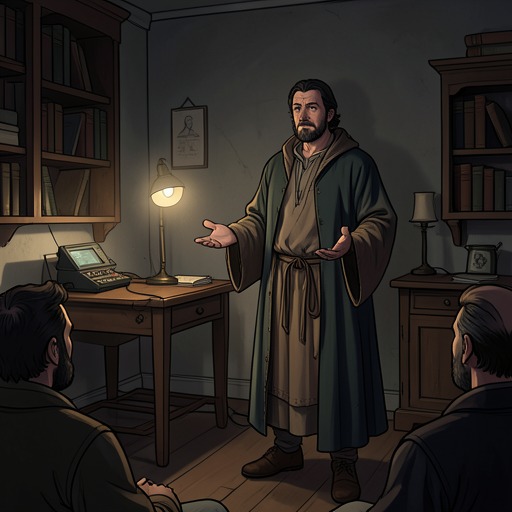
Guido’s gift for holding attention later becomes useful beyond amusement. At a secret meeting in the Amphitheater, attended by roughly fifty or sixty expectant children, he rises and calls the gathering to order with a sweeping gesture. The conversation falls quiet, and he explains why the children have been summoned: people are saving time yet finding themselves with less of it, because the Men in Gray are stealing the time they mean to save. He presents the theft as a crime and asks the children to help stop it.
He does not immediately impose a plan. Guido says he has considered and rejected hundreds of schemes, and that he wanted to give the assembled children a chance to suggest something better before revealing the course he favors. His proposal is a mass demonstration. The children are to paint posters and banners, march through the streets, attract as much attention as possible, and invite the whole city to the old Amphitheater to hear the facts. His envisioned sequence turns publicity into a means of breaking the Men in Gray’s secrecy: first draw a crowd, then reveal the truth to it. He predicts that thousands will come and imagines the disclosure changing the city overnight. This is a plan he announces, not an outcome the account confirms.
Narrative Role and Significance
Guido’s arc links storytelling with the power to gather listeners. His early tours are knowingly invented performances that earn him money; his later stories, enlarged through Momo’s attention, hold audiences over time; at the children’s meeting, his speech seeks to convert an audience into participants in a public campaign. The same facility with words thus moves across distinct settings and purposes, from neighborhood hustle to intimate friendship to collective action.
The reversal does not make Guido’s talent itself a guarantee of truth. His first listeners can mistake invention for history, and some neighbors explicitly criticize him for taking payment for lies. At the meeting, however, he argues for making concealed wrongdoing publicly known. The scene places his theatrical confidence in the service of disclosure: the boy who once made tourists believe fabricated histories now urges a crowd to expose the real story of stolen time. Momo’s friendship is central to this development, both because it deepens his imaginative life and because she is the person whose encounter with a member of the gang he asks to have heard by the children.