Men in Gray
MomoThe Men in Gray are the covert agents of the Timesaving Bank, a predatory force that feeds on time taken from human beings. Their defining contradiction is that they operate openly yet remain unnoticed: they move through ordinary streets and buildings, while the people whose lives they exploit rarely recognize their presence. The same dependence that sustains them also makes them vulnerable. When stolen time is no longer available to support them, they can disappear as abruptly as they arrived.
Identity and Appearance
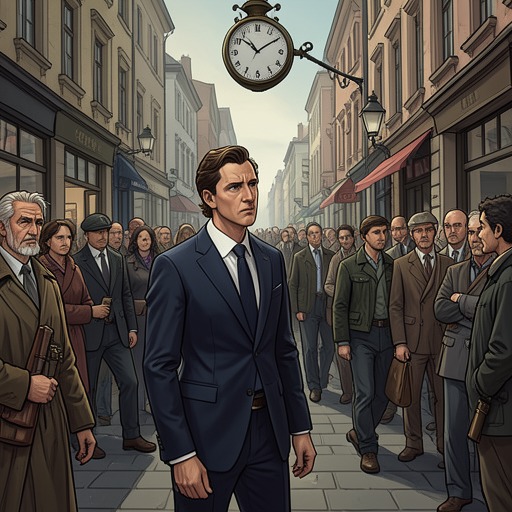
The Men in Gray spread through the city gradually, like an invading force whose advance meets no resistance because it is barely perceived. They are not invisible. Rather, they are difficult to notice and easy to forget, a capacity that allows them to conduct their business without needing to hide. Even Beppo Roadsweeper, who notices much that others miss, fails to recognize their growing presence.
Their appearance makes them seem like variations on a single figure. They wear gray suits, gray bowler hats, and carry steel-gray briefcases; their faces are gray, and each smokes a small gray cigar. Smart gray limousines carry them through the streets. They frequent restaurants and haunt buildings, sometimes making notes in little gray notebooks. These repeated details give their presence a bureaucratic uniformity: the agents appear less as individuals than as the visible surface of an organized operation.
Time Theft and the Bank's Methods
The Men in Gray understand that time is bound to human life, and they exploit the fact that people commonly treat it as an ordinary resource. Their operation depends on people giving them the opportunity to do so. As the city increasingly lets efficiency govern everyday choices, the agents gain influence over how people use their lives without having to rule them openly.
Their advice to Mr Figaro shows how that influence enters daily work. They urge him to halve the time spent with each customer, avoid conversations, and reduce the hour he spends with his mother. He then applies the same treatment to every customer, hires two assistants, and watches their work closely for wasted moments. A timetable becomes the organizing principle of the barbershop. Mr Figaro's enjoyment of his work becomes secondary to the demand to make each action efficient. The agents' power thus operates not only through theft, but through routines that make people enforce the loss of time themselves. The story's central reversal is that people who save more time end up with less of it.
The Men in Gray describe their work as draining the hours, minutes, and seconds people save, and say that their need grows as their numbers grow. Their supply is not simply stored human time in a living form. Professor Hora explains that time dies when it is taken from its rightful owner, and that the agents feed on this dead matter. The gray cigars are made from the petals of hour-lilies: the petals are dried and rolled, then smoked so that the remaining life in them is converted into dead time. The smoke sustains the agents. Without a cigar, one of them cannot exist.
Invisibility, Influence, and Coercion
The agents' unobtrusiveness is a practical advantage, but their reach also rests on human cooperation. Professor Hora explains that their human appearance is a disguise and that they exist because people give them the opportunity to do so. They take advantage of the opportunity when people allow them to shape their lives. Their power therefore combines concealment with consent: the agents remain difficult to recognize, while the habits that serve them can appear to be ordinary common sense.
When the Men in Gray cannot separate the children from Momo by bringing them directly under their control, they turn to the children's elders. They enlist suitable adults and use the children's own weapons against them, pursuing the same end by an indirect route. Their effort to isolate Momo develops into a broader strategy of exploiting people around her rather than confronting her openly.
The agents also use explicit bargains. While Beppo Roadsweeper is detained, one offers to arrange his release and return Momo on condition that he never speak again about the Men in Gray or their activities. The price is a further hundred thousand hours of his time, which he must save for them. The offer makes the terms of their power stark: silence protects their secrecy, while the ransom turns Beppo's labor and future time into payment. Later, they approach Momo with a different bargain, promising to return her friends and restore their carefree life if she will show them where Professor Hora lives. They present the proposal as honest and beneficial, but its purpose is to use Momo to reach the person they cannot locate themselves.
Surveillance, Exposure, and Defeat
The Men in Gray monitor Momo indirectly as well as making offers to her. Agents keep watch on her reunion with Cassiopeia in the square. After Momo and Cassiopeia leave, the watchers recognize that the reunion has produced an unexpected advantage: Cassiopeia is leading Momo toward Professor Hora, and Momo can in turn lead the agents there without intending to. Their patience has yielded a possible route to the place they have long sought, illustrating how their surveillance turns even an unplanned human action into an opportunity.
Their confidence in secrecy is undercut by the exposure and punishment of Agent No. BLW/553/c. The agent is tried by a tribunal made up of his own kind, on a bench above a vast garbage mound surrounded by other gray figures. The court declares that he is being judged by his own kind and sentences him, after he pleads guilty to high treason, to be deprived of all time. Once he loses his cigar, he grows transparent and vanishes, leaving only a trace of ash that soon disappears. The episode reveals that the agents' dependence on their cigars is not a mere habit: it is the condition of their existence, and the Bank enforces its law through the same resource on which its members depend.
The Men in Gray's power is consequently formidable but conditional. Their secrecy lets them spread through a city without being recognized; their influence makes ordinary people participate in the habits that feed the Bank; and their human accomplices extend their reach when direct control fails. Yet their survival rests on time removed from human lives and transformed into smoke. Near the close of the story, another of them vanishes too. That ending confirms the fragility concealed beneath their uniform appearance: the agents who seem to control time are themselves dependent on a stolen supply that can be lost.