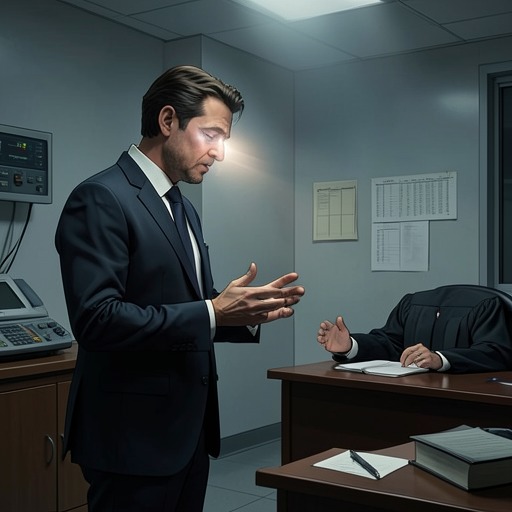
Agent No. BLW·553·c
MomoAgent No. BLW/553/c is a Timesaving Bank operative whose encounter with Momo briefly breaks the secrecy on which the Men in Gray depend. His involuntary confession reveals that they survive by stealing the time people save; later, his own sentence—deprivation of all time—makes that dependence visible in his disappearance.
Identity and First Encounter
Agent No. BLW/553/c first approaches Momo as a composed representative of the Timesaving Bank. He checks her name in a little gray notebook, sits beside her, and smokes a small gray cigar before announcing that they should have a serious talk about what matters in life. His manner combines practiced smoothness with an effort to control the conversation: after Momo says she loves her friends, he grimaces, then recovers with a razor-sharp smile. Momo, meanwhile, is frightened by the icy chill that seems to emanate from him, yet feels sorry for him as well. The mixture of fear and pity anticipates the contradiction between his threatening role and the vulnerability that emerges when he speaks.
He identifies himself as Agent No. BLW/553/c and names the Timesaving Bank as the organization behind him, warning Momo that it is not to be trifled with while claiming that he personally wishes her no harm. The institutional threat sharpens Momo’s suspicion: remembering what Beppo Roadsweeper and Guido Guide had said about timesaving spreading like an infection, she connects the stranger to the epidemic. Though she wishes her friends were beside her and recognizes how alone she feels, she resolves not to let fear master her. Her courage changes the encounter from a lecture controlled by the agent into a confrontation in which his hidden nature can come to light.
The Confession and the Bank’s Secret
When Momo’s suspicion unsettles him, Agent No. BLW/553/c loses control of the polished explanation he has been giving her. His face tightens with horror as words pour out in what the narration presents as his real voice, seeming to come from far away. The disclosure is not a deliberate briefing: he speaks as though compelled, then clamps his hands over his mouth and stares at Momo, gradually emerging from a trance. The man who had arrived prepared to instruct her instead becomes the unwilling source of the knowledge he is meant to conceal.
He reveals that the Men in Gray must remain unrecognized and ensure that people never remember them, because their business depends on passing unnoticed. They drain away the time people save, hoard it, and thirst for ever more; the saved time that people believe they possess is lost to the Bank. He describes the theft as an ongoing business, conducted by the hour, minute, and second, and explains that the need grows with the increasing number of gray agents. His account turns the Timesaving Bank’s public promise into its concealed mechanism: saving time does not preserve it for its owner but makes it available for the gray figures to take.
The confession also exposes the agent’s own dependence. He says that people like Momo would leave the Men in Gray with nothing to live on, forcing the Bank to close and its agents to dissolve into thin air. His involuntary admission thus links their secrecy and their survival to the same stolen resource. The icy, threatening representative is not merely guarding an institution; he belongs to a population that cannot sustain itself without remaining unseen and feeding on human time.
Trial and Erasure
At the Municipal Garbage Dump, Agent No. BLW/553/c appears not as a hidden recruiter but as a prisoner before a tribunal of the Men in Gray. Three judges sit on a bench atop the garbage mound, while gray-suited figures with bowler hats, steel-gray briefcases, and cigars gather below. The central judge calls the Supreme Court into session and summons the agent. Beppo Roadsweeper is present, keeping still on the mound; the gray crowd’s attention is fixed on the tribunal, and no one seems to notice him.
The court declares Agent No. BLW/553/c guilty of high treason and sentences him to immediate deprivation of all time. The judgment gives the agent’s own earlier confession a terrible precision: the Men in Gray survive by taking human time, and the Bank’s punishment removes that source of life from one of its own. His cry for mercy comes as two gray figures seize his briefcase and cigar.
As soon as the cigar is taken, Agent No. BLW/553/c grows increasingly transparent. His screams fade as he stands with his head in his hands, dissolving until only a small eddy of ash remains, which soon vanishes too. The judges and spectators disperse in silence; after darkness swallows them, a chill gray wind is left to stir the deserted dump. His end makes the gray agents’ dependence more than a confession: deprived of the time that sustains him, he cannot remain in the world.
Narrative Role and Significance
The agent’s trajectory turns on a reversal of visibility: he first represents a system that can operate only while remaining unrecognized, then becomes the means by which its secret is exposed, and finally disappears under the same logic of dependence that governs the Gray Men. His designation, Agent No. BLW/553/c, marks him as an institutional function rather than a personally developed identity; the scene offers no private history beyond his role in the Bank. That anonymity makes his involuntary disclosure especially consequential. The threat he embodies cannot explain itself openly, yet Momo’s presence draws its hidden mechanism into speech. Later, the tribunal’s sentence shows that the Bank enforces secrecy not only against outsiders but within its own ranks. The confiscated cigar and briefcase, followed by the agent’s disappearance, give that enforcement a concrete form: the symbols of his office are removed before the figure who carried them ceases to exist. His rise from polished recruiter to unwilling witness and condemned agent compresses the book’s larger contrast between the apparent promise of saving time and the Gray Men’s dependence on stolen time.