Amphitheater
MomoThe Amphitheater is the setting for the starkest contrast in Momo’s return: she wakes alone on its grass-grown steps, believing only a little time has passed, and later finds her friends gathered there again after time has been restored. Its worn stones and open arena hold both the loneliness the Men in Gray impose and the reunion they cannot prevent. The place matters not simply as a destination, but as the shared ground where absence is endured, remembered, and finally answered.
Setting and Return
Momo wakes on the Amphitheater’s grass-grown steps, bewildered to find herself back there after being with Professor Hora in Nowhere House only moments earlier. Dawn is just beginning above the eastern skyline; it is cold and dark, and she burrows into her baggy jacket. The physical details make her return immediate, while her confusion exposes the gap between her experience of time and what has happened beyond it.
Her memories of the journey remain vivid: she recalls following the tortoise through the city, the district of dazzling white houses, Never Lane, and the hall filled with clocks. Most insistently, she remembers what she witnessed beneath the golden dome: the hour-lilies in their splendour and the music of the sun, moon, and stars, still clear enough in her mind to hum. The Amphitheater therefore receives her back not unchanged in experience, but carrying the vision and music of a world her friends have not shared.
An Empty Meeting Place
At first, Momo is eager to see Beppo Roadsweeper, Guido Guide, and the children again. Sitting on the steps, she joins the music within her and sings toward the rising sun. Though nobody is there to hear, the birds, crickets, trees, and even the Amphitheater’s time-worn stones seem to listen. The scene gives the deserted place a momentary audience drawn from the natural world, but the narration undercuts that comfort: Momo does not know that these will be her only listeners for a long time.
She waits all day, and no one comes. As the sun sinks and the air grows colder, the familiar meeting place becomes evidence of a separation she cannot yet explain. Hungry, she rises stiffly and concludes that even Beppo and Guido must have forgotten her, consoling herself that their absence is only a mistake that will be put right the next day. The reader knows otherwise: Momo has been gone for a whole year, and the city has changed in the meantime. The Amphitheater’s silence lets that difference in knowledge become part of the setting; for Momo, the empty steps suggest a temporary oversight, while for the reader they register the long passage of time and the success of the Men in Gray’s scheme.
The Children’s Continued Presence
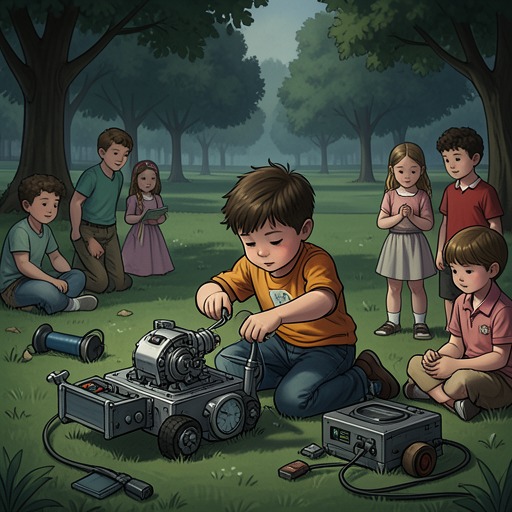
While Momo is away, the children continue to meet at the Amphitheater whenever they can. They make castles, palaces, and galleons out of old crates and boxes, using them to imagine voyages around the world, and they keep telling one another stories. Their play preserves the habits of the group and keeps Momo at its centre even when she is physically absent: they act as if she were still among them, and their shared certainty that she will return makes that absence less final.
The Men in Gray cannot break this attachment by confronting the children directly. Instead, they enlist adults and turn the children’s own means against them. The net they spread across the city eventually leaves even the most resourceful children unable to get through, and the Amphitheater becomes silent and deserted. Its emptiness is thus not proof that the children have ceased to care or to expect Momo; it is the consequence of their being prevented from gathering. The site holds both versions of the separation: the children’s persistent inward certainty and the outward silence imposed around them.
Reunion and Restored Time
After the stolen hours have been released and time resumes, Momo finds Beppo Roadsweeper in the city. Their reunion is expressed through laughter, tears, repeated embraces, and a rush of talk; because there is now time to spare, passers-by can stop and share their happiness. Beppo shoulders his broom, takes the rest of the day off, and walks arm in arm with Momo to the old Amphitheater.
The renewed atmosphere of the city accompanies their return. Children play in the streets while drivers wait or join their games; neighbours have time to talk, workers can take the time their jobs require, and people pause over flowers or feed birds. At the Amphitheater, the reunion becomes collective: Guido Guide, the children, Nino, Liliana, and Momo’s other regular visitors are already waiting. Their gathering answers the earlier empty day with a crowd of people who know and believe what has happened. After the celebration lasts until the stars appear, everyone sits on the grass-grown steps. Momo enters the arena, remembers the music of the stars and the hour-lilies, and sings. The Amphitheater’s final role is therefore more than that of a meeting place: the song that once had only stones and birds for listeners is heard again among friends, in a city where time is no longer being hoarded.