Time Warehouse
MomoThe Time Warehouse is the concealed infrastructure of the Men in Gray’s theft of human time: a vast underground vault in which stolen hour-lilies are preserved, and from which the Men in Gray draw the material that sustains them. Its importance turns on a reversal. What appears to be a secure storehouse is also the point at which their control over stolen time fails, as the flowers thaw and return to the people from whom they were taken.
Concealed Location and Design
Professor Hora explains to Momo that hour-lilies stolen from people’s hearts are preserved by freezing them until they become hard as glass goblets. He does not know where the Men in Gray keep them, but infers that a gigantic cold store must lie deep underground. The Time Warehouse is therefore first introduced not through direct observation but as a hidden place deduced from the conditions necessary to keep the flowers intact. Its position and scale make the theft seem organized on a vast, concealed scale.
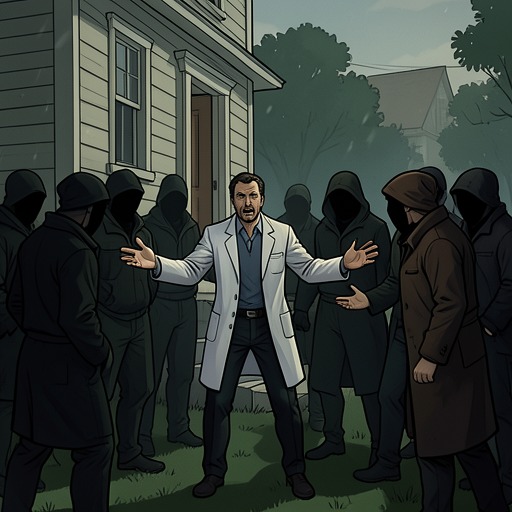
Momo reaches the warehouse through an unexpected route on the city’s northern outskirts. There, uniform housing blocks and straight streets make it difficult to judge whether she is advancing; the regularity of the development turns it into a maze. After nearly losing hope, she spots a disheveled Man in Gray and follows him past rows of houses to a gap in the street. A gate in the boarded fence stands slightly open at a large site where a house should have been. The last of the Men in Gray slips through, and Momo follows.
Inside, the apparent building site opens into an enormous pit, with construction equipment and workers frozen in place. Passages lead away beneath the housing development, forming a network that Momo explores before tracing a babble of voices to a great room. The warehouse is not simply a single cellar beneath one building: its approach extends into tunnels running throughout the development. The ordinary, repetitive city above thus conceals a second spatial order below it.
The Store and Its Dependents
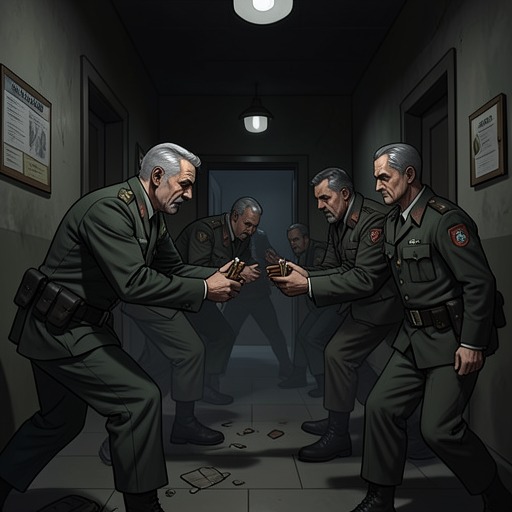
At the end of the underground route, Momo finds the surviving Men in Gray gathered in two rows at a long conference table. A huge steel door is set into the wall behind their presiding member; it stands ajar, with cold air escaping from beyond it. The meeting reveals the warehouse’s practical role. The Men in Gray discuss economizing and carefully husbanding their reserves, because they do not know how long those reserves must last. Their survival depends on supplies held behind the door.
The Men in Gray explain that the open door is both their immediate good fortune and the beginning of their defeat. Had it been shut when disaster struck, they say, no power could open it. Yet because it remains open, the refrigeration plant is losing cold. As the hour-lilies thaw, the Men in Gray will be unable to prevent them from returning to their original owners. The warehouse’s preserving mechanism is therefore also a vulnerability: its stock is not inert property but time still bound to living people, capable of going back to them.
Professor Hora has already explained how the stored flowers become the Men in Gray’s supply. They remove the petals, let them dry and turn gray, and roll them into cigars. The petals retain remnants of life, but living time harms the Men in Gray; smoking the cigars converts that time into smoke and makes it dead. The Time Warehouse thus links the theft of individual hours to the Men in Gray’s continued existence. Its reserves are stolen human lives in stored form, while the cigars are the altered substance through which those lives are consumed.
Opening the Vault
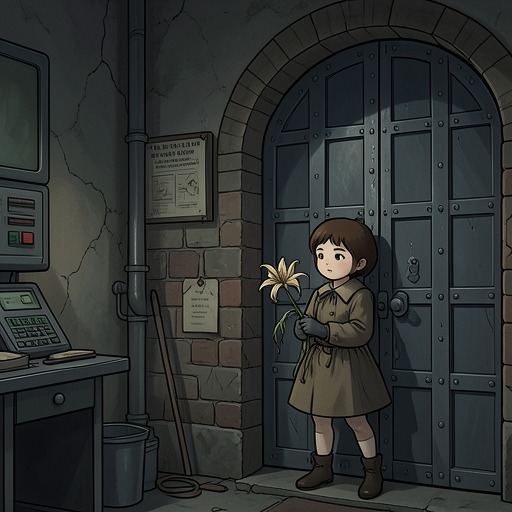
After the last of the Men in Gray have gone, Momo approaches the steel door and touches it with her hour-lily, which has only one petal left. She opens the door wide. The cold has gone from the store, and the interior reveals seemingly endless shelves carrying innumerable hour-lilies, each different in appearance. The narration describes hundreds of thousands, indeed millions, of hours taken from people’s lives. The scale of the vault makes visible what the earlier account could only describe: the private loss of time has accumulated into a vast, ordered stock.
As the temperature rises until the vault is as hot as a greenhouse, the flowers leave the shelves in clouds. Their release coincides with the fall of the last petal from Momo’s own flower. The image reverses the warehouse’s defining arrangement: the hour-lilies are no longer immobilized on shelves but move freely out of confinement. The released time is carried through the dark passages and into the open air above the city, in a flowering storm that bears Momo along with it. The vault’s contents are not destroyed or appropriated by Momo; they return to circulation, restoring the connection between the hours and their rightful owners.
Narrative Significance
The Time Warehouse gives the novel’s idea of time theft a concrete architecture. Freezing, shelves, a steel door, and a failing refrigeration system turn an invisible loss into a physical system that can be entered and undone. The frozen flowers preserve the contradiction at the heart of the Men in Gray’s scheme: they can hold human time apart from its owners, but cannot make it truly theirs. Once the cold escapes and the door is opened, the stored hours move back toward the lives from which they came.
Its location beneath a monotonous housing development also shapes the discovery as a passage from apparent sameness into concealed difference. Above ground, Momo’s straight streets make movement feel like standing still; underground, the branching passages lead to the source of the Men in Gray’s reserves. The place that once enabled their continued existence becomes the setting for their disappearance and for time’s return to the city. The vault’s opening is therefore both a physical escape from storage and the decisive reversal of the system it was built to maintain.