Green Hill
MomoGreen Hill is the residential suburb where Momo searches for Guido Guide’s new home. Its immaculate streets and spacious villas suggest comfort and status, but their emptiness gives the neighborhood an air of exclusion: the green lawns seem made for children, yet no one is there to play. The contrast shapes Momo’s passage through the district and the guarded arrival at her friend’s house.
Setting and Appearance
Momo knows where Green Hill is: several miles from the amphitheater, on the other side of the city, near a housing development whose flats form identical rows. Reaching it takes a long walk. Though Momo is accustomed to going barefoot, her feet ache by the time she arrives, and she stops on a curb to rest. The distance makes the search a physical undertaking before she has even found the right house.
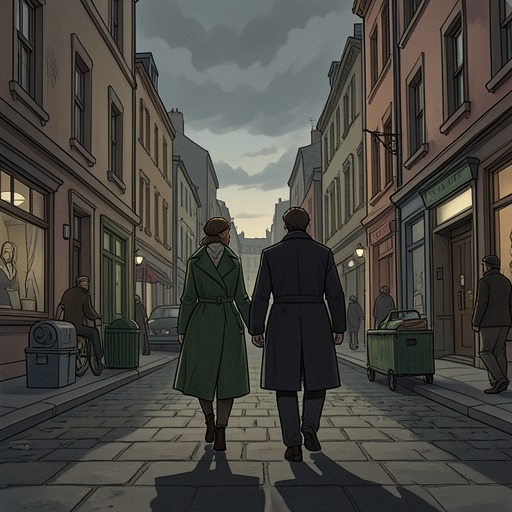
The suburb is described as smart and carefully maintained. Its streets are broad, clean, and deserted; high walls and iron railings enclose gardens where old trees rise above low, flat-roofed villas of concrete and glass. Smooth lawns spread out in front of the houses, lush enough to seem to invite children to turn somersaults. But there are no children, or indeed anyone strolling or playing. The setting’s comfort is therefore also a sign of absence: its attractive spaces offer leisure in appearance, while remaining unused.
Momo’s Search
Momo comes to Green Hill the morning after setting out to find Guido Guide’s house, accompanied by Cassiopeia. Resting on the curb, she admits she does not know how to discover where Guido lives. Cassiopeia signals that she will find out. The exchange places the tortoise alongside Momo in the search, while the neighborhood’s uniformity makes the destination difficult to identify from the street.
When Momo asks for directions, a man in a white jacket questions whether Guido is really expecting her. She explains that he is her friend and that he pays for her meals at Nino’s Inn. The man responds acidly about show-business people, then tells her that the house is at the end of the street. His reaction turns a simple request for directions into a brief encounter with the social distance surrounding Guido’s new life.
The House at the End of the Street
The house identified as Guido’s stands behind a high wall, with a sheet-metal gate like the others in the street. From outside, Momo cannot see in; there is no nameplate or doorbell. The man in the white jacket slams the gate behind him, and Cassiopeia briefly displays the word SHOWOFF on her shell. The matching gates make the property part of Green Hill’s repeated, closed-off streetscape, while the absence of any visible name or bell leaves Momo with no ordinary way to announce herself.
Momo doubts that this can be Guido’s home because it does not look like the kind of place he would choose. Cassiopeia confirms that it is. Green Hill thus frames a small but pointed disjunction: Momo’s sense of her friend does not fit the imposing, inaccessible house she has been directed to. The neighborhood’s polished order and empty lawns stand against the familiarity of her friendship with Guido, making the search both a journey across the city and an approach to a changed domestic world.