The Unnamed City
MomoThe Unnamed City is the setting of Momo’s story, a place where old stone survives inside a modern city and where the pursuit of saving time gradually remakes both the built environment and its inhabitants’ lives. Its decisive transformation is visible in two contrasting landscapes: a half-forgotten amphitheater on the southern outskirts and regimented housing developments on the northern edge. One holds traces of local, unhurried life; the other embodies a city organized around sameness, planning, and speed.
An Ancient City Within a Modern One
The city belongs to a kind of place where ancient settlements have survived into the present, though life around their remnants has changed. Cars and buses carry people through streets equipped with telephones and electric lights. Amid modern buildings, fragments of an older city remain: a column, an archway, a stretch of wall, or an amphitheater. The story takes place in such a city, but the narrative does not supply it with a proper name.
Those surviving structures are not presented as a preserved whole. They stand amid contemporary life as partial remains, sometimes valued chiefly as sights to visit. The city’s history is therefore encountered in scattered pieces, rather than as an intact ancient setting. That layering matters to the story: the place can appear thoroughly modern while still containing spaces beyond the rhythms that increasingly govern its streets.
The Forgotten Amphitheater on the Southern Outskirts
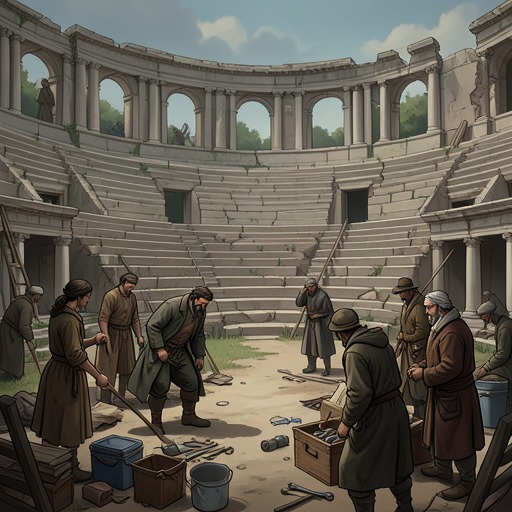
At the city’s southern edge, fields begin and the houses grow shabbier and more dilapidated. Hidden among pine trees lies a small ruined amphitheater. Even in its earlier days it was never grand: it had served as a place of entertainment for poor people. By the time Momo arrives, it has almost been forgotten. A few archaeology professors know it exists, but, since there is nothing left to excavate, they take no further interest in it.
The site has little appeal to the city’s visitors, either. The occasional tourists or sightseers clamber over its grass-grown tiers, make noise, take a couple of photographs, and leave. Their brief visits give way again to silence and the crickets’ monotonous song. The amphitheater is not wholly deserted, however. People living nearby graze goats there; children play ball on what was once the central stage; and sweethearts sometimes meet there in the evenings. Its uses are modest and local, unlike the spectacle sought by passing visitors.
This overlooked southern refuge establishes a contrast between official attention and everyday presence. Archaeologists find no further material to unearth, and tourists move on, but neighborhood life continues in the old structure. Its worn tiers and former stage are not merely remains to inspect: they are part of the surroundings in which people still spend time together.
The Spread of Time-Saving
The city’s later transformation gathers force as more inhabitants adopt time-saving. The practice spreads by imitation as well as conviction: people copy those already doing it, including some who do not truly want to join in but feel obliged. The city’s response is therefore collective, yet not simply the result of every resident freely choosing the same way of life.
Publicity makes the campaign hard to escape. Radio, television, and newspapers praise new time-saving gadgets as a route to a future in which people will be free to live the supposedly right kind of life. Posters depicting happiness and prosperity cover walls and billboards, while notices appear not only in offices and boardrooms but also in doctors’ rooms, shops, restaurants, department stores, schools, and kindergartens. The message reaches across the city’s public and commercial spaces, extending even into places associated with children.
A City Made Uniform
As the time-saving movement advances, the city’s physical fabric changes with it. Old buildings are pulled down and replaced by modern ones stripped of features now considered superfluous. Houses are not designed around the different people who will live in them: building a range of individual homes would cost more and take more time, so identical designs prevail instead.
Huge developments rise on the northern outskirts in endless rows of indistinguishable, multistorey tenements. Their sameness extends outward: because the buildings look alike, the streets do too. The roads lengthen in dead-straight lines toward the horizon, converting the countryside into what the narrative describes as a disciplined desert. The inhabitants’ lives take on a corresponding pattern, running straight ahead under plans and programs that prescribe each move and every moment.
The city’s apparent efficiency carries a loss its inhabitants mostly fail to acknowledge. People save time without noticing that they are losing something else, and few care to admit that life is becoming poorer, bleaker, and more monotonous. The children feel this deprivation most keenly because adults no longer have time for them. In this way, the city’s architecture and its social condition become parallel evidence: identical buildings and programmed routines express the same narrowing of difference and of time available for human attention. The old amphitheater’s local uses stand in quiet contrast to that direction of change, making the city a setting in which forgotten spaces and increasingly standardized lives coexist.