Never Lane
MomoNever Lane is the temporal boundary around Nowhere House, where time flows in reverse and the stolen time sustaining the Men in Gray is drawn out of them. Its peculiar rules shape Momo and Cassiopeia’s approach to the house, turn the pursuit behind them into a race run at the wrong pace, and expose the difference between human life and the gray men’s borrowed existence.
Setting and temporal rules
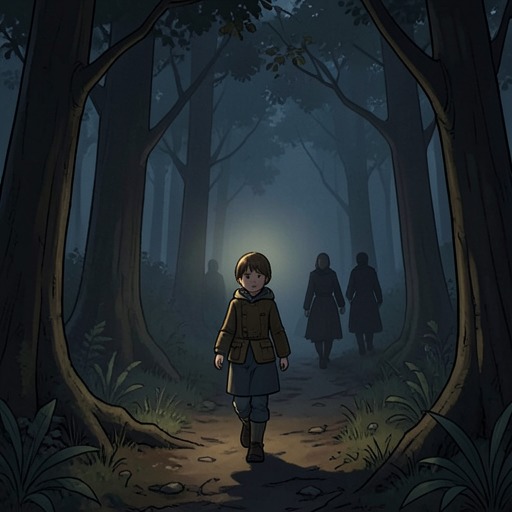
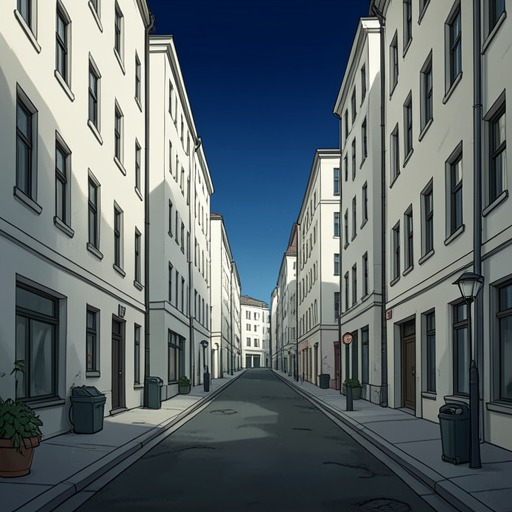
Never Lane belongs to the uncanny District of White Houses: the light there is neither dawn nor dusk, shadows point in different directions, and forbidding white houses stand with cavernous black windows beside an egglike monument on a black stone plinth. The district’s disorienting appearance accompanies a practical reversal. Near Nowhere House, Momo must do things backwards, and the lane itself makes progress depend on accepting rather than resisting its reversed flow.
Professor Hora explains that time normally flows into a person: as time accumulates within a human being, that person grows older. In Never Lane, time instead flows out. A human who travels along it grows younger by the amount of time spent crossing, although Momo does not notice the change. The effect is limited and specific, not a wholesale undoing of her life; the lane reverses the direction of time passing through her during the journey.
The lane’s temporal law is connected to the role of Nowhere House. When Momo wonders whether Professor Hora makes time, he clarifies that all the time in the world comes from the house and the lane, but that he is its custodian, responsible for ensuring that each human being receives an allotted span. The location therefore marks not simply a passage through strange territory but the point at which the novel discloses how time is safeguarded and distributed.
The approach to Nowhere House
On the return journey, Momo is exhausted, forcing herself onward one step at a time while Cassiopeia crawls at her own pace. When the street grows pale, the familiar signs of the district come into view, and the prospect of seeing Professor Hora again restores Momo’s courage. She asks Cassiopeia to move faster; the tortoise’s reply is that haste will bring less speed. As before, their slow crawl carries them forward more effectively than rushing would.
At the turn into Never Lane, Momo remembers that she had made no headway until she turned around and walked backwards. She repeats that action as Cassiopeia continues toward Nowhere House. The detail makes the lane’s rule part of the journey’s physical action: Momo does not overcome its strangeness by force or speed, but by recalling how to move in accord with it.
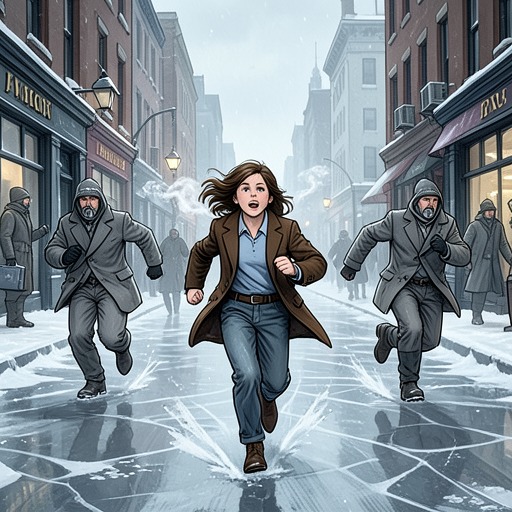
The pursuers also learn to adapt. The Men in Gray, who had previously tried to overtake Momo and Cassiopeia, now follow at their pace and discover the lane’s peculiarities. Moving even more slowly than their quarry, they steadily close the distance. Their pursuit becomes a race in reverse, and the streets behind Momo fill with an advancing army. At Never Lane, the gray ranks stretch across the entire width of the street, turning the threshold into the point where escape and confrontation meet.
The gray men and temporal suction
The Men in Gray’s apparent mass conceals their dependence on stolen time. Professor Hora calls the force that acts upon them in Never Lane temporal suction: because they consist only of stolen time, the reverse flow strips that substance away. They vanish when they set foot in the lane. The contrast with Momo is decisive. She grows younger by a little, but remains herself; the gray men have no life apart from the time they have stolen, so when that time escapes, nothing remains.
The professor compares their disappearance to air escaping from a burst balloon, with one crucial difference: a balloon’s skin survives, but the gray men leave no remnant. The lane thus makes visible a distinction that their human appearance obscures. Momo is more than the time she carries; the gray men, by contrast, are constituted by dead, stolen time.
Limits and significance
Momo recognizes the tactical implication and asks whether time might be made to run backwards throughout the world, if only briefly, so that the time-thieves would be reduced to nothing. Professor Hora rejects the proposal because the forward and reverse currents balance one another. Cancel one current and the other disappears too, leaving no time at all. Never Lane’s power is therefore not a solution that can simply be extended everywhere: its reversal depends on a balance that preserves time’s movement beyond the lane.
As both route and rule, Never Lane links the story’s geography to its moral distinction between human time and time stolen from others. It offers Momo a way to reach Professor Hora and a force that destroys the gray men, yet the same explanation that reveals its power also marks its limit. The lane can draw stolen time out of those who depend on it; it cannot replace the balanced flow on which time itself depends.