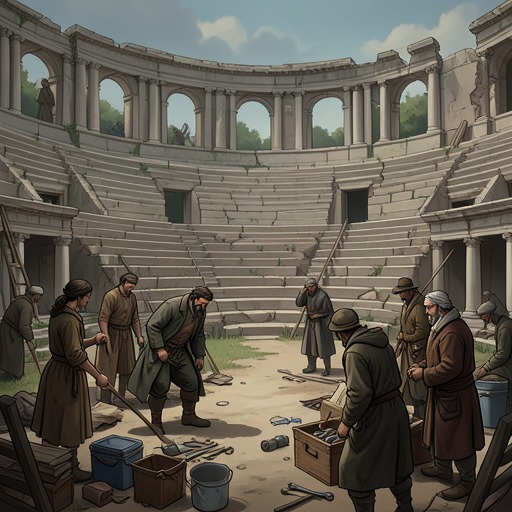
Ancient Amphitheater
MomoThe Ancient Amphitheater changes from an almost forgotten ruin into a home, a neighborhood meeting place, and a base for collective action. Set among pine trees at the poor southern edge of a modern city, it is a space the city barely notices but its neighbors know and use. Momo settles in its underground chambers; the welcome she receives makes the abandoned structure a community. Later, children gather there in numbers to discuss a plan and prepare for action, making the old arena a setting where companionship becomes organization.
Setting and Earlier Uses
The amphitheater lies on the southern outskirts, where fields begin and houses grow shabbier and more dilapidated. It is hidden in a clump of pines, and even in antiquity it had not been a grand monument: it served as a place of entertainment for poor people. By the time Momo arrives, archaeologists know of it but have lost interest because there is nothing left to excavate. It attracts few visitors, and those who do come climb over the grass-grown tiers, make noise, take snapshots, and leave. Their brief intrusion gives way to the arena’s usual quiet, marked by the unchanging song of crickets.
Despite its neglect by scholars and sightseers, the building has not been wholly abandoned. People from the immediate neighborhood graze goats there; children play ball on the former central stage; and sweethearts sometimes meet there in the evenings. The amphitheater thus has two contrasting kinds of recognition: outsiders treat it as an insignificant remnant, while nearby residents incorporate it into ordinary life. Its history as a modest place of entertainment for the poor continues in this local, practical use rather than in archaeological attention or tourism.
Momo Makes a Home
When word spreads that someone has moved into the ruins, the newcomer is identified as a girl called Momo, though her unusual clothes make people uncertain at first. She sets up house not in the open arena but in underground chambers beneath the grassy stage. The rooms are partly choked with rubble and reached through a hole in the outer wall. This hidden, makeshift dwelling gives the amphitheater a new purpose: it shelters Momo, who has made a home in a place the wider city has nearly forgotten.
A group of neighborhood men and women comes to question her. Momo watches them apprehensively, fearing that they may drive her away; she soon recognizes that they mean well. The visitors are poor like her and understand the difficulty of life. Their concern does not remain a conversation at the entrance to her shelter. Neighbors bring what they can, and the children arrive with small portions of food: a morsel of cheese, a piece of bread, fruit. With so many children joining in, the welcome becomes a housewarming party. The occasion marks more than Momo’s occupation of an abandoned structure: it begins her friendship with the people of the neighborhood.
A Place for Children to Gather
The amphitheater later hosts a much larger gathering. By three o’clock in the afternoon, excited voices fill the old arena; some fifty or sixty children have come from near and far. The gathering crosses differences of wealth, temperament, and age. Maria brings younger members of her family, some still in arms, while Franco, Paolo, and Massimo are also present. Many of the other children are newcomers to the amphitheater, drawn by a particular interest in the matter being discussed. The arena’s open space accommodates not only familiar neighborhood play but a gathering that reaches beyond Momo’s immediate circle.
Claudio, the boy who owns a transistor radio, arrives without it. He sits beside Momo, introduces himself, and says he is glad to have been invited. His presence, like that of the many children who are new to the place, shows how the meeting expands the amphitheater’s social reach. Momo is saddened that none of her grown-up friends has come apart from Beppo Roadsweeper and Guido, but the children’s attendance gives the gathering its own force. Here the ruin serves as a forum in which young participants can hear a proposal and respond together.
From Meeting Place to Organizing Base
The children approve the proposal unanimously. Guido announces that they will invite the whole city to the amphitheater the following Sunday, but that until then they must keep their plan secret. The setting becomes more than a place to talk: it provides a base for coordinated preparation. Over the next few days, the arena hums with concealed, energetic work. Paper, paint, brushes, paste, cardboard, poles, and planks appear; some children make banners, posters, and placards, while others devise slogans and paint them carefully.
This change develops the amphitheater’s earlier communal character rather than replacing it. A site used by neighbors for goats, games, and meetings between sweethearts becomes a place where children from across the city can assemble, deliberate, and make materials together. The contrast with its treatment by tourists is sharp: visitors pass through, take snapshots, and depart, while the children return and work toward a shared public invitation. The neglected arena’s importance comes not from restored grandeur or scholarly value, but from what people make possible there. For Momo and her neighbors, it is both a shelter and a civic space.