Fern and Charlie begin their affair
MovingFern Woolbright and Charlie Treadaway begin their affair during a power cut, when a moment of attraction becomes a private relationship concealed from the world beyond the household. The encounter marks a shift from Fern’s fascination with Charlie to physical intimacy, while the arrangement he later describes makes clear that he does not intend it to become a conventional partnership.
The Blackout Encounter
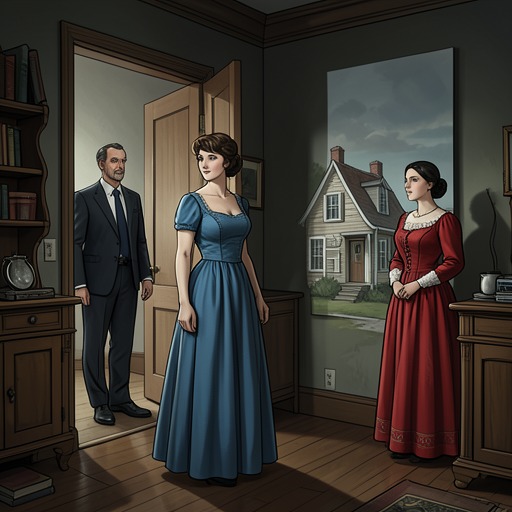
As the record player slows and Brian Ferry’s song comes to a halt, the lights go out. Jill calls for fifty pence, but Fern feels someone take her hand; Charlie leads her from the kitchen into his room. When the lights return, Fern is naked. She experiences the episode as a startling conjuring trick, an abrupt transformation from the party’s ordinary bustle into a private encounter with Charlie.
A Secret Kept Within the House
Felicity and Dee object to the affair because Charlie already has a girlfriend. Felicity calls it unsisterly, and Fern answers that she is an only child and therefore cannot be unsisterly. The exchange exposes a conflict between the moral language her friends use and Fern’s own sense of the situation: Dee only tuts and chews the skin around her fingernails, while Fern rejects the rebuke rather than treating Charlie’s existing relationship as a reason to stop.
The affair takes place on Charlie’s terms and largely in private. He and Fern meet when Fabiana is out of the way and the coast is clear; sometimes they use his cave-like bedroom, with jeans strewn across the floor and the smell of red wine, cigarettes, and dope. Their intimacy is an open secret inside the household, but Charlie does not want it known beyond it. The boundary is not merely about discretion: he explicitly distinguishes Fern from a girlfriend, describing Fabiana as the girlfriend whose role is to nag and wheedle, while Fern is his courtesan and a treat. His account makes the unequal arrangement plain—Fern is admitted to a hidden intimacy, but not offered the recognition of a proper couple.
That distinction complicates the enchantment of the blackout encounter. Fern is drawn into a relationship that Charlie keeps separate from his public one, and his own explanation anticipates why it would not fit ordinary partnership: he says a girlfriend would become bored with his poor timekeeping, dope-smoking, staying up until five in the morning unwashed, listening to music and scribbling. The affair thus begins in sudden physical closeness but settles into a pattern of concealment and sharply divided roles, with Charlie defining the terms and Fern occupying the private place he has made for her.
Domestic Intimacy and Unequal Knowledge
The affair acquires a quieter domestic texture in Fern’s room. She dislikes the smell of Charlie’s cigarettes and dope and will not let him smoke there; she also thinks smoking makes him lazy, including about cleaning his little yellow teeth. She buys him a spare toothbrush for the kitchen sink and tells him that oral hygiene matters. Charlie laughs at her care, calls her his beautiful mermaid, and writes teasing descriptions of her on her skin in biro. Fern worries that the ink will not come off and that James Frobisher might see it, a trace of the secret threatening to cross from the private affair into her other life.
Fern prefers when they sleep in her bed: the sheets are cleaner and the duvet cover fresher. Their exchanges also give her fragments of Charlie’s history. He asks the names of her pets and tells stories of his childhood; she gradually assembles a family picture that includes his clever twin sister, talented mother, Alicia as a treasured family figure, his dead father, a stuffy but acceptable stepfather, and a stepbrother he disparages. He says little about the stepbrother by name and sings a gravelly Pie Jesu into Fern’s ear, recalling his time as a choirboy. The disclosures make the intimacy feel personal, while leaving Fern to piece together Charlie’s family from partial stories.
That partial knowledge sharpens Fern’s envy of the way Charlie speaks about his twin sister: she is spellbound by his obvious love for her and wants to keep the pictures he has drawn, even to sleep with his pencil beneath her pillow. The tenderness she perceives in his attachment to his sister is distinct from the role he assigns Fern. Jill, meanwhile, regards the affair as doomed and considers Charlie slippery; her own relationship with Rob offers Fern a pointed contrast, grounded in mutual affection and the ordinary routines of shared life. The contrast does not undo Fern’s fascination, but it makes visible how little security or public recognition Charlie’s arrangement provides.
An Uneven Measure of Intimacy
Jill Miller’s judgment that Charlie is slippery gains force beside the details of her own relationship with Rob. Rob is her faithful Labrador, and despite his chronic athlete’s foot she loves him as much as he loves her. Their affection is measured in small reciprocal chores, such as taking turns to buy toilet roll. Charlie, by contrast, never buys it; Rob says he uses Rizla papers instead. The comic domestic detail makes the difference concrete: Jill’s relationship has mutual obligations, however unglamorous, while Charlie keeps Fern in a private role distinct from the girlfriend he already has. His easy familiarity may fascinate Fern, but it does not amount to the steadiness she can see in Jill and Rob.