Edwina Plans to Reunite with Rowena in Australia
MovingEdwina’s plan to reunite with Rowena in Australia is a quiet ending built from practical arrangements and belated recognition. Lucas has just left, and Edwina cannot know whether she will see him again; nevertheless, she intends to give him a fair share of the house-sale money and his father’s desk. At the same time, the jewellery box on her table confirms that Lucas has been in the room. Rowena’s letter, the tickets Edwina checks each night, and a list of family keepsakes make a possible reunion tangible. The plan does not undo years of estrangement, but it gives Edwina a direction beyond grief and blame.
After Lucas Leaves
The front door slams, leaving Edwina with the possibility that Lucas will not return. Her response is not to withhold what she considers his due: he is to receive his share of the proceeds from the sale of the house, as well as his father’s desk. This intended fairness matters alongside her unresolved feelings. She has no certainty about their future relationship, yet she distinguishes that uncertainty from the practical obligation to treat him justly.
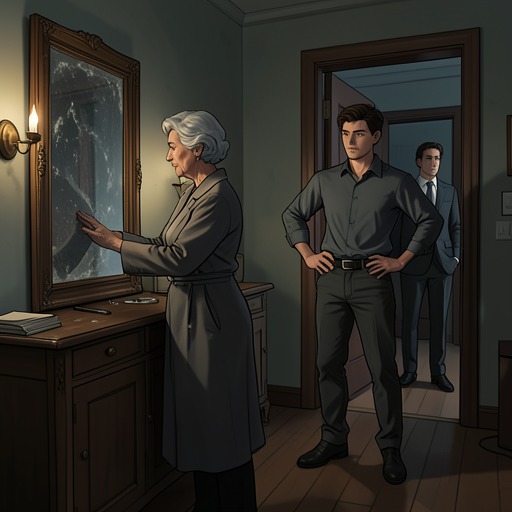
The jewellery box on the table makes Lucas’s presence almost difficult to believe, especially as the tea in the pot has gone cold. Edwina reasons from the object: the box is there, so Lucas must have been in the room. Its physical presence marks the difference between a feared or doubted encounter and one that has actually occurred. She can now take the box with her; what had been lost has returned to the household, and the scene’s stillness gives that recovery the weight of a beginning rather than a resolution.
The Photograph and Charlie
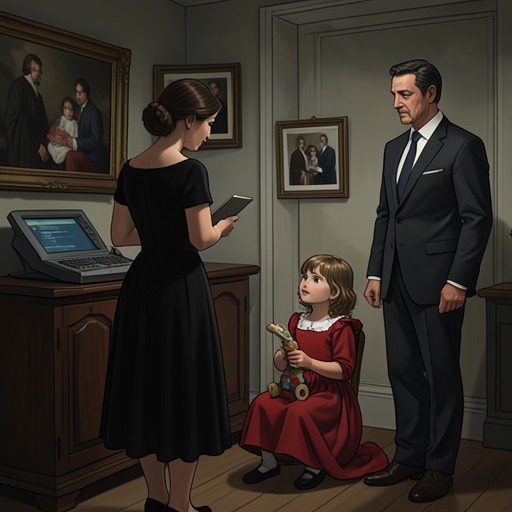
Before turning fully toward Australia, Edwina looks at a photograph of her family on the beach. Ollie Treadaway has Rowena on his lap, while Edwina holds Charlie as he reaches toward the sea. The image preserves a family arrangement that can no longer be restored, but it also makes visible the fear that accompanied Edwina’s love for her son. She remembers being afraid he would drown and understands that, deep down, she had expected to lose him. From the night Charlie arrived unexpectedly, she felt that he was only visiting and could never be hers to keep.
That recognition does not make Charlie’s loss less painful. Edwina recalls him as reckless and acknowledges the force of her love for him; the tenderness of that memory sits beside the knowledge that her grief turned against Rowena. After Charlie died, Edwina blamed his twin, punished her for years, ignored her letters, and refused to speak to her. The photograph therefore holds both affection and the history of a rupture: the mother who feared losing her son became a mother who drove away the daughter who survived him.
Acknowledging the Estrangement
Edwina does not suddenly forgive Lucas for his actions in court. She does, however, begin to see how events reached that point, connecting consequences to the moment she caught Dickie’s eye and recognizing that people can react badly when they lose someone they love. Her reflection shifts the emphasis from a simple division between injury and blame to the ways bereavement can distort a family’s conduct. She applies that recognition to herself, recalling how she treated Rowena after Charlie’s death. Understanding how such damage happens is not the same as undoing it, and the account leaves Edwina’s hurt toward Lucas intact.
Rowena’s latest letter offers a concrete alternative to silence. She writes, “We live very near St Kilda beach. You can paint, Mum, you can paint and we will fire up the barbie. I wear your charm bracelet every day. We are here, and we are waiting.” The invitation joins specific prospects—painting, a nearby beach, and a shared meal—with the assurance that Rowena and her family are waiting. The charm bracelet makes the connection material as well as verbal: Rowena wears an object associated with her mother in her daily life. The letter does not claim that the years of rejection have disappeared; it shows that Rowena has continued to leave a way back open.
Preparing to Go
Edwina already has the tickets and checks them every night, alongside her passport. She now adds the photo, teeth, rings, and a matchbox of hair to the checklist. The small, particular items turn travel into an act of carrying family history: the journey is not an escape from what happened but a move made with reminders of those she has lost and those she hopes to see. The repeated checking also shows that reunion remains a plan requiring preparation, rather than an accomplished event.
She will take the old, battered jewellery box too. Seeing it reminds her that it is the only thing she has left that belonged to her mother, giving the returned box a significance beyond its contents as lost treasure. It connects Edwina’s intended reunion with Rowena to an earlier generation and to the objects through which family memory endures. Edwina concludes that blood is strong and pulls like the tide. The image makes kinship a force drawing her toward Australia, but it does not promise that reconciliation will be easy. The ending rests instead on what Edwina can do now: make a fair provision for Lucas, keep the objects that bind her to the past, and prepare to answer Rowena’s invitation.